


Japanese manufacturing confidence hits a four-year high, adding "more weight" to a rate hike in December

Japan's large manufacturing companies' business confidence rose to a four-year high in December, coupled with strong capital expenditure and stable inflation expectations, clearing a key obstacle for the Bank of Japan to raise interest rates this week. The market has heavily priced in the central bank raising the benchmark interest rate to 0.75%, and this rate hike is seen as a continuation of the monetary policy normalization process, rather than the endpoint
Japan's large manufacturing companies' business confidence rose to its highest level in four years in December, demonstrating the resilience of the country's businesses in the face of external uncertainties. The release of this key data further solidified market expectations that the Bank of Japan will raise interest rates at its meeting this week, indicating that the process of normalizing monetary policy has not been hindered.
On December 15, Monday, the Bank of Japan's quarterly Tankan survey report showed that the large manufacturing business sentiment index rose from 14 in September to 15 this month, in line with economists' median expectations, marking the third consecutive quarter of improvement. Meanwhile, pricing in the overnight swap market indicated that traders believe there is a 95% chance that the Bank of Japan will raise the benchmark interest rate to 0.75% at the two-day meeting ending on Friday. A Bloomberg survey of 50 observers also unanimously expected the central bank to raise rates by 25 basis points.
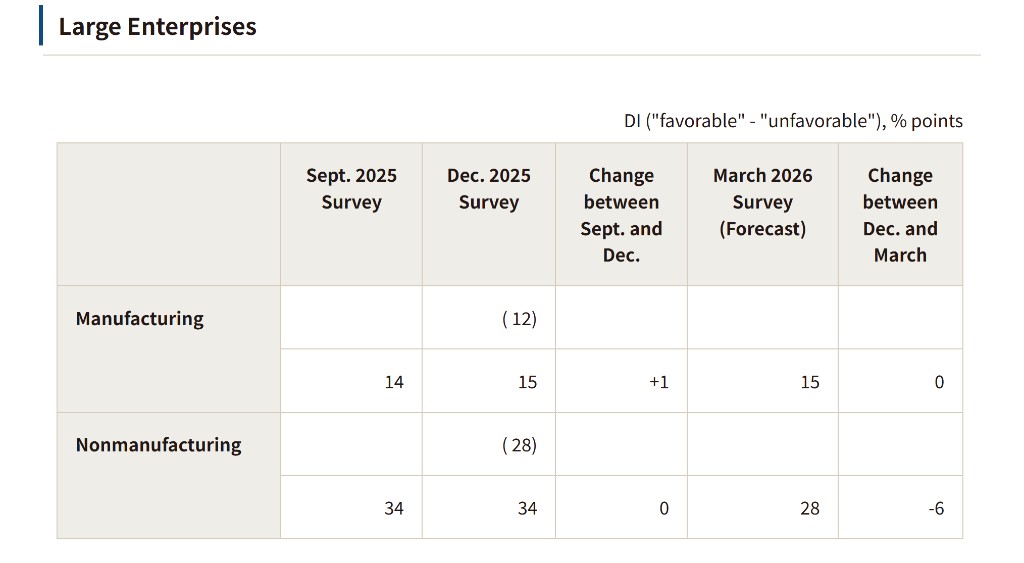
This closely watched data indicates that not only is the manufacturing sector performing strongly, but the business sentiment index for large non-manufacturing companies also remains high at 34, close to its strongest level since the early 1990s. This result strongly supports the judgment of Bank of Japan Governor Kazuo Ueda and his committee members regarding economic recovery, greatly alleviating previous concerns that U.S. tariff policies could significantly impact Japan's export-oriented economy.
Hideo Kumano, executive economist at Dai-Ichi Life Research Institute, pointed out that this Tankan report has reduced the Bank of Japan's level of concern, making an interest rate hike later this week a "done deal." He believes that solid business investment suggests the possibility of wage growth next year, and the Bank of Japan is not only focused on recent trends but also on long-term economic growth, with today's data supporting the central bank's rationale for achieving its economic outlook.
Business Confidence Solid, Undeterred by Tariff Shadows
The most notable feature of this Tankan survey is the resilience of companies to external shocks.
According to Reuters, the large manufacturing business sentiment index reached its highest point since December 2021, indicating that despite previous market concerns about the uncertainties of U.S. tariffs and trade policies, Japanese companies have not experienced significant negative impacts.
Bloomberg economist Taro Kimura noted that despite facing tariff headwinds, business sentiment remains resilient thanks to Prime Minister Sanae Takaichi's supportive fiscal stance for stimulus and the weakening yen.
Confidence among manufacturers of petroleum and coal products has also improved, providing the Bank of Japan with an early read on corporate responses following the implementation of tariff reductions.
However, according to Bank of Japan officials, while the easing of trade policy uncertainties has boosted business sentiment, many companies still express concerns about labor shortages and rising prices impacting consumption. Reuters pointed out that companies expect the business environment to deteriorate in the next three months, highlighting the uncertainties that still exist in the outlook.
Strong Capital Expenditure, Inflation Expectations Anchored
In addition to the rebound in confidence indices, corporate capital expenditure plans also provide strong support for interest rate hikes.
The Tankan survey shows that large enterprises across all industries plan to increase capital expenditure by 12.6% in the current fiscal year, slightly higher than the plans from the previous quarter and exceeding the market median forecast of 12%. At the same time, net profit forecasts are expected to decline by only 0.2%, a significant improvement compared to the approximately 5% decline predicted in the previous report.
Regarding inflation, corporate price growth expectations seem to be anchored around 2%. Data shows that companies' forecasts for the annual inflation rate five years from now remain at 2.4%, the highest level recorded since 2014.
This data is crucial, as wage growth has always been a key component for the Bank of Japan to achieve stable inflation targets. Masato Koike, a senior economist at Sompo Institute Plus, stated that unless the economy or market suffers a significant shock, the central bank is likely to proceed with interest rate hikes.
Policy Outlook: The End of This Rate Hike Cycle Is Not Yet in Sight
Despite the overall positive tone, the Japanese economy still faces dual challenges of structural and geopolitical nature.
The labor market is extremely tight, with the employment situation index indicating the most constrained state since the asset bubble period of 1991. While this may limit economic growth, it also supports the logic of wage increases. Additionally, the persistently weak yen, while beneficial for exporters, has increased operational costs for service industry companies that employ most of the workforce.
Takaichi has committed to taking various measures in her upcoming economic plan to address inflation, which is expected to mitigate the impact of rising prices and interest rate hikes on households and businesses. Despite these risks, the current consensus is that the next interest rate hike will not mark the end of this rate hike cycle.
