


Led by Musk, with Bezos and Jensen Huang joining in, the American tech circle suddenly has a "flood" of discussions about space data centers

To address the surge in AI computing power demand and ground power bottlenecks, American tech giants are collectively turning to the concept of "space data centers." Google plans to launch prototype testing satellites in 2027, while companies like SpaceX and Blue Origin are also accelerating their layouts. This trend is being driven by the decrease in launch costs and the reshaping of capital narratives, pushing the field from a technological vision into the early validation stage
With the explosive growth in demand for computing power in the artificial intelligence industry, American tech giants are collectively turning their attention to orbital space, attempting to address the bottlenecks of ground infrastructure through the concept of "space data centers."
This idea, once confined to the realm of science fiction, has recently become a market focus due to the intensive statements from heavyweight figures such as SpaceX founder Elon Musk, Amazon founder Jeff Bezos, and NVIDIA CEO Jensen Huang.
In the latest industry developments, this enthusiasm has begun to translate into actual actions. Google, as one of the world's largest cloud service providers, announced last month plans to launch prototype satellites in 2027 to test the performance of its AI chips in space environments. Meanwhile, the startup Starcloud announced this week that it has successfully trained the first space large language model in the field on a demonstration satellite equipped with NVIDIA GPUs.
The logic behind this trend is not limited to technological vision but also reflects the severe power shortages and regulatory hurdles faced by domestic data centers in the United States. Industry leaders believe that rather than dealing with increasingly high electricity costs and community opposition on the ground, it is better to utilize the endless solar energy and natural cooling environment of space.
For investors, this narrative is reshaping capital expenditure expectations in this hardware sector, especially against the backdrop of SpaceX preparing for an IPO, as bringing AI infrastructure into space injects new growth imagination into the rocket launch business.
Despite concerns about radiation risks and maintenance challenges, the structural decline in launch costs is moving space data centers from theory to the early stages of commercial validation.
Gathering of Giants and Breakthroughs by Startups
Recently, discussions about space data centers have surged, with Musk's series of intensive promotions on social media platform X playing a key role. However, this is not a one-man show. Bezos and former Google CEO Eric Schmidt have long been supporters of this idea, and NVIDIA's head Jensen Huang has also publicly joined this camp.
In addition to the statements from the giants, the technological validation by startups is accelerating this process.
Baiju Bhatt, CEO of startup Aetherflux (co-founder of Robinhood), announced this week plans to launch the first orbital data center satellite in 2027. Meanwhile, Bezos's Blue Origin has also deployed a dedicated team to develop space data center technology after successfully launching payloads with its reusable rocket New Glenn.
According to insiders who spoke to The Information, the company is actively exploring the commercial viability of this field.
Cost Efficiency and Launch Dividends
It is not just the technical feasibility; the change in economic calculations is the core driving force behind this trend. Supporters often cite the free, uninterrupted solar energy supply and natural cooling capabilities in space, which theoretically can significantly reduce operating costsElon Musk stated at a conference last month: "I estimate that the cost-effectiveness of space AI will overwhelmingly surpass that of ground AI."
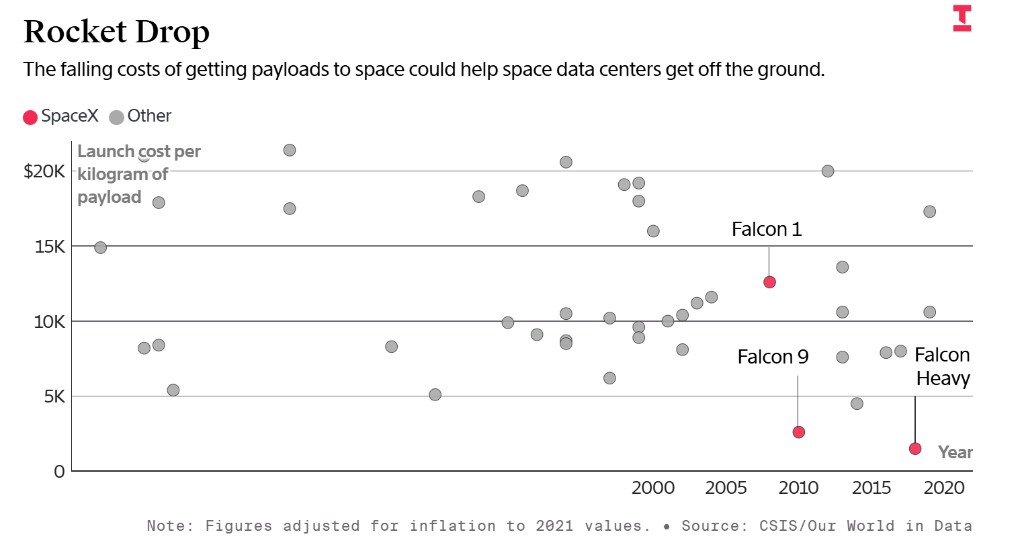
The realization of this vision is primarily attributed to the significant reduction in rocket launch costs. According to estimates from the Center for Strategic and International Studies, the current cost of sending objects into orbit via SpaceX's Falcon Heavy rocket is about $1,500 per kilogram. With the future deployment of SpaceX's next-generation giant rocket, Starship, this cost is expected to drop to $100 per kilogram in the coming years.
Additionally, competition from Blue Origin and other rocket startups is further driving down launch prices. This change in cost structure is making the economic model of transporting large quantities of GPUs and solar arrays to orbit increasingly feasible.
Bottlenecks in Ground Infrastructure
The sudden enthusiasm for space data centers in the tech circle largely reflects a pessimistic outlook on the challenges of ground construction.
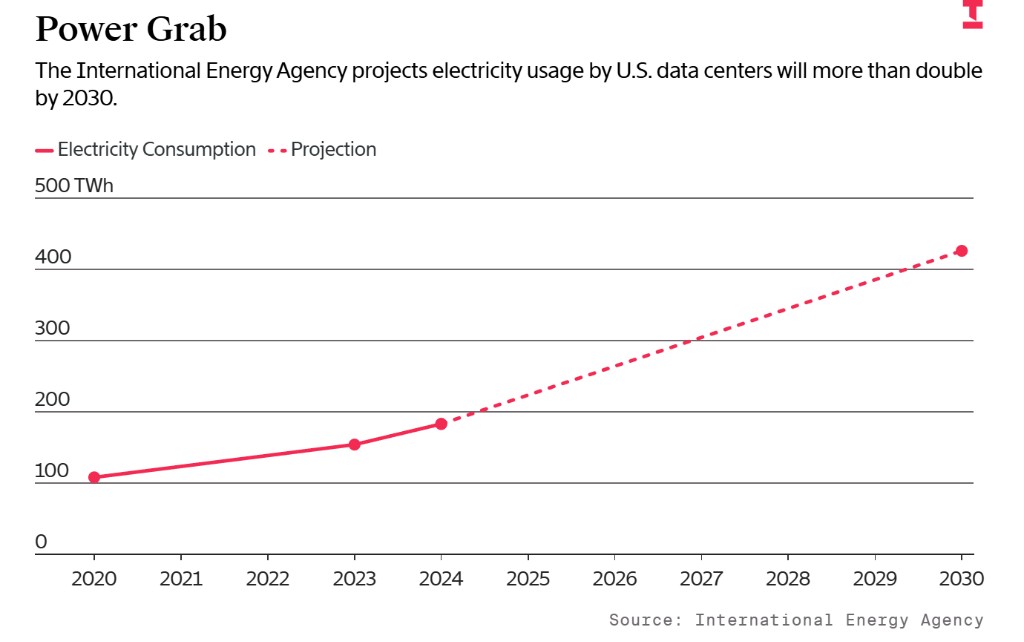
In the United States, the biggest obstacle to building data centers is the surge in electricity supply. A recent report from Morgan Stanley pointed out that due to the explosive growth in AI demand, the electricity shortfall for U.S. data centers could reach 20% in the coming years. The U.S. Department of Energy has also warned that without meaningful new power sources, the imbalance between electricity supply and demand could lead to more power outages before 2030.
In addition to the electricity shortage, community-level opposition is also growing stronger. The "NIMBY" (Not In My Backyard) effect is hindering project implementation. A report released by the research project Data Center Watch, operated by AI intelligence company 10a Labs, shows that bipartisan opposition has led to the blocking or delaying of U.S. data center projects worth $64 billion.
Baiju Bhatt referred to his space proposal as an "infrastructure bypass." He pointed out that establishing data centers in the U.S. can take years when considering permits, construction, and power guarantees, while the space proposal can circumvent these complex ground approval processes.
Capital Narrative and Potential Risks
Despite the grand vision, skepticism remains. Critics point out that space radiation could damage sensitive AI chips, and repairs or hardware upgrades after equipment failures would be extremely difficult. An executive from a space company expressed reservations about the claim that space deployment is cheaper than ground construction.
However, in the capital markets, this concept is providing strong narrative support for companies like SpaceX. According to previous reports from Bloomberg, SpaceX is considering an initial public offering in the second half of next year.
While its existing rocket launch and Starlink businesses dominate, the addition of the "space data center" concept allows it to tap into the hottest AI investment theme currently. Just as Tesla enhances its technological attributes through the Optimus robot, SpaceX is also attempting to tell a more imaginative growth story to investors by sending computing power into space
