


Bank of America: The Federal Reserve's RMP can lower the 10-year U.S. Treasury yield

Bank of America believes that the Federal Reserve's Reserve Management Purchase Program (RMP) will absorb most of the net supply of U.S. Treasuries over the next year. If the U.S. Treasury chooses to issue more short-term debt to offset the Fed's purchases, the supply of long-term U.S. Treasuries may decrease accordingly, potentially resulting in a 20 to 30 basis point drop in the yield of the 10-year U.S. Treasury compared to its original level
Bank of America believes that the Federal Reserve's purchase of short-term U.S. Treasury bonds may suppress long-term yields.
After the Federal Reserve's interest rate decision, the team of strategists at Bank of America led by Mark Cabana pointed out in a report that the Fed's Reserve Management Purchase Program (RMP) will absorb most of the net supply of short-term debt over the next year, forcing the U.S. Treasury to reconsider how to meet the growing borrowing demand.
Bank of America believes that the Treasury's decisions regarding the issuance scale of short-term debt will directly affect the supply of long-term bonds. If the Treasury chooses to issue more short-term debt to offset the Fed's purchases, the supply of long-term bonds may decrease accordingly, thereby putting downward pressure on the benchmark 10-year Treasury yield.
The Bank of America strategist team estimates that this "supply-demand environment more favorable to duration" could lower the 10-year Treasury yield by 20 to 30 basis points from its original level. This impact depends on whether the U.S. Treasury further delays increasing long-term Treasury issuance and whether it relies more on short-term financing tools.
Bank of America expects the U.S. Treasury to begin increasing the scale of some long-term debt monthly auctions starting in February 2027, a view widely accepted on Wall Street. This week, U.S. Treasury yields fluctuated, with long-term Treasury yields generally rising, and the 10-year yield increasing by nearly 3 basis points.
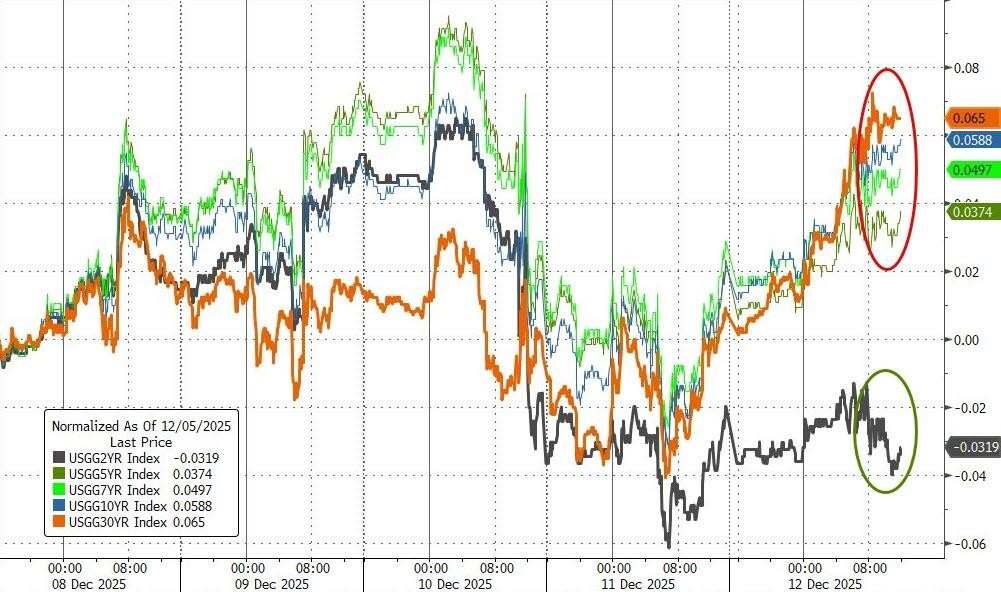 (Yield trends of major U.S. Treasury maturities this week)
Wall Street Significantly Raises Bond Purchase Expectations
Wall Street Journal previously mentioned that as the Federal Reserve announced aggressive purchasing plans, several major Wall Street banks quickly adjusted their estimates of the supply-demand relationship for U.S. Treasuries in 2026.
Barclays' strategists, including Samuel Earl and Demi Hu, now estimate that the total amount of short-term Treasury bonds purchased by the Fed in 2026 could approach $525 billion, significantly higher than the previous forecast of $345 billion. This means that the net issuance available to private investors will plummet from the previously estimated $400 billion to $220 billion.
The bank believes that the Fed's aggressive move shows a "very low tolerance" for financing pressure, and it expects the pace of purchases to remain high in the first quarter of next year, potentially decreasing from $55 billion per month (including MBS reinvestment) to $25 billion in April.
JP Morgan has also raised its expectations. Strategists Jay Barry and Teresa Ho expect the Fed to maintain a purchase scale of $40 billion per month until mid-April, then decrease to $20 billion per month.
Combining with approximately $15 billion of MBS reinvestment per month, the Fed's total purchases in the secondary market in 2026 will reach $490 billion. This will result in a net issuance of only $274 billion for short-term U.S. Treasuries next year
