


Will silver become the new gold?

A serious supply-demand imbalance has built a solid fundamental, while geopolitical risks have intensified market volatility. Retail investors' enthusiasm and the "fear of missing out" mentality further boost demand, and the expectations of dollar depreciation that may be triggered by the Federal Reserve's interest rate cut cycle have expanded its financial appeal. As analysts say, "Silver is becoming the new gold."
The "crazy" surge in silver prices continues.
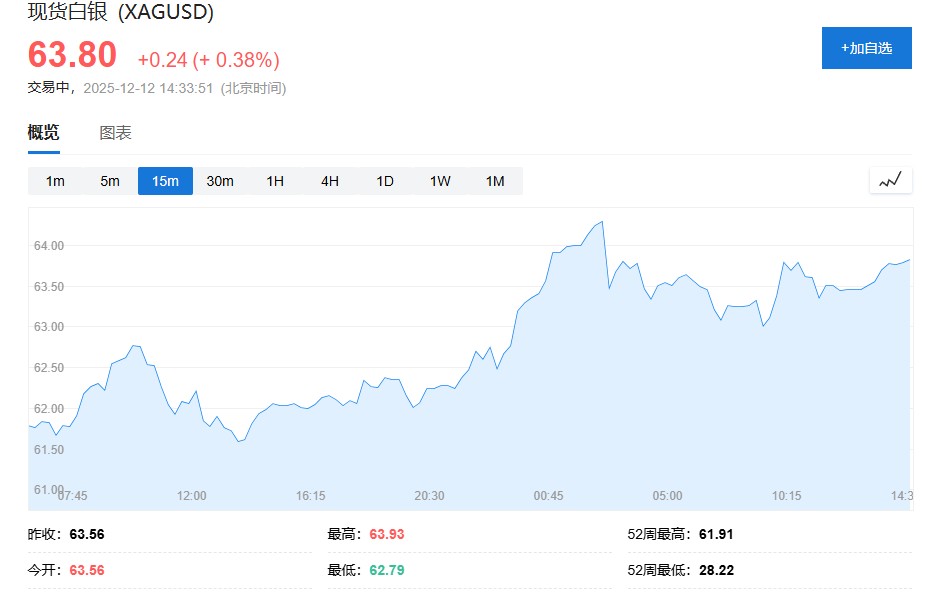
Spot silver briefly touched a historic high of $64.28 per ounce on Friday, doubling in price since the beginning of the year, far outpacing gold. This unprecedented increase is redefining the investment logic in the precious metals market.
On Friday, Gillian Tett, a columnist for the Financial Times, published an article that delves into the deep reasons behind the soaring silver prices, using the German Ministry of Finance's cancellation of the Christmas commemorative silver coin issuance as a starting point—a severe supply-demand imbalance has created a solid fundamental backdrop, geopolitical risks have intensified market volatility, retail enthusiasm and "fear of missing out" psychology have further boosted demand, while expectations of dollar depreciation due to the Federal Reserve's interest rate cut cycle have expanded its financial appeal.
The article states, as analysts have noted, "Silver is becoming the new gold."
It points out that the current silver price trend exhibits a "parabolic" rise, a pattern that has only occurred twice in recent history: during the oil crisis in the late 1970s and during the global financial crisis in 2008. However, this time is different—the surge in silver prices has not been accompanied by a collapse in the stock or bond markets, making the current market landscape both unusual and fraught with uncertain risks.
Supply-Demand Imbalance Drives Price Increase
The article notes that the strong performance of silver prices primarily stems from structural changes in the fundamentals. The surge in industrial demand has become the core driving force behind the price increase. Notably, in emerging industries such as electric vehicles and computer chips, the demand for silver has seen significant growth.
This demand growth is set against the backdrop of a global green transition and accelerated digitalization. Silver plays an irreplaceable role in solar panels, electric vehicle batteries, and various electronic products. With the rapid development of renewable energy and electronic technology, industrial demand for silver has reached historic highs.
However, the response from the supply side has been relatively lagging. Although historical experience shows that rising prices will eventually stimulate more mining activity, this process cannot be realized in the short term, as mineral supply has stagnated at around 813 million ounces for several consecutive years.
More concerning is that, according to the Silver Institute's 2025 World Silver Survey, the global silver market will experience a supply gap for the fifth consecutive year. The gap is expected to be about 117 million ounces in 2025, marking one of the largest supply-demand imbalances in recent years. This structural shortage is providing strong fundamental support for the continued rise in silver prices.
Geopolitical Factors Intensify Market Tension
Changes at the geopolitical level have further intensified market tensions. The Trump administration recently designated silver as a strategic commodity, a decision that has raised market concerns about impending tariff policies.
This policy expectation has led to stockpiling behavior within the United States. Companies and investors are rushing to purchase silver to hedge against potential supply disruption risks. This stockpiling behavior has not only exacerbated supply tensions domestically but has also had a ripple effect on markets in other regions An interesting phenomenon that has emerged is the significant price difference between London and New York. Market rumors suggest that some savvy financiers are taking advantage of this price gap for arbitrage trading. This brings to mind the historical event in 1980 when the Hunt brothers manipulated the silver market; although the scale and nature are different, both reflect the distorting effect of financial speculation on market prices.
Retail Frenzy and "Fear of Missing Out," "Silver is Becoming the New Gold"
The article cites the Bank for International Settlements, indicating that retail enthusiasm is on the rise. "FOMO" (Fear of Missing Out) is driving investors to speculate in sectors related to artificial intelligence, gold, and cryptocurrencies.
As the prices of these assets rise, some investors are beginning to turn their attention to silver. They realize that, unlike many other speculative assets, silver has actual industrial uses, making it more attractive.
Behind this retail frenzy is a questioning of traditional assets' ability to preserve value. Against the backdrop of rising inflation expectations, precious metals are seen as an effective tool to hedge against the risk of currency depreciation.
Concerns Over Monetary Policy Trigger "Depreciation Trades" in the Dollar
In addition to supply and demand factors and speculative sentiment, concerns over monetary policy are also driving silver prices higher. The Federal Reserve has cut interest rates three times this year, despite inflation rates still exceeding the 2% target. This policy combination has raised market concerns about "fiscal dominance," where the government may force the central bank to lower interest rates to alleviate the ever-expanding debt burden.
The article cites Steven Blitz, Chief U.S. Economist at TD Lombard, warning in an email to clients: "All of this has an inflationary nature." He pointed out that, in addition to cutting rates, the Federal Reserve also committed this week to resume purchasing government bonds.
This policy expectation has led to an unusual phenomenon: even as short-term interest rates decline, long-term bond yields in the U.S. and other regions have risen in 2025. Apollo's Chief Economist Torsten Slok noted, "Historically, it is extremely rare for long-term rates to rise during a Fed rate-cutting cycle."
This change in the interest rate environment has prompted some investors to view precious metals as "depreciation trades," tools to hedge against inflation or even default risks that erode the value of fiat currency.
In the face of market concerns, officials like U.S. Treasury Secretary Scott Basset have attempted to reassure investor sentiment. He posted a light-hearted message on social media featuring the cartoon character Franklin the Turtle, urging American savers to buy more government bonds, as he believes they are reliable stores of value.
However, the market's response clearly diverges from the official optimism. Investors continue to flock to the precious metals market, seeking alternative stores of value. This divergence itself reflects the trust crisis facing the current financial system.
Financial historians may point out that silver or gold is not necessarily a more reliable asset. On the contrary, due to the relatively small market size, silver prices have historically been very volatile, and traders have even nicknamed this precious metal "widow makers" because it can lead to significant losses The story of the Hunt brothers is a classic example. After a dramatic price surge in 1980, silver prices collapsed, completely destroying the brothers' wealth. This historical lesson reminds investors that even commodities with strong fundamentals can face severe price fluctuations.
Next step, aiming for the $100 mark?
The current situation in the silver market does have similarities to 1980, but there are also significant differences. This time, the rise is more based on actual industrial demand growth rather than pure speculation. However, this does not mean that prices will not experience a pullback.
Market analysts generally believe that silver prices may experience significant volatility during the upward trend. Although several analysts predict that silver prices are likely to break the $100 mark next year, investors still need to be prepared for possible price fluctuations.
As mentioned in a previous article, Paul Williams of Solomon Global predicted back in October, when silver was nearing $50, that it would break $100 by the end of 2026. Philippe Gisel of BNP Paribas also expects silver to enter the triple-digit range by 2026.
These optimistic predictions are mainly based on two factors: ongoing supply shortages and increasing industrial demand. As the global green transition deepens, the application of silver in new energy technologies will continue to expand. At the same time, the acceleration of digitalization will also provide strong support for silver demand.
The current silver market is at a critical crossroads. On one hand, strong fundamentals support the continued rise in prices; on the other hand, speculative sentiment and policy uncertainty are also exacerbating market volatility. For investors, understanding this complex market dynamic and finding the right balance between opportunities and risks will be key to future investment decisions
