


Kunlun Core is gaining momentum! Wall Street is optimistic about Baidu: expected to replicate Google's AI comeback path

The expectation of Baidu's subsidiary chip company Kunlun Core going public is driving Wall Street to reassess Baidu's value, with the valuation logic shifting from traditional businesses to hard technology assets centered around chips. Macquarie Securities estimates that Baidu's 59% stake in Kunlun Core is valued at approximately $16.5 billion, accounting for about 30% of its target valuation for Baidu. Kunlun Core's revenue is expected to double next year to around $1.4 billion, placing it in the same tier as Cambricon
With the rising expectations for the spin-off listing of its chip subsidiary Kunlun Chip, Baidu is regaining favor on Wall Street.
Analysts believe that the rise of this semiconductor business will not only help unlock Baidu's potential value but also enable this leading Chinese internet search company to replicate Alphabet's path to success in the field of artificial intelligence through its chip strategy.
The capital market has reacted positively. According to a Bloomberg report on December 12, both Goldman Sachs and Macquarie Securities stated last week that Kunlun Chip's potential IPO is a key step for Baidu to "unlock value." Since the end of August, the average target price for Baidu's Hong Kong shares has been raised by about 60%, ranking third among the constituent stocks of the Hang Seng Tech Index during the same period. Previously, buoyed by Kunlun Chip's orders from state-owned giant China Mobile and news of its spin-off listing, Baidu's stock price had already risen by 45%.
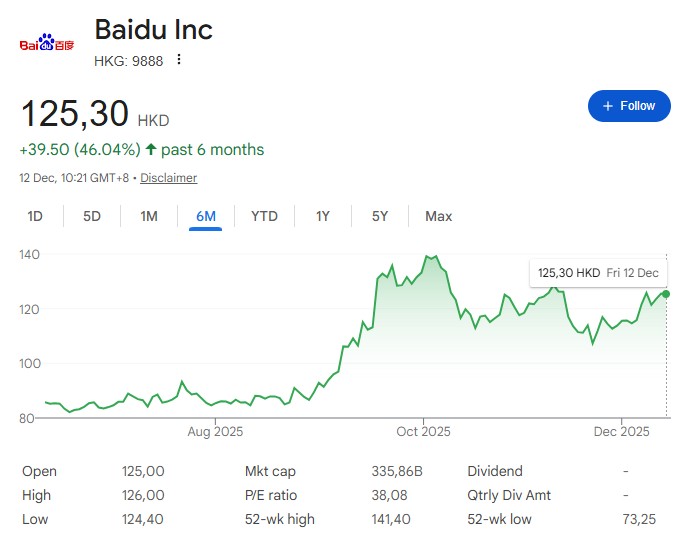
Market sentiment is undergoing a fundamental shift. Macquarie analyst Ellie Jiang pointed out in a report on December 5 that investors had largely overlooked Baidu's vertical integration progress from chips and cloud architecture to models and applications. However, the latest channel research shows that, thanks to the explosive demand for application-layer inference, the domestic chip market is experiencing a surge. Although the advertising business still faces pressure from the macroeconomic slowdown, the growing contribution from AI-related businesses is prompting investors to reassess Baidu's valuation logic.
This shift is occurring against the backdrop of intensified AI competition. With the ongoing uncertainty surrounding the acquisition channels for Nvidia's top processors, Baidu, leveraging Kunlun Chip's efficient inference capabilities, is not only providing a competitive alternative in the cloud but is also reshaping its market position in the wave of technological self-sufficiency.
Valuation Reconstruction: Non-Advertising Business Becomes Dominant Factor
Wall Street analysts generally believe that Baidu's valuation system is shifting from a single internet advertising model to hard technology assets.
Arete Research Asia Ltd. analyst Shawn Yang pointed out that non-advertising businesses, including chips and autonomous driving, are expected to become the "dominant factor" determining Baidu's valuation level. He believes that although traditional advertising business is unlikely to show signs of reversal in the short term, these new growth engines will effectively offset the weakness of traditional businesses.
Macquarie Securities quantifies this viewpoint further. Ellie Jiang estimates that Baidu's 59% stake in Kunlun Chip is worth approximately $16.5 billion, accounting for about 30% of the target valuation given to Baidu. This valuation is no longer based solely on Baidu's search traffic but is beginning to account for its deep accumulation in the AI infrastructure field.
Revenue Doubling Expectations and Benchmarking Cambricon
The financial performance and growth potential of Kunlun Chip are the core support for this valuation logic. According to Macquarie's estimates, the revenue of this chip division is expected to double next year to about $1.4 billion. This revenue scale will place it in the same tier as Cambricon, which, as a chip designer, is referred to by investors as "China's Nvidia," with a stock price increase of 110% by 2025 Goldman Sachs further dissected the value potential of Kunlun Core in a research report released on December 9. The Goldman Sachs team pointed out that if we refer to the current price-to-sales (P/S) ratio of Cambricon and combine it with Kunlun Core's expected rapid increase in external sales by 2026, the valuation range of the 59% equity held by Baidu may be between $3 billion and $11 billion.
According to Reuters, Kunlun Core is expected to exceed 3.5 billion yuan in revenue by 2025 and achieve breakeven. Goldman Sachs believes that even without considering a spin-off listing, Kunlun Core's sales growth and Baidu's own business use of the chip will directly enhance the company's performance.
Differentiated Advantages in the Localization Process
Under the macro narrative of semiconductor localization, Kunlun Core is facing unique strategic opportunities.
Data shows that due to policy support, Chinese semiconductor stocks have generally outperformed internet stocks during the AI boom. Besides Cambricon, chip foundries Hua Hong Semiconductor and SMIC have ranked among the top three performers in the Hang Seng Tech Index this year.
Arete's Shawn Yang pointed out that Kunlun Core has specific advantages compared to domestic competitors: on one side, Cambricon is facing capacity bottlenecks, while on the other side, Huawei is facing external restrictions, which provides favorable space for Kunlun Core's market expansion.
Goldman Sachs analyst Lincoln Kong and his team emphasized in a report on Tuesday that due to the unclear prospects for Chinese mega-enterprises to acquire high-end chips like Nvidia's H200, Baidu Cloud can provide highly price-competitive alternatives for AI model inference and even training tasks.
Kunlun Core's high inference efficiency makes it very suitable for the current market's shift towards inference applications. In addition, Kunlun Core has established a clear technology roadmap, planning to launch the M100 chip in early 2026 and the M300 chip for inference and training in 2027, with the goal of building a million-level chip cluster by 2030
