


After a one-year treatment course, the average weight loss reached 28.7%! Eli Lilly's new generation of weight loss drugs shows remarkable performance, far exceeding similar medications

Eli Lilly announced the results of its Phase 3 clinical trial for the new generation weight loss drug retatrutide, showing that patients in the highest dose group lost an average of 28.7% of their weight after 68 weeks of treatment. This weight loss effect significantly outperformed existing weight loss medications on the market, including Eli Lilly's own Zepbound (approximately 22.5%) and Novo Nordisk's Wegovy (less than 20%). Following the news, the company's stock price rose 1.6% overnight
Eli Lilly announced the significant Phase 3 clinical data for its next-generation weight loss drug Retatrutide.
According to the news released by Eli Lilly on December 11, the Phase 3 clinical trial targeting patients with obesity and knee osteoarthritis showed that after receiving the highest dose of Retatrutide treatment for 68 weeks, patients experienced an average weight loss of 28.7%, approximately 71.2 pounds. This figure is significantly higher than the approximately 22.5% weight loss effect of its already marketed drug Zepbound and the less than 20% weight loss effect of competitor Novo Nordisk's Wegovy.
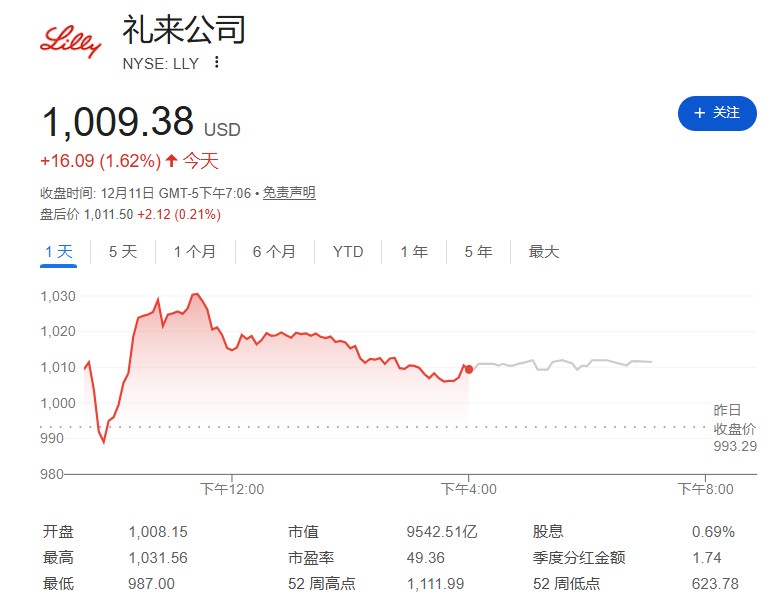
This positive trial result immediately triggered a response in the capital market. Following the announcement, Eli Lilly's stock price rose by 1.2% in pre-market trading and closed up 1.6% overnight. Analysts believe that the success of Retatrutide could open a new blockbuster product line for Eli Lilly, continuing the explosive growth brought by drugs like Mounjaro and Zepbound.
Retatrutide regulates appetite and may increase energy expenditure by mimicking three gut hormones, with a mechanism of action that is more complex than existing drugs. In addition to the significant weight loss effect, the study also found that the drug effectively alleviated patients' knee pain, providing more imaginative space for its future application scenarios and market positioning.
Kenneth Custer, President of Cardiovascular Metabolic Health at Eli Lilly, stated: "We believe that for patients with significant weight loss needs and specific comorbidities (including knee osteoarthritis), Retatrutide may become an important option."
At the same time, the company expects that seven additional Phase 3 clinical trials for this drug will be completed by 2026.
New Efficacy High, But Accompanied by Higher Side Effects
The Phase 3 clinical trial announced this time recruited patients who were not diabetic but had a body mass index (BMI) of at least 35, suffering from severe obesity and knee osteoarthritis. In the 68-week trial, they received weekly injections of Retatrutide or a placebo. The results showed that the weight loss effect in the highest dose group reached a record 28.7%.
However, the powerful efficacy was also accompanied by side effects. The study found that patients experienced gastrointestinal side effects such as nausea and diarrhea, similar to known issues with similar weight loss drugs.
JP Morgan analyst Chris Schott pointed out that the incidence of these side effects for Retatrutide was higher than that of earlier drugs like Wegovy and Zepbound, but overall still aligned with the characteristics of this class of drugs. A noteworthy detail is that some participants discontinued treatment due to excessive weight loss. Schott believes that the target population for this drug will be patients with very high BMI
