


Even if the financial report exceeds expectations, Oracle may still struggle to overcome doubts about debt and AI trading risks

Analysts believe that Oracle may still be insufficient to alleviate market concerns about its long-term risks. These risks include: financial structure pressure from aggressive capital expenditures and negative free cash flow, risks associated with over-reliance on a single partnership with OpenAI, and the uncertainty of returns from substantial investments in the AI field. Although short-term performance may be positive, investors are more concerned about these fundamental challenges, which will continue to affect the company's valuation and market confidence
Oracle will announce its second fiscal quarter earnings on Wednesday Eastern Time (Thursday early morning Beijing Time). Analysts point out that regardless of performance, concerns about its high debt, ongoing negative free cash flow, and whether the collaboration with OpenAI can deliver results are unlikely to dissipate.
Since the stock price hit an all-time high on September 10, Oracle has fallen 33%, reflecting a cautious market attitude towards AI-related concept companies. Many tech companies, including Oracle, are facing investor confidence challenges due to aggressive capital expenditures and risks associated with circular transactions in business collaborations.
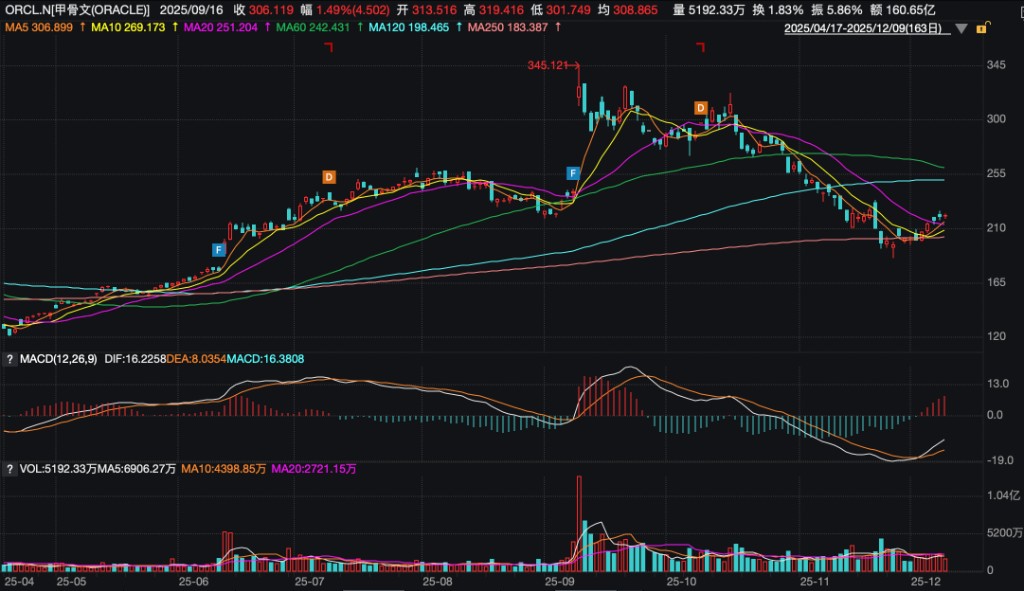
Currently, the pricing of the company's five-year credit default swaps has risen to historical highs, becoming an important tool for the market to hedge against credit risks in the AI sector. Analysts generally believe that this uncertainty may overshadow any potential positive signals in the earnings report. Gabelli Funds analyst Ryuta Makino emphasized, “The core issue lies in customer concentration and the corresponding financing structure. In the coming years of continued investment in data center construction, its free cash flow is likely to remain under pressure.”
Debt Risk Becomes the Focus
Oracle's debt situation is drawing significant market attention.
In recent months, the Austin-based tech company has issued hundreds of billions of dollars in bonds through direct issuance and project financing. Argent Capital Management portfolio manager Jed Ellerbroek pointed out, "Their balance sheet has reached its limit, free cash flow is negative, and leverage is very high."
Analysts expect Oracle's adjusted earnings per share to grow by 11% year-over-year, with revenue increasing by 15%. However, the financial pressure from capital-intensive investments is expected to narrow its gross margin from 71% in the same period last year to about 69%. The balance between funding costs and return cycles continues to affect investor sentiment cautiously.
The obvious deterioration of the financial structure has become the core concern of the market, with the most significant change reflected in its capital expenditures. The market expects Oracle's capital expenditures for the second fiscal quarter ending in November to reach $8.2 billion, a substantial increase from less than $4 billion in the same period last year; free cash flow is expected to be negative $5.9 billion, compared to positive $2.7 billion in the same period last year.
Reliance on OpenAI Raises Questions
Investors are closely monitoring the concentration risk of Oracle's revenue sources.
In September this year, Oracle signed a large-scale cloud computing service agreement with OpenAI, but such deep binding has also raised market concerns about its strategic risks.
JonesTrading chief market strategist Michael O’Rourke pointed out, “I have always believed that tying the future of a company to a startup while taking on significant leverage is very dangerous. Now that OpenAI is facing difficulties, the risks are further exacerbated. If OpenAI is slow to act or unable to execute its plans, management must come up with contingency plans In the upcoming earnings call, Oracle executives will almost certainly be asked about the progress of their collaboration with OpenAI. If the company can disclose representative new large clients, it may help alleviate current market concerns about its overly concentrated customer base.
Valuation Remains High
Despite a significant pullback from its highs, Oracle's valuation remains elevated.
The stock currently has a forward price-to-earnings ratio of about 30 times based on expected earnings over the next 12 months, which is not only well above its average level over the past decade (around 17 times) but also significantly higher than the Nasdaq 100 index's valuation level of about 26 times.
Regardless of the earnings report results, options traders expect Oracle's stock price to be influenced by the earnings report, anticipating a 10% volatility in the stock price following the report's release. Michael Sansoterra, Chief Investment Officer of Silvant Capital Management, noted: “The core issue is not whether its growth can be achieved, but rather the market's confidence in its growth trajectory. I do not believe a single earnings report can fundamentally change the current narrative.”
