


As the AI bubble faces skepticism, the slow-moving Apple unexpectedly "lies down to win": its stock price soared 35% in six months, outperforming Microsoft and Meta

Against the backdrop of skepticism surrounding the AI investment boom, Apple has unexpectedly become a market winner due to its prudent capital expenditure strategy. Its stock price has risen over 35% since the end of June, with a market capitalization surpassing $4.1 trillion, overtaking Microsoft to become the second-largest weighted stock in the S&P 500. Apple is viewed as a target that can both avoid the risks of an AI bubble and benefit from the widespread adoption of technology, with its valuation reaching historical highs
As Wall Street's investment frenzy in artificial intelligence becomes increasingly cautious, Apple, which has previously faced controversy for its relatively slow AI deployment, has unexpectedly emerged as a recent market winner.
Since the second half of this year, Apple's stock price has soared over 35%. Against the backdrop of ongoing market skepticism regarding AI-related spending, Apple's cautious strategy has been reinterpreted as a more certain "safe haven," thus attracting capital.
The strong performance of Apple's stock stands in stark contrast to other tech giants. During the same period, stocks like Meta and Microsoft, which have heavily invested in AI, have entered a correction phase, and even the leading AI chipmaker Nvidia's gains have lagged behind Apple's. In comparison, the S&P 500 index rose about 10% during the same period, while the Nasdaq 100 index increased by about 13%, with Apple significantly outperforming the market.
This turnaround has pushed Apple's market value to $4.1 trillion, surpassing Microsoft to become the second-largest weighted stock in the S&P 500 index, only behind Nvidia. As doubts arise about the sustainability of the hundreds of billions of dollars invested by large tech companies in the AI field, Apple's current relatively cautious positioning is seen as a strategic advantage that can flexibly benefit when AI technology truly matures.
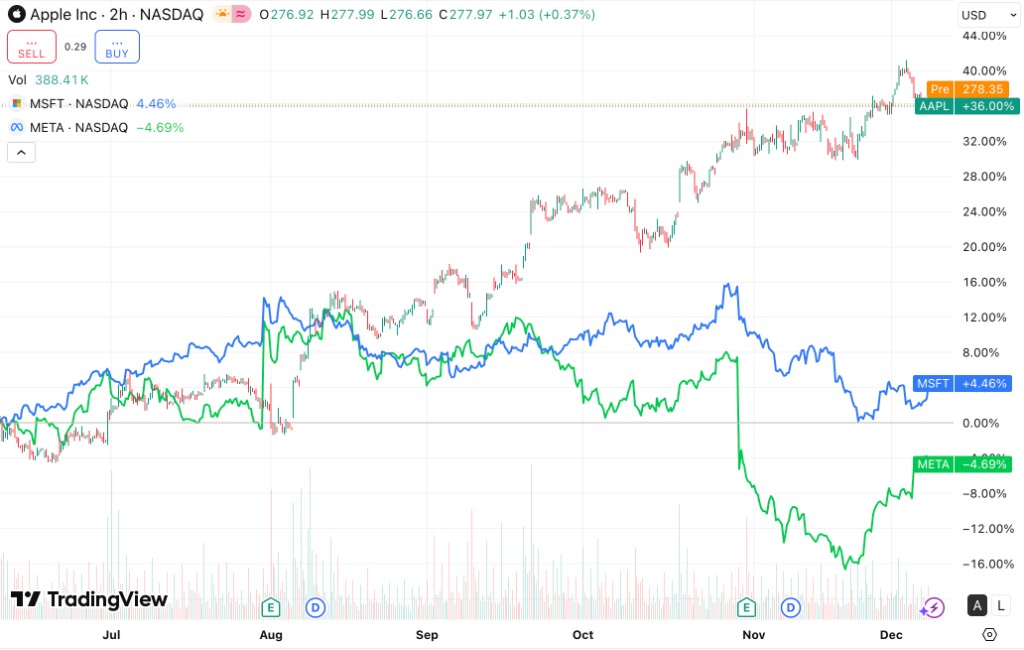
From Bottom in the First Half to Leading in the Second Half
Apple's stock price experienced a dramatic turnaround in 2025. In the first half of the year, it ranked at the bottom among the "Tech Seven," with a cumulative decline of 18%; however, since the end of June, the trend has completely reversed. Investors are viewing Apple as a unique defensive choice, avoiding the risks of over-investment while continuing to benefit from its ecosystem and hardware advantages as AI technology matures and becomes widespread.
Bill Stone, Chief Investment Officer of Glenview Trust Company, defines Apple as an "anti-AI concept stock," noting that while the company will undoubtedly enhance AI features in its phones, it has actively avoided the current AI arms race and the accompanying massive capital expenditures.
John Barr, portfolio manager of the Needham Aggressive Growth Fund, commented:
"The key is that while peers are ramping up investments, Apple has chosen to maintain rationality and spending restraint."
Valuation Surge Raises Concerns
Apple's stock price has continued to strengthen, pushing its valuation levels to historical highs. According to the latest data, its stock price corresponds to an expected price-to-earnings ratio of about 33 times for the next 12 months, which has only been reached a few times in the past fifteen years, and is only below the historical peak of 35 times set in September 2020, while the stock's long-term average price-to-earnings ratio is less than 19 times.
Currently, Apple has become the second-highest valued component stock in the "Bloomberg Tech Seven" index, only behind Tesla, which has a price-to-earnings ratio exceeding 200 times. Craig Moffett, co-founder of research firm MoffettNathanson, commented on this:
"It is hard to foresee that the stock can continue to appreciate at the same strong compound growth rate in the future. An obvious question is whether investors are paying too high a premium for Apple's 'defensive attributes.' Our answer is yes." It is worth noting that Warren Buffett's "Oracle of Omaha," Berkshire Hathaway, reduced its stake in Apple by about 15% in the third quarter while establishing a new position in the currently popular AI concept stock Alphabet. Nevertheless, in terms of market value, Apple remains the largest holding in Berkshire's stock portfolio.
Technical Warnings and Long-Term Outlook
BTIG's Chief Market Technician Jonathan Krinsky pointed out in a recent report that from a technical perspective, Apple's stock price has significantly deviated from the 200-day moving average, and there is "especially a risk of a pullback in the short term, particularly after entering January." However, he emphasized that "Apple's long-term trend remains clearly upward."
The market has reached a consensus on the logic of Apple's strength against the backdrop of AI concerns. As AI technology matures and enters the commercialization stage, hundreds of millions of Apple users will access related applications through their devices, which could not only drive hardware upgrade demand but also sustain the growth of its high-margin service business.
In this regard, Craig Moffett, co-founder of MoffettNathanson, analyzed:
"Although valuations are high, Apple's consumer ecosystem moat remains strong. In the current market, where there are widespread concerns about whether AI has a bubble, Apple is understandably seen as a quality choice for capital preservation."
