


Where are the opportunities for AI GPUs in China? Morgan Stanley's industry research: The inference field may become the biggest winner

Morgan Stanley's latest research shows that inference computing is replacing pure computing power stacking, becoming the growth core of China's AI chip industry. Domestic manufacturers are betting on 6/7nm and LPDDR to ensure production capacity and seize the inference market window. Based on this, Morgan Stanley has raised its AI GPU revenue forecast for 2026-2027 and expects China's self-sufficiency rate to rise to 50%
Morgan Stanley's latest research report on the semiconductor industry chain points out that China's AI chip industry is undergoing significant structural adjustments, with inference computing demand gradually replacing pure computing power stacking as the core driving force for market growth.
According to news from the Chasing Wind Trading Desk, Morgan Stanley's on-site research in the Asian market on the 8th shows that a new path differentiation is emerging in China's AI accelerator market. Some domestic AI chip design companies in China are proactively adjusting their technical routes by developing products with relatively mid-range specifications to focus on inference applications.
The direct impact of this shift is the pragmatization of technical specifications. The report indicates that supply chain feedback shows that local chip designers, including Suiruan Technology, are turning to TSMC's 6nm or 7nm process to design inference chips. Meanwhile, to adapt to the energy efficiency and cost-sensitive characteristics of inference tasks, these chip solutions are increasingly shifting to using LPDDR memory instead of the supply-constrained and costly HBM, exploring new growth spaces in specific application scenarios.
On the foundry side, Morgan Stanley maintains an optimistic outlook on TSMC, while being more favorable towards SMIC among domestic foundries. Analysts believe that the strong growth of global AI demand is still sufficient to support TSMC's compound annual growth rate to exceed 40% over the next five years.
The Rise of Inference Chips: Mid-Range Route Becomes Mainstream
Morgan Stanley's supply chain survey shows that Chinese AI chip companies are adopting more flexible strategies to adapt to the rapid expansion of inference scenarios.
The survey points out that the focus of AI computing in China is shifting from the training end to the inference end. Currently, the available computing power in the market mainly comes from NVIDIA's 5090-level consumer graphics cards, early Hopper architecture products, and some domestic AI accelerator chips. In this combination, local manufacturers like Suiruan Technology are accelerating the iteration pace of inference-specific chips through more mature 6nm and 7nm nodes.
Information from the memory supply chain also confirms the rise of inference demand. Morgan Stanley notes that the new generation of domestic AI inference chips is accelerating the adoption of LPDDR as the main supporting storage solution. This type of memory solution has significant advantages in terms of cost, energy consumption, and deployment flexibility, making it more suitable for the high concurrency, low latency, and low power consumption usage scenarios of inference.
Reshaping Market Supply and Demand and Local Substitution Window
In terms of external supply, Morgan Stanley observes that the AI computing power demand in the Chinese market presents a layered pattern of "tight training, expanding inference." The report believes that some new types of AI accelerators have failed to generate strong volume momentum in the Chinese market due to factors such as pricing, energy efficiency, or ecological adaptability, thereby releasing more window periods for local solutions.
The survey indicates that the actual main force of AI inference computing power in China is still jointly borne by consumer-grade GPUs, early Hopper chips, and domestic substitution solutions. This pattern provides domestic chip design companies with greater iteration space and drives them to focus on breakthroughs in "inference performance" through differentiated routes. In the domestic wafer foundry sector, Morgan Stanley has updated its scenario analysis. The report suggests that if Chinese cloud service providers (CSPs) can increase the usage proportion of domestic design solutions in specific scenarios, or if Taiwan-based processes for domestic chips accelerate production, some existing demand may be redistributed in the short term.
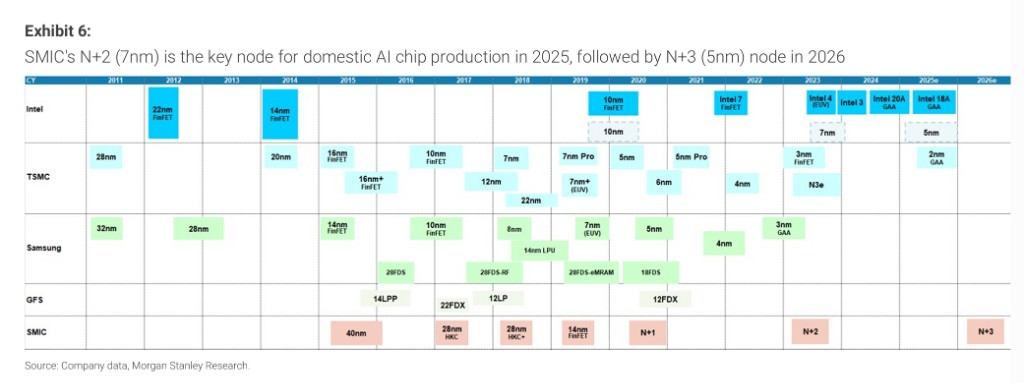
Despite this diversion effect, Morgan Stanley still maintains an "overweight" rating on SMIC and believes its prospects are better than Hua Hong Semiconductor. Analysts emphasize that SMIC's N+2 (7nm) node is expected to become a key technology point for domestic AI chip production in 2025, while the N+3 (5nm) node in 2026 will further enhance local supply capabilities.
Market Outlook: Self-sufficiency Rate and Revenue Forecast Upgraded
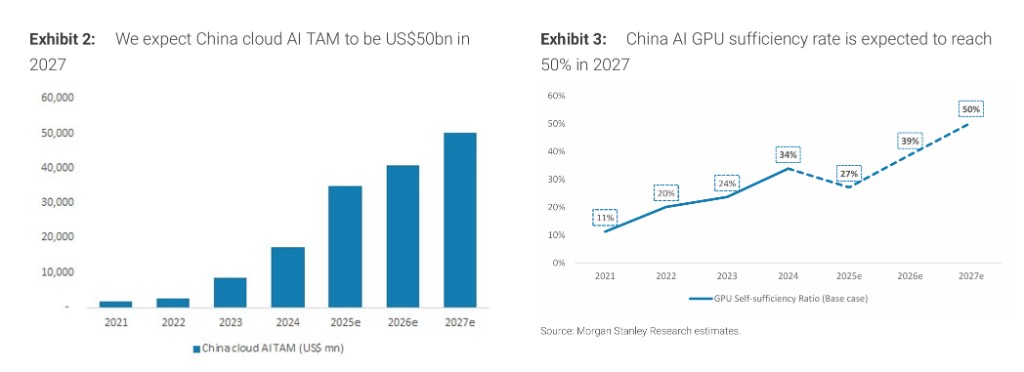
Based on the judgment of strong growth in inference demand, Morgan Stanley has raised its revenue expectations for the Chinese AI GPU market. In the baseline scenario, analysts have upgraded the revenue forecasts for China's AI GPU in 2026 and 2027 from RMB 94 billion and RMB 136 billion to RMB 113 billion and RMB 180 billion, respectively.
Data models indicate that as domestic manufacturers fill supply gaps, it is expected that by 2027, the self-sufficiency rate of China's AI GPUs will reach 50%. Despite facing a complex external environment, the structural resilience of domestic AI computing demand remains, and "inference" applications will be the biggest winners supporting market growth in the coming years
