


The Future Battle of Hollywood! Warner's bidding war heats up, Paramount vs. Netflix

Paramount launched a cash offer of $30 per share for Warner Bros., with an enterprise valuation of up to $108.4 billion and funding certainty, posing a direct challenge to Netflix's cash and stock proposal. As Trump expressed antitrust concerns over the Netflix deal, Paramount's proposal gained advantages in both regulatory and market aspects, tipping the scales of the transaction, leaving Warner Bros. shareholders with a critical choice between guaranteed premiums and lengthy approval risks
The battle for control of Warner Bros. has officially evolved into a heated capital showdown. Paramount (after merging with Skydance) launched a strong offensive today, proposing a full cash acquisition of all outstanding shares of Warner Bros. This offer aims to directly counter Netflix's previous acquisition proposal with superior financial terms and certainty, intending to reshape the global media and entertainment landscape.
As new bidding details were disclosed, the secondary market quickly reacted, with investors voting with their feet to express their views on the different proposals. Paramount's stock price surged nearly 10% during early trading on the New York market, while competitor Netflix's stock price came under pressure, falling about 4%.
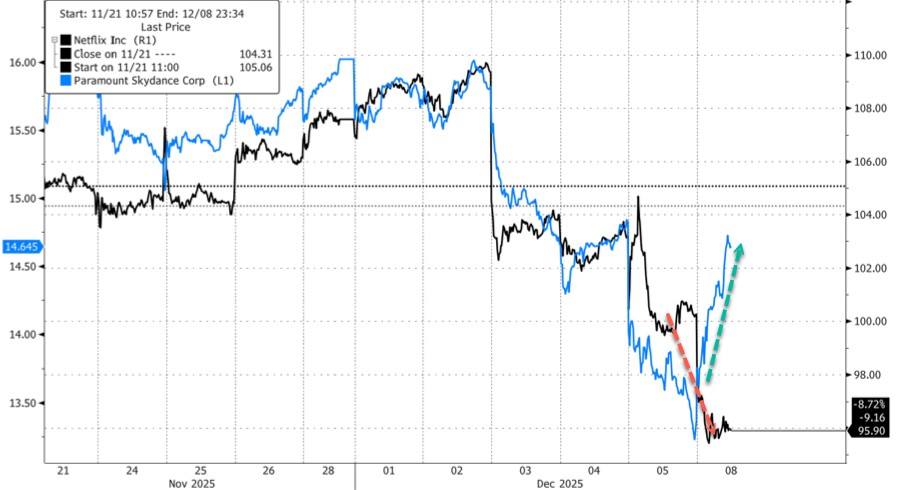
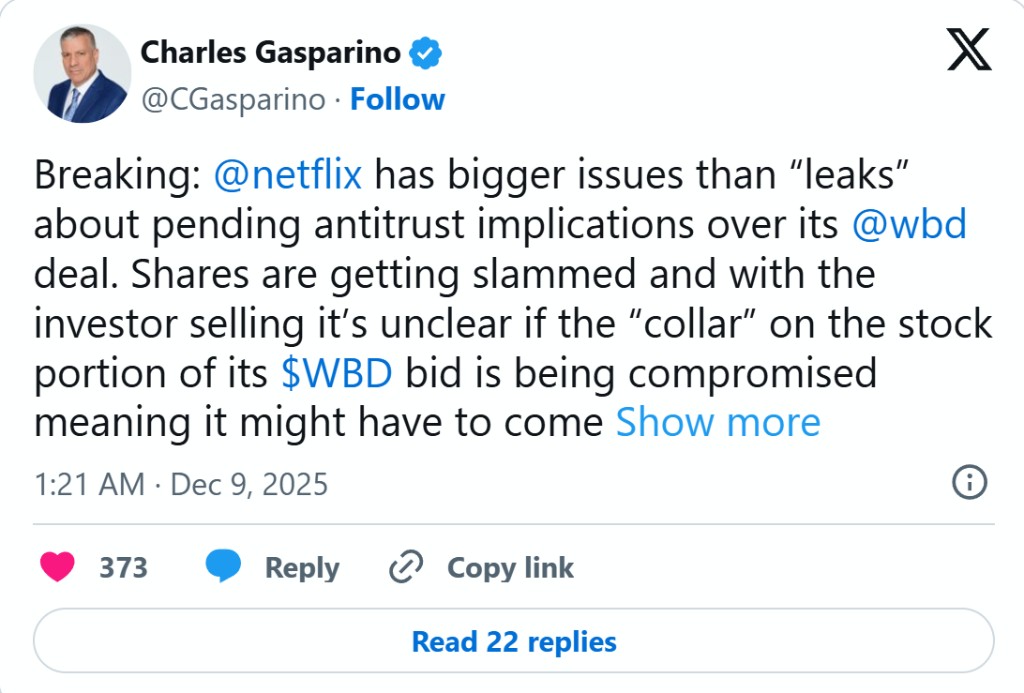
According to Fox Business reporter Charles Gasparino, as Netflix's stock price plummeted, the value protection mechanism for the stock portion of its previous bid faced the risk of failure, which means Netflix may be forced to raise more cash to maintain the attractiveness of the deal.
The impact of this bidding war has transcended Wall Street, directly touching the regulatory nerves in Washington. President Trump has publicly expressed skepticism about the antitrust implications of the Netflix acquisition, warning that the deal could lead to excessive concentration and has rarely hinted that he will personally monitor the relevant approval decisions.
As a result, the predicted probability of a deal between Netflix and Warner Bros. on the prediction market Polymarket has dropped from about 20% to 16%.
Paramount's proposed all-cash offer values Warner Bros. at $108.4 billion, which not only provides a higher premium compared to Netflix's complex cash-and-stock proposal but also promises a clearer regulatory path.
Warner Bros. shareholders currently face a critical choice: to accept Paramount's promised investment and industrial synergy or to bear the uncertainties brought about by stock price fluctuations and lengthy regulatory reviews in Netflix's proposal.
All-Cash Premium and Structural Advantages
According to the statement released by Paramount, the proposed acquisition price is $30 per share in cash, representing a 139% premium over Warner Bros.'s unaffected stock price as of September 10, 2025.
In stark contrast, Netflix's proposal announced last Friday is valued at approximately $27.75 per share, using a mixed structure of “$23.25 in cash + $4.50 in stock.” Paramount pointed out that Netflix's offer not only has a lower total value (enterprise value of about $82.7 billion) but also heavily relies on Netflix's future stock performance In terms of transaction structure, Paramount emphasizes that its proposal is to acquire all assets of Warner Bros., while Netflix's agreement assumes the divestiture of certain assets under Warner Bros., leaving shareholders with a smaller, highly leveraged "global network" residual asset.
Paramount Chairman and CEO David Ellison stated that its all-cash proposal offers shareholders a "certain and faster path to completion," avoiding the holding of uncertain non-core assets and dealing with complex regulatory processes.
This all-cash acquisition proposal has received full equity support (provided by the Ellison family and RedBird Capital) as well as bank underwriting debt financing (provided by Bank of America, Citi, and Apollo), ensuring strong funding support.
Strategic Synergy and Industry Restructuring
David Ellison emphasized in a statement that the merger of Paramount and Warner Bros. will create a stronger Hollywood production giant, benefiting not only the creative community but also the cinema industry.
Paramount listed several strategic advantages post-merger, including a larger content budget, stronger theatrical distribution capabilities, and a more profitable direct-to-consumer platform composed of "Paramount+" and "HBO Max."
Additionally, the merger proposal promises to achieve technological enhancements through partnerships with Oracle Corporation and to integrate global major sports broadcasting rights.
Paramount expects the merger to generate over $6 billion in cost synergies and to secure a more favorable position in competition with Netflix, Amazon, and Disney.
The former CEO of Warner Bros. commented that selling Warner Bros. to Netflix would be the most effective way to reduce competition in Hollywood, indirectly confirming the rationale of Paramount's proposal in maintaining diverse competition in the industry.
Regulatory Resistance and Political Maneuvering
Although corporate mergers are typically handled by independent regulatory bodies such as the Federal Trade Commission (FTC), this transaction has attracted the attention of the highest levels of the U.S. administration.
President Trump expressed skepticism about the prospects of Netflix acquiring Warner Bros. being approved while attending an event at the Kennedy Center Opera House. He pointed out that Netflix already holds a significant market share, and if it acquires Warner Bros., its share would "increase significantly," making the transaction "potentially problematic."
Trump explicitly stated that he plans to discuss the transaction mechanism with economists before granting approval and mentioned that he would "be involved in this decision." These remarks heightened market concerns about the long-term global antitrust litigation facing Netflix's proposal.
It is noteworthy that the Ellison family, as major supporters of Paramount, has a close relationship with Trump, while Netflix is viewed by the Trump administration as a company heavily influenced by the Obama era. This political spectrum difference could become a latent variable affecting the direction of the transaction.
Wall Street Questions Netflix's Acquisition Logic
In addition to regulatory pressure, Netflix's acquisition motives have also been questioned by sell-side analysts.
The Barclays analyst team not only questioned why Netflix would spend nearly $80 billion to acquire a traditional production company that it has already "disrupted" through its streaming model, but also pointed out that the expected cost synergies from the deal are only between $2 billion and $3 billion, and that the integration process will be unusually slow due to existing content licensing agreements.
In contrast, Paramount is currently making a dual effort in the war of public opinion and capital, trying to prove to the Warner Bros. board and shareholders that its all-cash proposal is the only way to maximize asset value. If Netflix cannot come up with a more convincing counterproposal or address regulatory concerns, the balance of this Hollywood century merger may tilt in favor of Paramount
