


Fu Peng: Will the Bank of Japan's interest rate hike in 2025 trigger a reversal of carry trade again? Let's take a look at the underlying logic! [Fu Peng's Commentary + Article Review]
Fu Peng discussed the potential reversal of carry trades triggered by the Bank of Japan's interest rate hike in 2025 and the underlying logic in Season 6 of "Fu Peng Says." He pointed out that past market volatility and the sharp decline in NVIDIA's stock price were not solely due to yen carry trades, but rather because of NVIDIA's high leverage. Fu Peng emphasized that understanding carry trades requires considering changes in the interest rate curve and capital flows, while yen liabilities remain the best choice for global carry trades
"Fu Peng Says Season 6" Fully Upgraded! Subscribe Now
 This year marks the tenth anniversary of Wall Street Insights' "Fu Peng Says" annual column!
"Fu Peng Says Season 6" has been fully upgraded. In addition to the regular videos, a new column group chat has been added to update Fu Peng's latest market views & chart data interpretations (community updates in real-time).
In addition to the regular content of Fu Peng Says, there is also a new online reading document for the column, which sends out daily trading focus morning reports, noteworthy research reports, recommended electronic reading lists, and extended reading materials. Everyone can also ask questions and communicate more in the community to improve together. Users who join the column please scan the QR code in the image below to add the assistant and enter the exclusive group chat for "Fu Peng Says".
Will the Bank of Japan's Interest Rate Hike in 2025 Trigger a Reversal of Carry Trade? Let's Examine the Logic Behind It!
After the Bank of Japan raised interest rates in August 2024, NVIDIA's stock price plummeted, and many shouted that the global volatility increased due to the unwinding of yen carry trades. At that time, I clearly pointed out that this was nonsense; the core of NVIDIA's explosive drop was the elevated leverage of NVIDIA, with excessive certainty leading to high off-exchange leverage. Once this off-exchange leverage blew up, it would return to where it came from.
What was the result? After the sharp drop, NVIDIA quickly V-shaped reversed, and no one mentioned the unwinding of yen carry trades anymore.
Years ago, I detailed the logic of yen carry trades in the column, which involves the interest rate curve. It is essential to observe both curves rather than simply shouting about a Japanese interest rate hike; the interest rate differential and the interest rate curve must be assessed to determine whether a reversal of capital flows has occurred.
The only change over the years is that yen liabilities + overseas assets have turned into yen liabilities + Japanese assets and overseas assets, which is essentially Warren Buffett's combination. The core of this is also the internal and external changes of Japanese assets, rather than changes in liabilities. Yen liabilities remain the optimal choice for carry trading globally; it's just that the returns can no longer be as high as before.
The Basic Logic of Global Arbitrage Carry Trading
Understanding global carry trading, one side finances with low-cost funds and buys high-return assets. So, if traditional U.S. Treasury yields are higher than those of Japan and Germany, can we arbitrage?
Two Models of Global Carry Trading
One is to directly borrow US dollars in the onshore short-term interest rate market and then lock in the exchange rate through forward contracts.
The second is to complete the borrowing of US dollars through swap agreements.
If we consider the exchange rate risk factors in between, once we take into account the locking costs, the calculations are not as straightforward. For example, for fund managers at financial institutions, one option to protect their overseas investment positions from exchange rate fluctuations is to sell foreign exchange forward contracts. As the forward contracts mature, investors can roll over their positions, or they can choose not to lock in the exchange rate for arbitrage, which is essentially not much different from holding an open currency position.
Another option is to complete the arbitrage financing process by swapping with other financial institutions. This way, they can protect their overseas investment positions from exchange rate fluctuations, lock in for risk-free arbitrage, which, although thin in profit, can be leveraged. Therefore, in this era of such low investment returns, this is indeed a good trade.
Thus, a key aspect of carry trading is the cost of locking in the arbitrage exchange rate. For forwards, the cost of rolling over is the difference between the forward contract and the spot contract. Under the exchange rate protection strategy, investing in overseas assets is "economically equivalent to" borrowing foreign currency using domestic currency as collateral. A three-month note period is more commonly used by most institutional investors, especially life insurance companies.
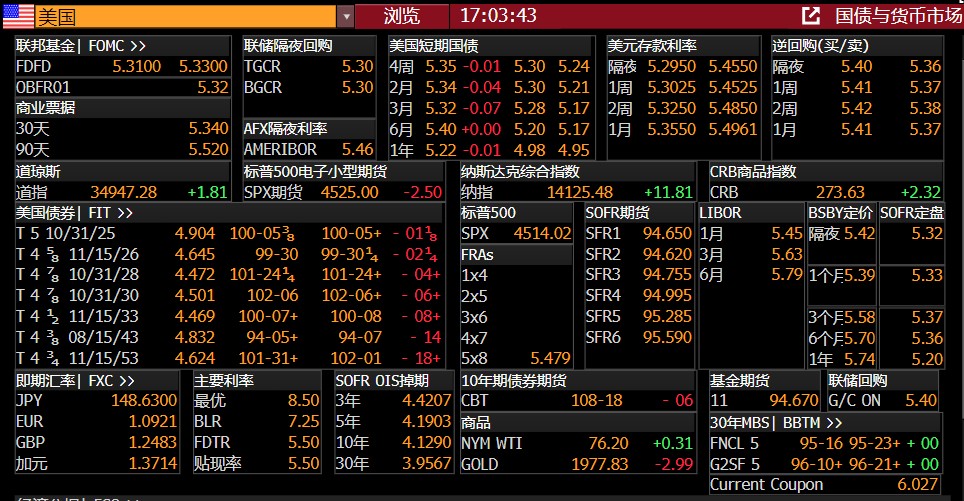
For example, a Tokyo institutional investor plans to buy US 10-year Treasury bonds at an exchange rate of 111.46 yen per dollar and simultaneously hedges with a forward contract to sell at an exchange rate of 111.15 yen per dollar three months later. This results in a hedging cost of 0.31 yen per dollar or 0.27% over three months for the institutional investor. In fact, during this period, the USD/JPY fell by 5.4% to 105.4, resulting in an annualized cost of about 1.11%, corresponding to a 1.85% yield on US Treasuries according to the forward curve.
Cost Accounting of Carry Trading
If investing in US Treasuries, institutional investors typically adopt a fixed exchange rate for dollar interest income. Before 2008, the existence of cross-border arbitrage meant that the borrowing costs of US dollars through direct borrowing in the onshore short-term interest rate market and through currency swap agreements were basically the same, with interest rate parity theory perfectly governing the financial market; however, the 2008 financial crisis caused a divergence between onshore and offshore markets.
As a result, the cost of converting the returns into another currency will be determined by the cross-currency basis swap.
Taking Japanese institutional investors as an example, in fact, only three financial institutions (Mitsubishi, Mitsui, and Mizuho) can participate in directly borrowing US dollars in the US onshore short-term interest rate market. Other financial institutions (insurance and savings institutions) can only obtain US dollar financing through swap agreements with brokers (yen-dollar swap operations), which allows their counterparties to receive dollar interest income Self-obtaining yen interest income), due to Japan's negative interest rate level, these Japanese institutional investors are actually paying to borrow the principal in yen.
At the same time, due to the positive interest rate level in the United States and the negative interest rate of the Bank of Japan, Japanese financial institutions incur additional costs of interest rate differentials when borrowing dollars through foreign exchange swaps, known as the "USDJPY Cross Currency Basis Swap," plus the SOFR rate.
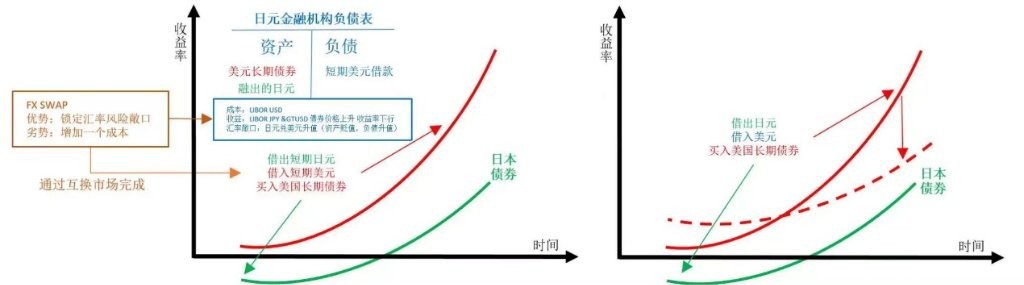
Yen holders arbitrage U.S. bonds
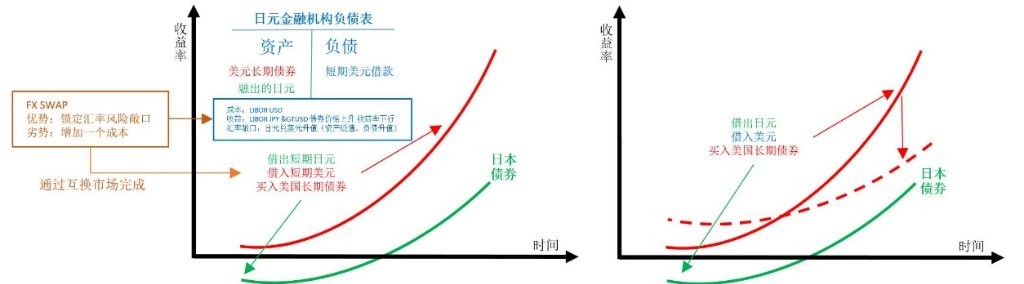
Due to the low domestic yields in Japan, Japanese institutional investors still need to purchase overseas bonds to pursue positive yields. Yen holders buy long-term U.S. bonds by borrowing yen and converting it into dollars. As previously mentioned, a large number of yen holders (Japanese financial institutions, pension social security, insurance savings, etc.) can only complete the borrowing of yen and conversion into dollars through swap transactions. As the cost of the cross-currency basis swap continues to rise (increasing negative values) and the dollar SOFR rate continues to rise, it continuously erodes the profits of yen holders' arbitrage. The returns from carry trading are basically subsidized to dollar liquidity. Japanese investors face high hedging costs when purchasing overseas bonds, especially the real yield of U.S. bonds declines, forcing Japanese investors to make adjustments in terms of duration, opting to buy some longer-term U.S. bonds, thereby lowering the long-term yield of U.S. bonds.
Dollar holders arbitrage Japanese bonds
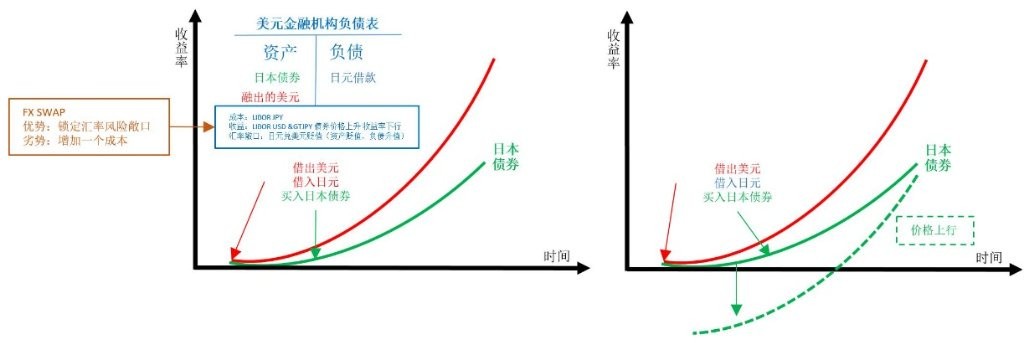
Due to the super negative interest rates and loose policies of the Bank of Japan injecting ample liquidity into the market, the overall yield of yen bonds has been suppressed. On one hand, this forces yen funds to pursue global high yields comprehensively (as mentioned above), while on the other hand, it also provides dollar holders with a speculative opportunity to arbitrage Japanese bonds.
The BLOOMBERG index【.JGB3MUSD INDEX】is used to measure the investment return level for dollar holders who lend dollars through basis swaps, convert into yen, and buy Japanese bonds of the same maturity (not considering cross-period).
Where is the critical value for arbitrage trading? Arbitrageurs do not make money, and the funds driven by arbitrage behavior stop.
When the cost of hedging continues to rise and the yield from arbitraging U.S. Treasuries approaches zero, arbitrage will cease, and even reverse trading behavior may occur.
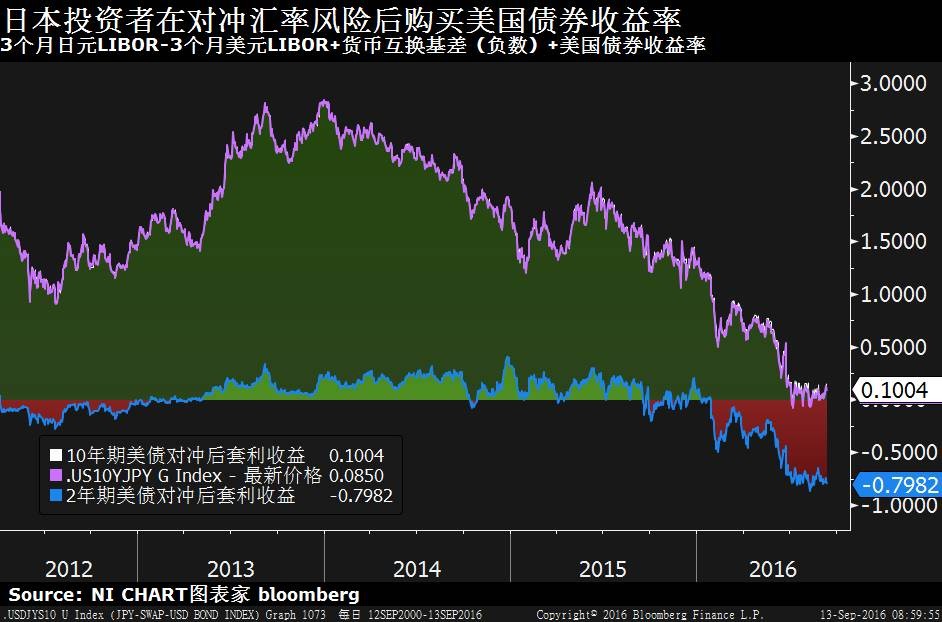
Here we review the case of the interest rate arbitrage critical point in 2016. We can clearly see that after July 2016, Japanese investors, through arbitrage, had driven the yield on U.S. 10-year Treasuries down to zero, while short-term Treasury purchases were already in a loss position, widening to -0.8. This situation also occurred in 2005-2006, which means that if Japanese investors, after hedging risks, find that the 10-year U.S. Treasuries no longer have any investment value, continuing to arbitrage and purchase U.S. Treasuries would mean taking on leverage risk without any yield, as all returns would be swapped to the dollar providers.
At this point, for yen holders, they essentially have to either choose a longer duration, which would face liquidity issues due to the limited supply of long-term U.S. Treasuries, or opt for increased credit risk to enhance yields.
However, for the arbitrage buying of U.S. Treasuries, when even the 10-year bonds start to become unprofitable, it signifies the critical point of the entire game.
At that time, the European and Japanese central banks were the main providers of global liquidity. The significant increase in asset interconnectivity was due to central banks purchasing assets and injecting ample liquidity into the market, which suppressed yields, leading to a widespread pursuit of high yields. The yields in Europe and Japan further lowered U.S. yields, with central banks acting as providers of Carrying trading. Once central banks prepare to stop expanding their balance sheets or begin to shrink them, it marks the starting point of the global music coming to an end.
Risk Warning and Disclaimer
The market has risks, and investment requires caution. This article does not constitute personal investment advice and does not consider individual users' specific investment goals, financial situations, or needs. Users should consider whether any opinions, views, or conclusions in this article align with their specific circumstances. Investing based on this is at one's own risk
