


Demand for Japan's 30-year government bond auction hits a new high since 2019, as interest rate hike expectations continue to rise

The bid-to-cover ratio for Japan's 30-year government bonds reached 4.04 times, far exceeding last year's average of 3.35 times, with the yield rising to the highest level since 1999 at 3.445%. Strong demand is driven by the attractiveness of high yields and expectations that the government may reduce the issuance of ultra-long bonds
Despite ongoing concerns about Japan's finances, high yields have attracted investors, with the auction of 30-year Japanese government bonds receiving the strongest demand since 2019.
On Thursday, the results of the 30-year bond auction showed a bid-to-cover ratio of 4.04, significantly higher than November's 3.125 and the average of 3.35 over the past 12 months.
Additionally, another strong demand signal was the tail difference narrowing to 0.09, down from 0.27 last month. The tail difference refers to the gap between the average price of government bonds and the lowest successful bid price; a smaller figure indicates that investor bids are more concentrated and demand is more stable.
Thursday's Japanese bond auction continued the strong performance of the 10-year bond auction on Tuesday, when yields reached attractive levels, prompting buyers to flock in. The 10-year benchmark government bond yield has touched 1.91%, the highest level since 2007.
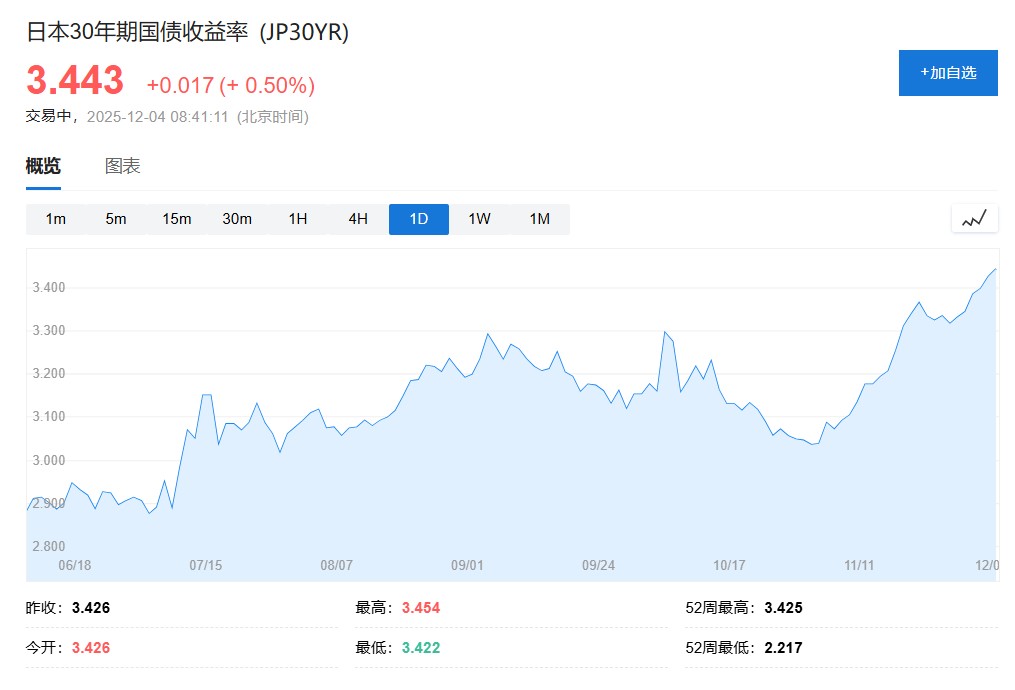
Wallstreet.cn reported that as market expectations for a rate hike by the Bank of Japan in December have surged, Japanese government bond yields have soared to multi-decade highs. The latest market data shows that the yield on 30-year Japanese government bonds rose by 2.5 basis points to 3.445%, marking the highest level since the issuance of this maturity bond in 1999.
The hawkish remarks made earlier this week by Bank of Japan Governor Kazuo Ueda have significantly heightened market expectations for a rate hike. The swap market currently indicates an approximately 80% probability of a rate hike at the policy meeting on December 19, with a probability exceeding 90% for a hike in January, compared to just 56% a week ago for a December hike.
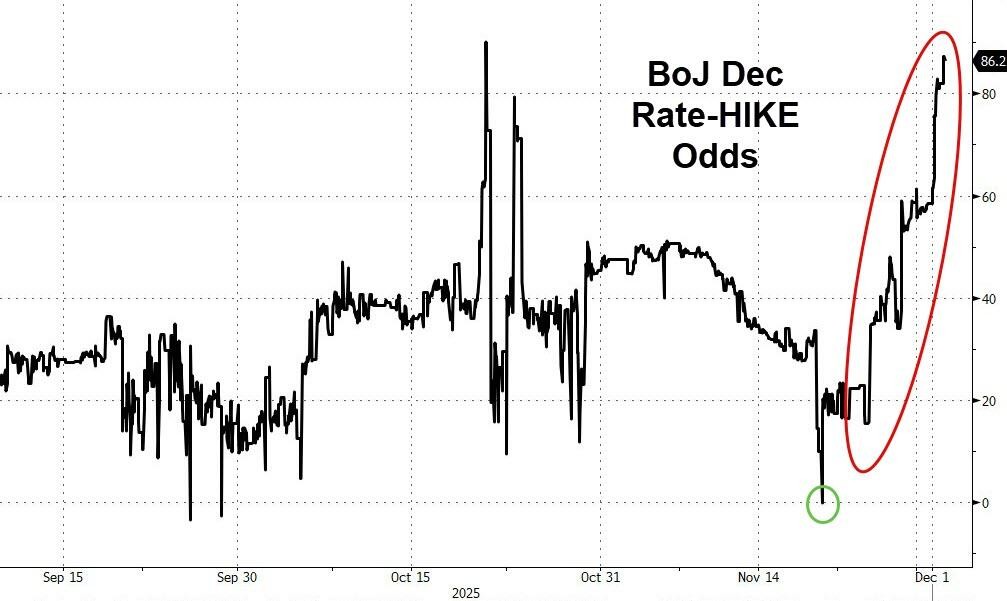 (Probability of Bank of Japan rate hike exceeds 80%)
Strong demand for bonds is also supported by expectations that the government may reduce the issuance scale of ultra-long-term bonds, as investors await the Ministry of Finance's statements on specific arrangements for the next fiscal year's budget.
Attention on Bond Issuance Plans
Investors are closely monitoring the government's budget details for the next fiscal year, particularly plans to further reduce the issuance of ultra-long-term bonds.
According to Bloomberg, major Japanese dealers requested the Ministry of Finance last week to cut the issuance scale of such bonds.
The Ministry of Finance has announced plans to increase the issuance of short-term bonds to fund Prime Minister Kishida Fumio's economic stimulus plan.
This plan will increase the issuance amount for 2-year and 5-year bond auctions by 300 billion yen (approximately $1.93 billion) and will increase the supply of treasury bills by 6.3 trillion yen. The increase in short-term bond supply may create room for a reduction in the issuance scale of ultra-long-term bonds.
Hawkish Signals Ignite Rate Hike Expectations
The catalyst that ignited market expectations was the speech by Bank of Japan Governor Kazuo Ueda on December 1st.
He unusually mentioned the upcoming monetary policy meeting scheduled for December 18-19 and stated that decisions would be made "as appropriate." According to Morgan Stanley's analysis, it is "extremely unusual" for a central bank governor to directly name the next meeting and hint at decisions in a routine speech, which is a strong signal.
Kazuo Ueda stated that the "confidence in achieving economic outlook is gradually strengthening," and the conditions supporting policy normalization are improving.
He believes that despite recent negative GDP data, this is merely a "temporary" technical adjustment, and the economy is still in a mild recovery. At the same time, he emphasized that uncertainties surrounding the U.S. economy have decreased, reducing external resistance for the Bank of Japan to take action.
Regarding wage growth, which is a key prerequisite for rate hikes, Ueda assessed that the "initial momentum" of wage negotiations next spring is improving.
He pointed out that the transmission of wages to sales prices is still ongoing, suggesting that potential inflation trends may be undergoing a lasting change, paving the way for the end of negative interest rate policies
