


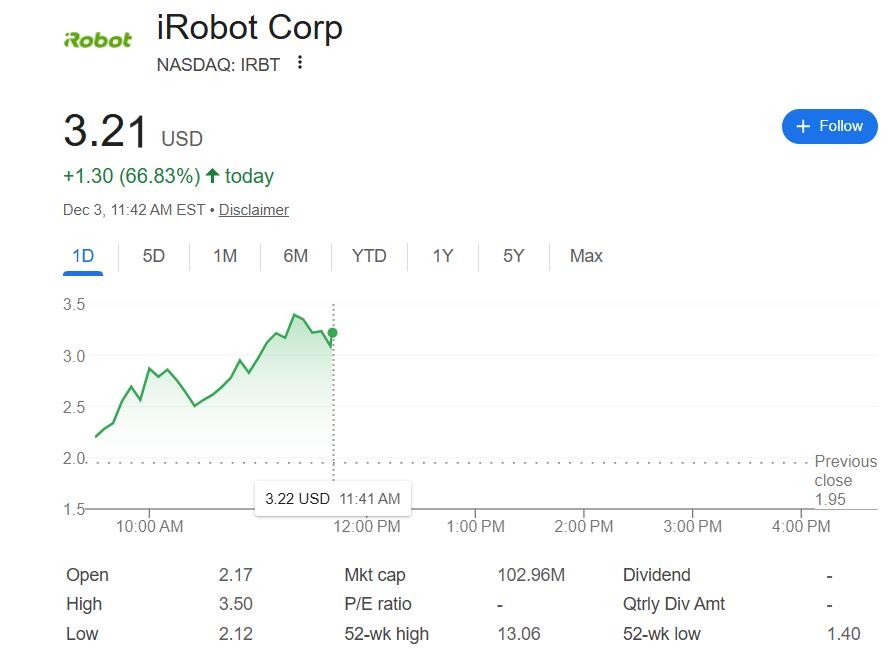
Trump administration All in! It is reported that it is considering issuing an executive order on robots next year, and iRobot surged nearly 80% during the trading session

The Trump administration is promoting the development of the robotics industry and is considering issuing an executive order on robotics next year. This move has driven related concept stocks to surge, with iRobot's stock price soaring nearly 80% during trading. The U.S. Department of Commerce has confirmed its commitment to the robotics industry, emphasizing its importance to American manufacturing. The U.S. Department of Transportation plans to establish a robotics working group, and Congress is also pushing for related legislation. The robotics industry has become a new frontier for competition between the United States and other economies
The news of the Trump administration's push for the development of the robotics industry has driven related concept stocks to surge during trading.
On Wednesday, December 3rd, Eastern Time, media reports indicated that U.S. Secretary of Commerce Gina Raimondo has been frequently meeting with CEOs in the robotics industry, expressing "full support" for the industry's accelerated development, and mentioned that the Trump administration is considering issuing an executive order on robotics next year. This news suggests that, following artificial intelligence (AI), the robotics industry is becoming the next major battleground for competition between the U.S. and other major economies globally.
In early trading on Wednesday, U.S. stocks saw iRobot (IRBT) shares soar, reaching an intraday high with a gain of over 79%, leading the robotics sector. Tesla's stock rose by as much as 3.5%, Serve Robotics (SERV) surged over 9%, Richtech Robotics (RR) increased by more than 7%, WeRide (WRD) rose nearly 5%, and Teradyne (TER) gained over 2%.
The aforementioned reports stated that a spokesperson for the U.S. Department of Commerce confirmed the commitment to the robotics industry, stating, "We are committed to robotics and advanced manufacturing because they are crucial for bringing critical production back to the U.S." This comes five months after the Trump administration announced its AI acceleration plan, marking another commitment to a high-tech industry.
Trump Administration Promotes Robotics Strategy Across Multiple Departments
Media reports on Wednesday cited informed sources indicating that the U.S. Department of Transportation is preparing to announce the establishment of a robotics working group, which may be revealed by the end of the year.
Interest in the robotics industry is also growing in the U.S. Congress. Republican lawmakers have proposed an amendment to revise the National Defense Authorization Act (NDAA) to establish a national robotics committee. Although this amendment was not included in the final bill, other legislative efforts are underway.
This series of actions indicates that robotics is becoming an important frontier in the competition between the U.S. and other major economies. This is the latest example of the Trump administration embracing industrial policy and attempting to compete in critical areas such as AI.
According to the International Federation of Robotics, as of 2023, China has 1.8 million industrial robots in its factories, four times that of the U.S. China, Japan, Australia, Germany, and Singapore have all developed national robotics plans.
Massive Investments Pouring In
The U.S. needs significant investment to catch up with other economies in the robotics industry. According to CB Insights, funding in this sector is expected to reach $2.3 billion by 2025, double that of last year. Goldman Sachs estimates that the global humanoid robot market could reach $38 billion by 2035.
The robotics industry has been pushing for government officials and legislators to get involved. The industry hopes to secure tax incentives from the U.S. government or federal grants to help businesses integrate advanced automation technologies, strengthen supply chains, and achieve large-scale deployment. They also seek to address foreign subsidies and intellectual property practices through trade policies The CEO of the U.S. humanoid robot startup Apptronik, Jeff Cardenas, whose valuation is $5 billion, stated: "We must get involved and consider formulating a national robotics strategy to support this emerging industry in the U.S. to remain competitive."
The general-purpose robot Apollo developed by Apptronik is one of the first humanoid robots operating in automotive factories. The company announced the completion of a $350 million Series A funding round in February this year, with investment from Google.
Tech Giants Bet on "Physical AI"
According to media reports, the aforementioned report on Wednesday described the Trump administration's support for the robotics industry as a shift in the White House's focus from AI to robotics, but essentially, it is an extension of the same theme. Leading companies in the AI field, such as NVIDIA, are heavily investing in "physical AI," which is essentially a term for the core technologies behind robotics and autonomous driving.
The CFO of SoftBank made it clear last month that the company's liquidation of $5.8 billion in NVIDIA shares in October was "not related" to the chip designer itself. SoftBank CEO Masayoshi Son elaborated on his views earlier this week: it is not mechanical robots that will change the world, but "physical AI embodied in robots."
At the FII Priority Asia forum on Monday, Masayoshi Son stated that selling NVIDIA shares made him "cry." He said: "I wish I had unlimited funds. I have great respect for Jensen (NVIDIA CEO Jensen Huang) and great respect for NVIDIA; I didn't want to sell a single share. I just needed funds more to invest in OpenAI and other opportunities, so I cried while selling NVIDIA shares. If I had more money, I would certainly want to keep holding NVIDIA shares."
SoftBank needs to pay $22.5 billion to OpenAI by the end of the year to increase its stake in the ChatGPT developer. SoftBank's AI plans also include significant investments in OpenAI and data center site selection as part of the Stargate project.
Masayoshi Son also rebutted critics who believe that the influx of funds into AI is a bubble, stating that they are "not smart enough." He believes that within the next decade, AI will be much smarter than humans, and "at least 10%" of global GDP will be replaced by superintelligent and physical AI robots. If it requires $10 trillion in investment to achieve this goal, the related cumulative capital expenditure will break even in just six months.
Musk: Robots are the Only Way to Solve the Debt Crisis
Tesla CEO Elon Musk stated in a podcast released last Sunday that he believes AI-driven robots improving productivity and output is the only way to solve the over $38 trillion U.S. debt.
Musk said:
"I think this is almost the only way to solve the U.S. debt crisis because the current U.S. debt is outrageous. The interest on the debt payments exceeds the entire U.S. military budget—just the interest payments, and it will continue to increase at least in the short term."
"So I believe that the only thing that can actually solve the debt problem is AI and robots."
Elon Musk stated that since AI and robots could lead to a significant increase in output, it is likely to result in deflation—opposite to inflation, which would lead to a decrease in price levels. He said, "If you have AI and robots, along with a significant increase in the output of goods and services, you might experience deflation. This seems quite likely. Because you simply cannot increase the money supply at the same rate as the growth in goods and services output."
When asked about the current inflation level in the U.S., which is still above the Federal Reserve's target of 2%, Musk stated that AI has not yet sufficiently improved productivity to cause deflation. He said, "AI has not yet had enough of an impact on productivity to make the growth of goods and services outpace the money supply. The U.S. is significantly increasing the money supply with a deficit of about $2 trillion, so you have to ensure that the growth of goods and services output exceeds that number to avoid inflation."
Musk estimated that within about three years or less, the growth of goods and services will surpass the growth of the money supply, at which point AI and robotic technology will reshape the economy and monetary system, and right now "we are not there yet."
He said, "I think at some point, if you have AI and robots producing chips and solar panels, mining resources to make chips and robots... once you complete that cycle, I think that is the moment you decouple from the monetary system."
Risk Warning and Disclaimer
The market has risks, and investment requires caution. This article does not constitute personal investment advice and does not take into account the specific investment goals, financial situation, or needs of individual users. Users should consider whether any opinions, views, or conclusions in this article are suitable for their specific circumstances. Investing based on this is at your own risk
