


Global markets temporarily catch a breather? Bitcoin halts its decline and the Japanese bond auction eases liquidity concerns

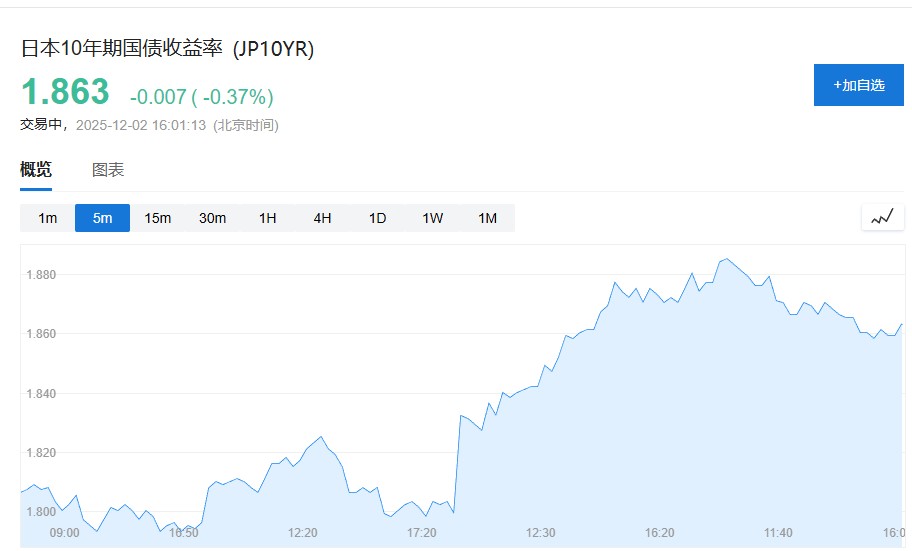
The Japanese 10-year government bond auction became the key to market stabilization on Tuesday. Before the auction, the benchmark government bond yield reached 1.88%, a 17-year high, which attracted investors including pension funds. Bitcoin also stabilized and rebounded, rising 0.7% to surpass the $87,000 mark. The strong demand for Japanese government bonds and the stabilization of the cryptocurrency market together alleviated investors' concerns about liquidity tightening
After experiencing a wave of sell-offs earlier this week, the global stock and bond markets stabilized on Tuesday, with strong demand in Japan's government bond auction and a rebound in the cryptocurrency market easing investors' concerns about liquidity tightening.
On Tuesday, the auction of Japan's 10-year government bonds attracted robust demand, including from pension funds, which warmed sentiment in the Asian markets. Bitcoin rose 0.7% to $87,053.6, and Ethereum increased 0.5% to $2,806.78, halting a previous decline of over 5%.
The yen stabilized against the dollar, and the Japanese stock market saw slight gains. The benchmark Nikkei 225 index and the Topix index both rose 0.1%, while the yen weakened slightly by 0.1% against the dollar. Other Asian markets performed steadily, with the Hong Kong Hang Seng Index flat, the China CSI 300 index up 0.5%, and the South Korean Kospi index up 1.7%.
Market volatility stemmed from statements by Kazuo Ueda, leading investors to believe that the Bank of Japan would raise interest rates for the first time in nearly a year. This pushed Japanese bond yields to multi-year highs and affected global bond markets, triggering sell-offs in risk assets like Bitcoin.
Japanese Bond Auction Stabilizes Market Sentiment
The auction of Japan's 10-year government bonds was key to the market's stabilization on Tuesday. Before the auction, the benchmark bond yield reached 1.88%, a 17-year high, attracting investors, including pension funds, due to this relatively high yield level.
Shoki Omori, chief strategist at Mizuho Securities, stated, "The market seems to believe that (a rate hike in December) is basically a done deal." Speculation about a potential rate hike by the Bank of Japan drove shares of major Japanese banks higher. Shares of Japan's largest bank, MUFG, rose 2.5% on Tuesday, while its biggest competitor, SMFG, closed up 3%.
Kazuo Ueda's remarks pushed Japanese government bond yields to multi-year highs—bond yields move inversely to prices—and triggered declines in other global bond markets. Higher yields on safe assets led to a drop in Bitcoin prices of over 5%.
Cryptocurrency Market Stabilizes
After a significant decline earlier, the cryptocurrency market stabilized on Tuesday. Bitcoin briefly rose 0.7% to $87,000, and Ethereum increased 0.5% to $2,806.78. This rebound alleviated market concerns about liquidity in risk assets.
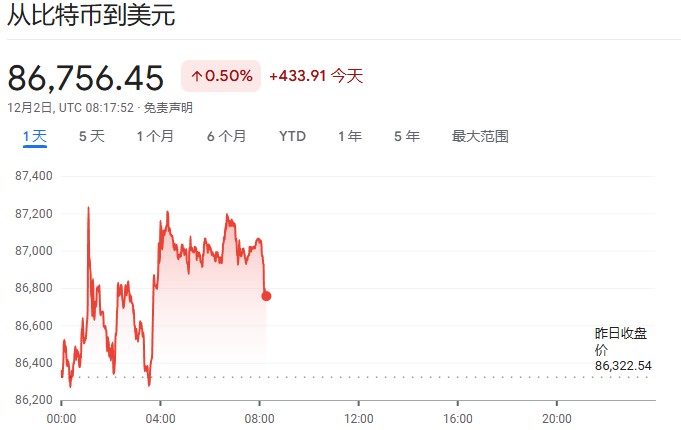
On Monday, Bitcoin's price fell over 5%, primarily influenced by rising Japanese bond yields pushing safer asset yields higher. As the cryptocurrency market returned to calm, global market tensions eased.
Yen Weakness Increases Pressure for Central Bank Rate Hike
The yen continued to weaken against the dollar, and analysts believe this will increase the likelihood of a rate hike by the Bank of Japan in December. Neil Newman, a strategist at Astris Advisory Japan, noted, "We are facing a situation where the Japanese Ministry of Finance has signaled it is ready to intervene to support the yen if necessary, while there are signs that small and medium-sized enterprises are feeling pressure from high input costs due to currency weakness." "I believe the Bank of Japan must take action in December."
In the two months since the new Prime Minister Sanae Takaichi took office, the yen has steadily declined, coupled with recent sharp fluctuations in Japanese government bond yields, raising market speculation about the unwinding of so-called "yen carry trades." Carry trades refer to the strategy of borrowing yen at low cost to invest in other assets.
However, JP Morgan senior economist Benjamin Shatil stated that there seems to be no direct catalyst currently leading to this unwinding, and the low volatility of the yen suggests that investors may still be increasing their yen carry trade positions
