


Morgan Stanley: Humanoid robots are "overheated in the short term and underestimated in the long term," with commercialization being the key to victory or defeat

Morgan Stanley believes that although orders in the Chinese market will exceed 2 billion yuan in the second half of 2025, there is uncertainty regarding deliveries; in the long term, the bank predicts that the global market size will reach 5 trillion dollars by 2050, with a stock of about 1 billion units, far exceeding the current automotive industry potential. In China, approximately 187 billion yuan in policy funds is driving industry development, while software capabilities and commercial ROI will become the key competitive factors
The humanoid robot industry is at a contradictory crossroads, with market sentiment oscillating between short-term speculation and long-term immense potential.
According to news from the Chasing Wind Trading Desk, investment bank Morgan Stanley pointed out in its latest industry outlook report that the humanoid robot sector exhibits a distinct characteristic of being "overhyped in the short term, but undervalued in the long term."
On one hand, short-term market sentiment is high, with impressive order data, but there are hidden risks of delivery uncertainty behind it. On the other hand, its long-term potential is severely underestimated, with Morgan Stanley predicting that by 2050, the global market size could reach $5 trillion, far exceeding the current automotive industry.
The report believes that although the industry is developing rapidly, the commercialization landing will be the key factor determining future success or failure, and it will also serve as a touchstone for verifying the industry's true value.
Short-term Overheating: Real Tests Behind Order Surge
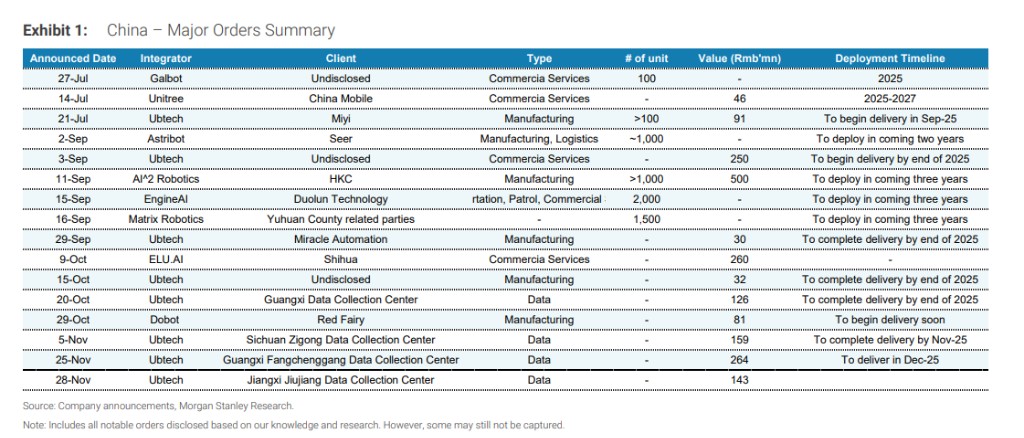
The report points out that the Chinese market is showing astonishing heat in the second half of 2025, with the total order amount announced by integrators exceeding 2 billion yuan (approximately $300 million), mainly from three sectors: industrial, commercial services, and data centers.
However, there are concerns behind the glamorous numbers. Morgan Stanley emphasizes, "Although the headlines are eye-catching, we acknowledge that many orders will not be fulfilled this year, and some are merely 'framework orders' with low execution certainty."
This phenomenon is accompanied by aggressive shipping targets from industry companies—some enterprises expect to ship 100,000 units by 2026. In contrast, Morgan Stanley holds a more conservative estimate of recent growth based on "limited working capacity."
Long-term Undervaluation: The Grand Narrative of a $5 Trillion Market
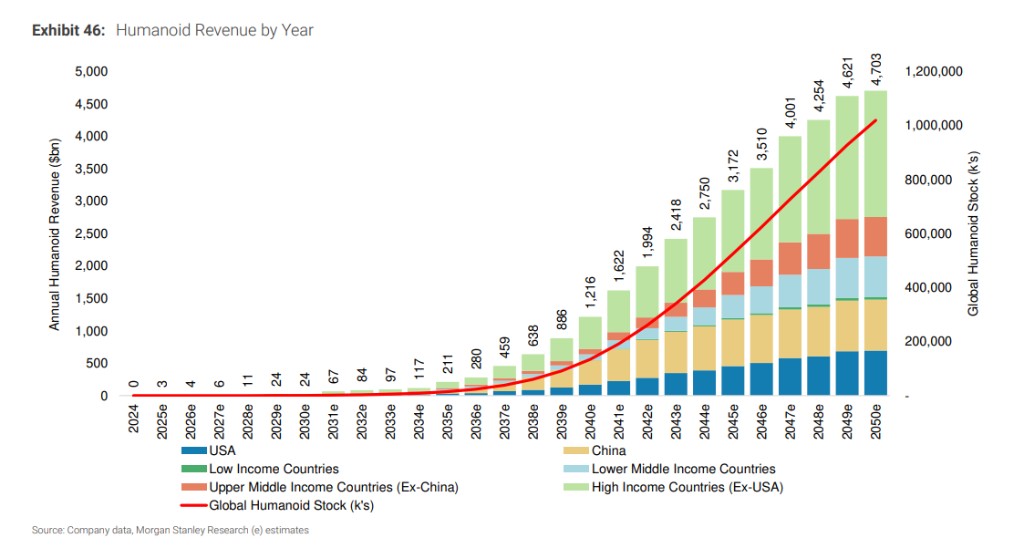
In stark contrast to the short-term uncertainties, the long-term market space for humanoid robots is vastly underestimated. Morgan Stanley's Total Addressable Market (TAM) model provides a shocking prediction: by 2050, the global stock of humanoid robots will reach 1 billion units, with an annual revenue market size approaching $5 trillion.
What does this mean? The report compares that the total revenue of the top 20 global automotive manufacturers in 2024 is approximately $2.5 trillion. This means that the long-term market size for humanoid robots could be twice that of the current global automotive industry.
Specifically, the report predicts:
-
By 2036, the cumulative deployment globally will be approximately 23.7 million units.
-
By 2040, this number will leap to 134 million units.
-
By 2050, the stock in the Chinese market alone will exceed 302 million units, with high-income countries (including the United States) holding approximately 296 million units.
This grand long-term narrative is the core cornerstone supporting the long-term investment value of this sector.
 In terms of price, the report assumes that the initial selling price of robots in high-income countries will be $200,000, dropping to about $50,000 by 2040; while the initial selling price in other markets is about $50,000, expected to fall to around $15,000 by 2050. The continuous decline in costs will be key to driving their transition from industrial to commercial and even household applications.
Morgan Stanley believes that as technology matures and costs decrease, humanoid robots will first become popular in the commercial sector, followed by households. The report predicts that by 2050, commercial applications will account for the vast majority, approximately 935 million units, while household applications will be around 84 million units. This grand vision is the fundamental reason attracting numerous tech giants and startups to invest in this field.
Commercialization Landing: From "Flexing Muscles" to "Calculating ROI"
The report clearly points out that the key to the current industry's development lies in successful commercialization. Industry participants are increasingly reaching a consensus: "In industrial environments, the form factor of robots becomes less important; return on investment (ROI) is the key metric, driven by efficiency, accuracy, and cost."
This means that the phase of merely showcasing technological advancement ("flexing muscles") is coming to an end, and the ability to create value for customers in real scenarios ("calculating ROI") has become the only standard for evaluating companies.
There are already some positive commercialization cases:
-
Figure AI: Its Figure 02 robot has participated in the production of 30,000 cars on the production line of BMW Group's Spartanburg factory over the past six months, installing over 90,000 components in total.
-
Booster Robotics: Since its establishment in August 2023, it has delivered over 700 humanoid robots to more than 200 customers in over 20 countries worldwide.
-
UBTECH ROBOTICS: It is expected that by 2026, its production capacity for industrial humanoid robots will reach 5,000 units.
The report also emphasizes that software will be the "key competitive differentiator," while the hardware supply chain (excluding reducers) has basically achieved domestic production (over 90%), providing a foundation for commercialization.
Ambitions of Chinese Humanoid Robots
The development of the Chinese market has been strongly driven by policies and capital. The report outlines that since 2023, a series of supportive policies have been introduced from the central to local levels. Recently, the Ministry of Industry and Information Technology of China established a standardization technical committee for humanoid robots.
According to The Paper, on November 24, the official website of the Ministry of Industry and Information Technology of China announced that Wang Xingxing from Yushu Technology Co., Ltd. and Peng Zhihui from Zhiyuan Innovation (Shanghai) Technology Co., Ltd. are proposed to be the deputy chairmen of the humanoid robot standardization technical committee.
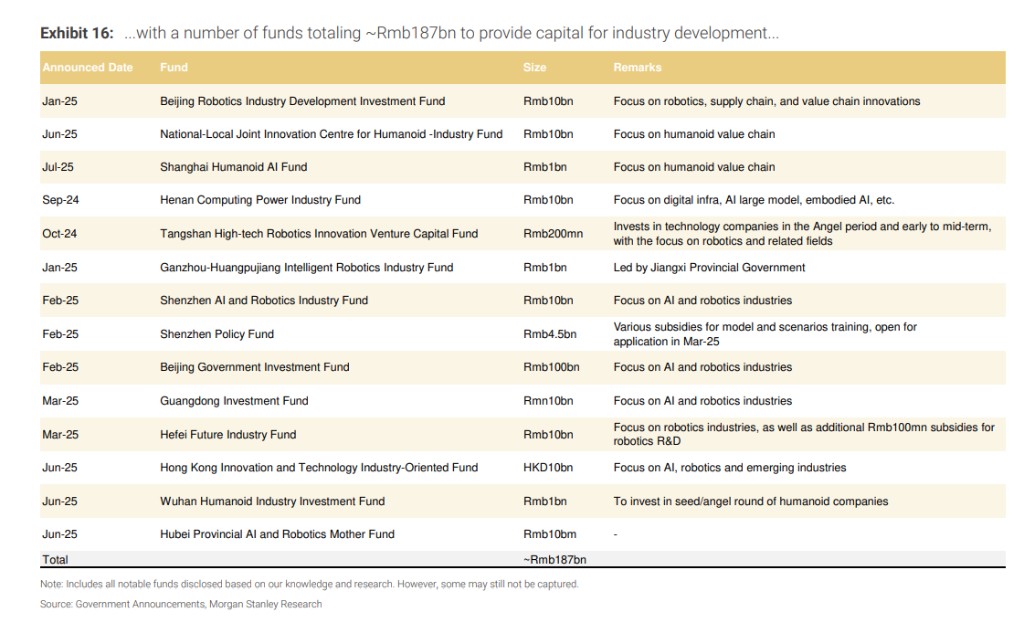
What is even more noteworthy for investors is the financial support. The report statistics show that multiple related funds have been announced across various regions, with a total scale reaching approximately 187 billion RMB, providing ample capital ammunition for industrial development. In the primary market, the financing competition is also exceptionally fierce, with Unitree and Leju racing towards IPOs, while listed companies like UBTECH ROBOTICS and Dobot are vertically integrating investments through placements This "policy + capital" dual-driven model provides China with a unique advantage in the global humanoid robot competition and indicates that the industry will accelerate its transition from the technology exploration phase to the commercialization phase.
Morgan Stanley's latest report reveals the contradictory situation of the humanoid robot market being "overheated in the short term, undervalued in the long term." For investors, the key lies in penetrating the short-term order data exceeding 2 billion RMB, which contains "water," and focusing on commercialization and ROI verification. Despite facing real challenges, the report predicts that the global market size will reach 5 trillion USD by 2050, indicating significant potential. In China, approximately 187 billion RMB in policy funds and an active capital market are strongly driving industry development, with software capabilities becoming the ultimate decisive factor.
The above exciting content comes from [Zhui Feng Trading Platform](https://mp.weixin.qq.com/s/uua05g5qk-N2J7h91pyqxQ).
For more detailed interpretations, including real-time analysis and frontline research, please join the【 [Zhui Feng Trading Platform ▪ Annual Membership](https://wallstreetcn.com/shop/item/1000309)】
[](https://wallstreetcn.com/shop/item/1000309)