


The Federal Reserve's "market rescue" becomes a turning point! In the last week of November, various assets "strongly rebounded."

In the last week of November, the S&P 500 index rose 3.7%, marking the best "Thanksgiving week" performance since the 2008 Lehman crisis. Additionally, U.S. Treasuries, commodities, and cryptocurrencies all experienced a strong rebound this week. The turning point stemmed from the dovish statements made by Federal Reserve officials. Analysts pointed out that ample liquidity has built a "safety net" for the market, and the "dual put options" from the Treasury and the Federal Reserve effectively block the space for systemic declines
After experiencing turmoil at the beginning of the month, the financial markets staged a broad-based rebound in the last week of November.
This week, as expectations for a Federal Reserve rate cut in December heated up, nearly all asset classes, including U.S. stocks, U.S. bonds, commodities, and even cryptocurrencies, rose in unison, sweeping away previous concerns about the AI bubble and economic growth.
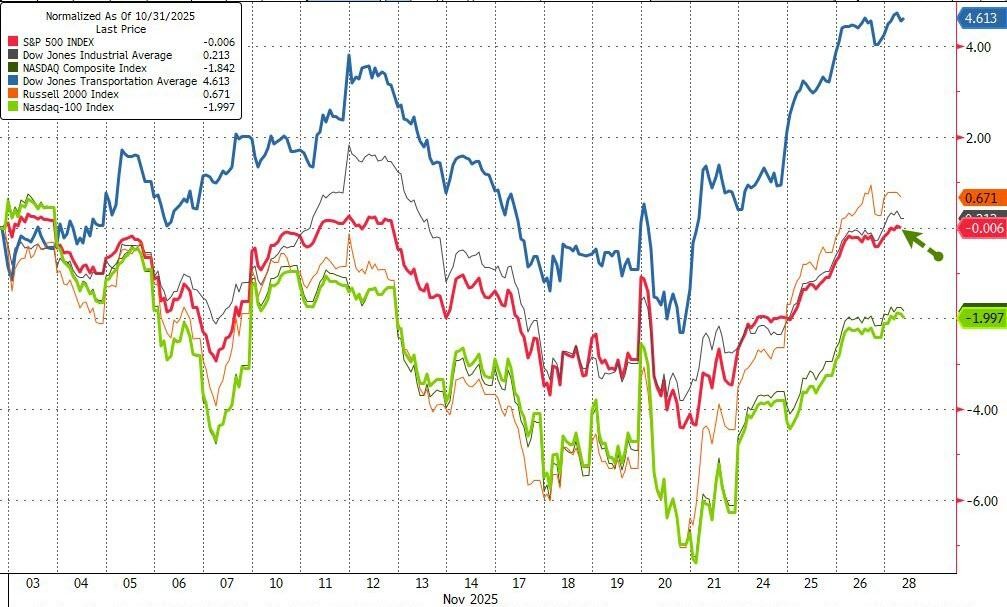 (The performance of the U.S. stock benchmark index in November, with the S&P 500 rebounding significantly from mid-month declines, ultimately closing roughly flat)
The key turning point in the market occurred last Friday, as Wall Street Journal mentioned that New York Fed President Williams adopted a dovish stance, causing market bets on the probability of a December rate cut to rise from about 30% to 50%. Subsequently, “Powell's allies” voiced support for a rate cut, and market expectations for a Federal Reserve rate cut in December surged to 80%.
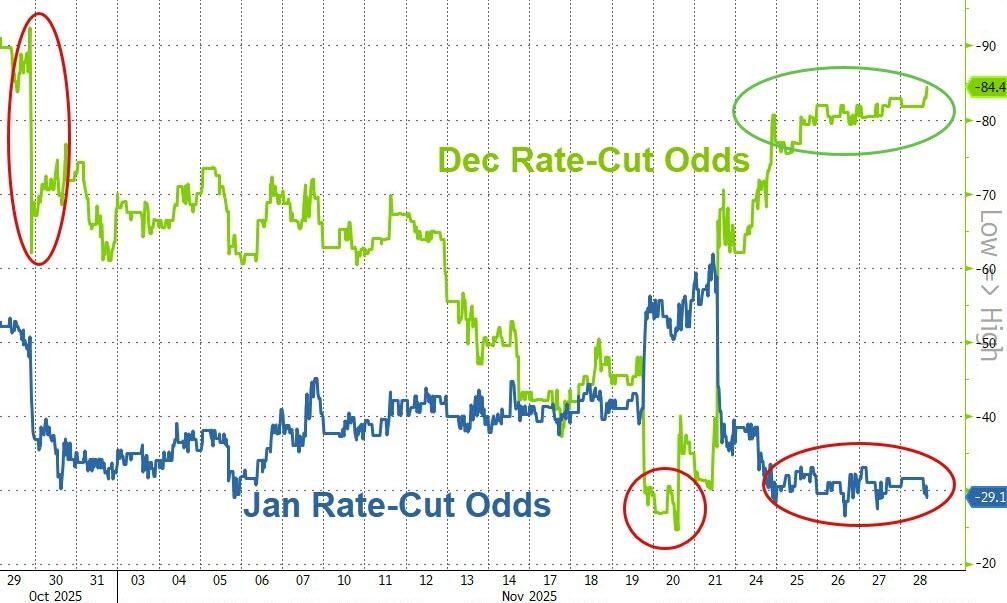 (Green line: Probability of a Federal Reserve rate cut in December vs. Blue line: Probability for January next year)
Analysts believe that although the internal structure of global assets is still adjusting, ample liquidity provides a solid bottom for risk assets, effectively limiting the space for systemic declines.
"Broad-based Rebound" Sweeps the Holiday Week
During the Thanksgiving holiday week, the market changed from the anxiety of previous weeks, staging one of the strongest cross-asset rebounds of the year.
On Friday, trading on the Chicago Mercantile Exchange was temporarily halted due to a data center failure, but this did not stop the upward momentum. Looking at the specific performance this week:
- The S&P 500 index surged 3.7% this week, marking its best weekly performance in six months and also the best "Thanksgiving week" performance since the 2008 Lehman crisis.
(The best week for the S&P 500 index during Thanksgiving since 2008)
- U.S. Treasury prices rose, with the 10-year Treasury yield briefly falling below the critical psychological level of 4%.
- Bitcoin also rebounded more than 7% from its November lows, rising above $90,000, indicating a significant warming of market risk appetite.
- The Bloomberg Commodity Index rose over 2% during the week, with spot silver and London copper both breaking historical highs.
The dramatic reversal in market sentiment stems from strong expectations for a shift in Federal Reserve policy. Last Friday, the dovish speech by New York Federal Reserve President John Williams was seen as a key turning point. Blake Gwinn, head of U.S. interest rate strategy at RBC Capital Markets, stated:
The market largely viewed Williams' remarks as Powell revealing his cards.
This week, Barclays strategist Emmanuel Cau remarked:
The lesson this week is not to fight the Fed, not to fight AI; this remains a market adage.
He pointed out that with the rising probability of a rate cut in December, stocks and all liquidity-driven markets have rebounded.
J.P. Morgan's client survey also showed that investors' net long positions in U.S. Treasuries have risen to the highest level in about fifteen years.
Previously, concerns over AI valuations had triggered market volatility, but the news of Google's parent company Alphabet releasing its latest AI model and TPU chips helped restore market confidence in the innovation cycle of large tech companies.
This month, NVIDIA was the worst-performing stock in the Tech Seven Index, with a decline of about 13%, marking its worst monthly performance since December 2022. Google, on the other hand, performed strongly.
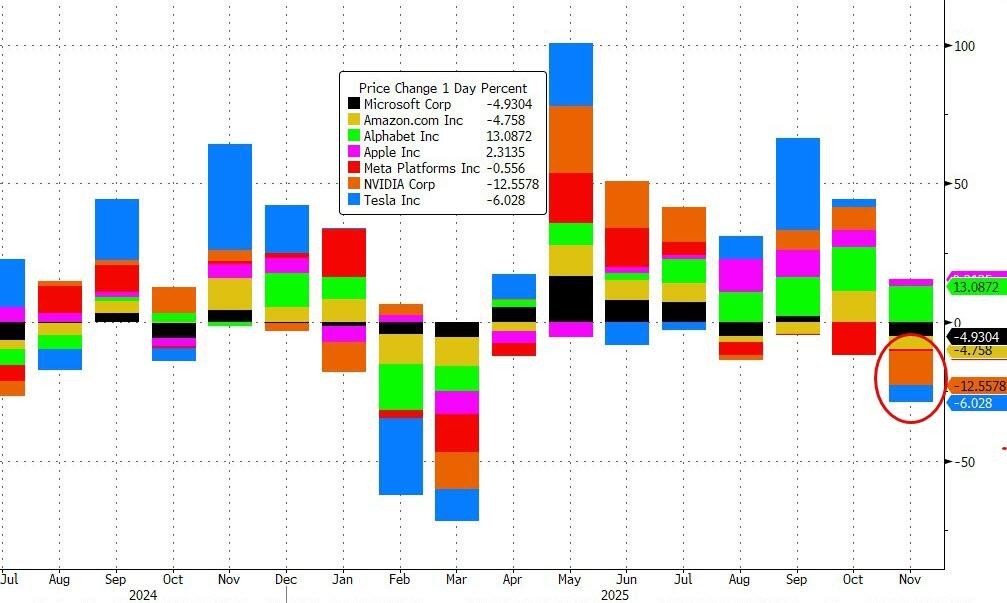 (Google performed strongly in November, leading the Tech Seven)
Predictions Made Early, Tightening Liquidity Forces Policy Shift
Even before this round of rebound, analysts had anticipated that the Fed might be forced to shift.
Wallstreetcn mentioned that Michael Hartnett, chief investment strategist at Bank of America, had pointed out in a previous report that tightening liquidity has impacted multiple asset classes such as cryptocurrencies and credit, releasing signals similar to the market conditions of December 2018, which may force the Fed to shift to easing.
Hartnett believes that the cryptocurrency market is the "canary in the coal mine" for sensing central bank policy shifts, as it is most sensitive to liquidity changes.
He predicts that before the central bank's "market rescue" signals are fully realized, assets like Bitcoin will have already started to surge. The recent rebound in the cryptocurrency market from low levels seems to confirm his viewpoint.
According to Hartnett's analysis, the cumulative rate cuts by global central banks over the past two years have created a liquidity bonanza, directly fueling the AI investment frenzy and cryptocurrency speculation. When the market is pressured by tightening liquidity, it will ultimately force the Fed to repeat its "policy surrender" and initiate a new round of rate cuts.
Bottom Support, Abundant Liquidity Builds a "Safety Net"
At a deeper level, the fundamental reason for the market's rapid rebound lies in the abundant liquidity environment.
Wallstreetcn reported that according to Bloomberg macro strategist Simon White's analysis, **despite the pullback in U.S. stocks in early November, under the support of the "dual put options" provided by the U.S. Treasury and the Fed, a bear market is difficult to form **
White pointed out that the so-called "fiscal put option," which involves the Treasury injecting liquidity into the market through specific bond issuance strategies, is currently countering the Federal Reserve's quantitative tightening.
At the same time, a key indicator of global liquidity—"excess liquidity" (the portion of actual money growth in G10 countries, measured in U.S. dollars, that exceeds economic growth)—is currently in positive territory.
Historical data shows that when this indicator is high and rising, the downside potential for the stock market will be effectively capped.
Therefore, White believes that the current ample liquidity provides a "safety net" for risk assets. While this does not mean that the market will immediately enter a "raging bull market," it suggests that it is unlikely to evolve into a "ferocious bear."
Analysts believe that for investors, this means that while short-term volatility is inevitable, the probability of a systemic collapse is extremely low.
