


Breakfast | US stock market closed, oil prices "flash crash" during trading, gold falls from nearly two-week high

U.S. stock markets are closed, U.S. stock index futures are slightly up, the U.S. dollar index has hit a new weekly low, Bitcoin has risen 2% during the session, approaching the $92,000 mark for the first time in a week. The continuation of the OPEC+ policy to pause production increases has driven a rebound in crude oil for the second day, but the prospects of Russia-Ukraine talks triggered a brief "flash crash" in crude oil during the session, while spot gold has fallen from nearly two-week highs
Market Overview
U.S. stock markets are closed, and U.S. stock index futures are slightly up. The pan-European stock index has risen for four consecutive days, closing slightly higher and reaching a two-week high. After Deutsche Börse revealed acquisition negotiations, the European fund distribution platform Allfunds surged 22%; Puma, which is being considered for acquisition by companies like Anta and Li Ning, rose nearly 19%.
The U.S. dollar index hit a new weekly low, briefly turning positive during the session; the offshore yuan has hit a 13-month high for three consecutive days, but later fell more than 100 points during the session; Bitcoin rose 2% during the session, approaching the $92,000 mark for the first time in a week.
OPEC+ continued its policy of suspending production increases, which drove oil prices to rebound for the second day, but the prospects of Russia-Ukraine negotiations triggered a brief "flash crash" in oil prices. Spot gold fell from a nearly two-week high.
During the Asian session, A-shares and Hong Kong stock indices showed a mixed performance, with the ChiNext and Hang Seng Tech indices retreating after hitting highs. Lithium batteries and solid-state batteries strengthened, the consumer sector surged, Vanke bonds experienced a "roller coaster" market, and platinum-palladium futures debuted with a significant rise.
Key News
The National Development and Reform Commission held a symposium on cost identification for price disorder competition. The NDRC stated that attention should be paid to preventing a high degree of overlap in humanoid robot products being "crowded" onto the market, establishing and improving the entry and exit mechanisms for the embodied intelligence industry, and encouraging the orderly development of various new energy storage and hydrogen energy technology routes.
The State Council Information Office released a white paper: Emerging fields such as outer space, the internet, and artificial intelligence are new high grounds for human development, new focal points for strategic security, and new domains for global governance.
China's profits of large-scale industrial enterprises in October fell by 5.5% year-on-year, with rapid growth in manufacturing and electricity over the first ten months.
The fire in Tai Po, Hong Kong, has largely been extinguished, and all units in the burning building will be searched.
OPEC+ reportedly maintained its decision to suspend production increases in Q1 of next year during a meeting on Sunday. Oil prices rebounded for two days, but Putin confirmed that a U.S. delegation will visit Moscow next week, leading to a brief "flash crash" in oil prices.
Putin publicly discussed a peace plan for the first time, stating that there is no final proposal yet and preparing for "serious" discussions with the U.S. next week; negotiating with the current Ukrainian leadership at this stage is of no practical significance.
NVIDIA is undergoing a full "AI transformation," with some internal staff requesting to "use less AI," to which Jensen Huang reacted strongly: "Are you crazy?"
DeepSeek launched the DeepSeekMath-V2 model, focusing on self-verifying mathematical reasoning capabilities.
Alibaba is entering the AI hardware market, with its first Quark AI glasses starting at 1,899 yuan, equipped with the Qianwen large model and deeply integrated ecological services.
Puma surged nearly 19%, with reports indicating that giants like Anta and Li Ning are considering bidding.
Market Closing Report
U.S. and European Stock Markets: U.S. stock markets are closed. The European STOXX 600 index rose 0.14%, closing at 575.00 points.
A-shares: The Shanghai Composite Index rose 0.29%, closing at 3,875.26 points; the Shenzhen Component Index fell 0.25%, closing at 12,875.19 points; the ChiNext Index fell 0.44%, closing at 3,031.30 points Bond Market: U.S. Treasuries are closed.
Commodities: Brent crude oil futures for January rose by 0.33%, closing at $63.34 per barrel. LME zinc futures fell by about 1.4%, closing at $3,015 per ton. LME aluminum futures fell by about 1.1%, closing at $2,828 per ton.
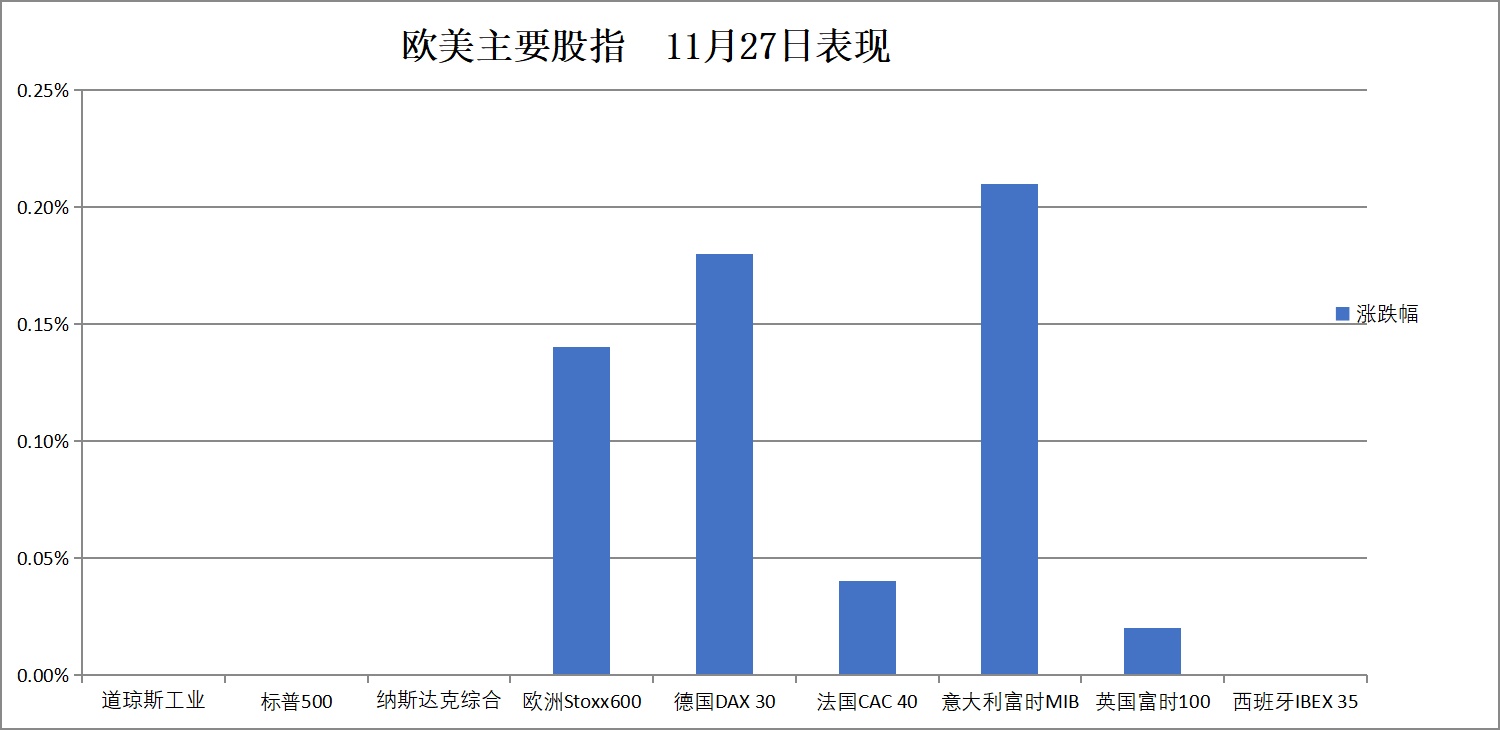
News Details
Global Highlights
National Development and Reform Commission Price Department held a seminar on the identification of costs in price disorder competition. The meeting pointed out that the issue of price disorder competition in some industries remains prominent, with some enterprises failing to implement the requirements for standardized price competition behavior, and even continuing to disrupt market price order. The National Development and Reform Commission will work with relevant departments to continuously promote related work, govern enterprises' price disorder competition, maintain a good market price order, and support high-quality development.
The National Development and Reform Commission: Attention should be paid to preventing a surge in the launch of humanoid robot products with high redundancy, and establish a sound entry and exit mechanism for the embodied intelligence industry. Li Chao, spokesperson for the National Development and Reform Commission, stated that currently, the national new energy storage installed capacity exceeds 100 million kilowatts, which is more than 30 times that at the end of the 13th Five-Year Plan, accounting for over 40% of the global total installed capacity. In the next step, encouraging the orderly development of various new energy storage and hydrogen energy technology routes will provide strong support for building a new power system. Regarding the "two heavy" constructions, 700 billion yuan and 800 billion yuan of ultra-long-term special treasury bonds were arranged last year and this year, respectively.
The State Council Information Office released the white paper "China's Arms Control, Disarmament, and Non-Proliferation in the New Era". The white paper pointed out that outer space, cyberspace, and artificial intelligence are emerging fields that are new high grounds for human development, new focal points for strategic security, and new domains for global governance.
Hong Kong Tai Po Fire: Firefighting has been largely completed, will search all units in the burning building. According to Xinhua News Agency, the Hong Kong Special Administrative Region Government Fire Services Department held a press conference at around 1:20 a.m. on the 28th, stating that the firefighting operation has been largely completed, with four units still being extinguished, and other units being sprayed with water to cool down to prevent rekindling. The Fire Services Department stated that they will enter all units in the seven affected buildings to search, ensuring that no other trapped individuals are inside, and this operation is expected to be completed by 9 a.m. on the 28th.
NVIDIA's entire staff is going "AI", with some internally requesting to "use less AI," Jensen Huang directly exploded: "Are you crazy?" Jensen Huang is strongly promoting the company's full "AI" transformation In response to internal demands for "less use of AI," Jensen Huang angrily exclaimed, "Are you crazy?" and instructed employees to hand over every automatable task to AI. He assured employees that they would not lose their jobs, urging them to "use it (AI) until it works," and actively recruiting thousands of employees to support expansion.
- The debate between "The Big Short vs Nvidia" continues! "The Big Short" Burry refutes Nvidia's response point by point: Can't believe this comes from the world's highest market value company. "The Big Short" Burry stated that Nvidia's internal memo responding to his criticism "reads like a scam," filled with "straw man arguments." He bluntly said, "No one cares about Nvidia's own depreciation," and the real crisis lies in the huge asset write-down risks faced by its customers due to accelerated technological iterations, with the focus on future risks. Burry indicated that he "continues to hold put options on Nvidia and Palantir," with each position around $10 million.
“AI New King” Google’s market value approaches $4 trillion, Morgan Stanley predicts: “External sales” will reach 1 million TPU by 2027! Morgan Stanley's report pointed out that Google’s TPU may sell 1 million units externally, transforming it from a cost center to a profit center, directly challenging Nvidia's hardware monopoly. As giants like Meta plan large-scale purchases, market expectations for its "AI models + self-developed chips" collaborative ecosystem continue to rise, becoming the core driving force behind its market value nearing $4 trillion.
- How did Gemini turn the tide? Google’s chief AI architect: Starting by admitting lagging behind, regaining its rhythm. Admitting lagging behind is the first step for Google to restart. They restructured the underlying architecture, building core advantages in multimodal understanding; made "usability" the main battlefield, achieving a qualitative change in the large model experience; in addition, by reorganizing the team into "parallel systems" and reactivating infrastructure, this tech giant ultimately regained its rhythm.
DeepSeek launches DeepSeekMath-V2 model, focusing on self-verifying mathematical reasoning capabilities. On November 27, DeepSeek launched the mathematical reasoning model DeepSeekMath-V2, using a self-verification training framework, achieving gold medal levels in competitions such as IMO and CMO. The model significantly improves the accuracy of proof quality assessment through a verification-generation closed loop and meta-verification mechanism, achieving fully automated labeling. Tests show it surpasses mainstream models in multiple benchmarks, validating the feasibility of self-driven learning systems in complex mathematical reasoning tasks Alibaba enters the AI hardware market, the first Quark AI glasses priced from 1,899 yuan, equipped with Qianwen large model and deeply integrated ecological services. Alibaba has launched its first Qianwen large model-driven Quark AI glasses S1 and G1, making a strong entry into the consumer-grade wearable market. The glasses are deeply integrated with Alibaba's ecological services such as Alipay, Taobao, and Amap, enabling smart interactions for payment, navigation, and photography, starting at a price of 1,899 yuan. The product features dual flagship chips, Super Raw low-light enhancement photography, and dual replaceable batteries among its leading hardware configurations.
- Best carrier for AI at the edge? AI glasses are rapidly rising under the acceleration of AI penetration and the vast existing market, with IDC predicting global shipments will reach 12.8 million units by 2025. Tianfeng Securities believes that the future integration of AI and AR will drive rapid growth, with chips and optics (light waveguide, Micro LED) being the core of the industry chain, and "SoC + MCU" collaboration being the ideal computing power combination. This market has enormous future potential and is expected to replace the traditional eyewear market worth hundreds of billions.
Oil price roller coaster! The dawn of Russia-Ukraine talks triggers a short-term plunge in crude oil, OPEC+ stabilizes market expectations and drives a rebound. On Thursday evening, Putin confirmed that a U.S. delegation would visit Moscow, and the dawn of Russia-Ukraine talks led to a rapid decline in geopolitical risk premium, causing international oil prices to plummet. Subsequently, OPEC+ released signals to stabilize the market, expecting to maintain the current policy of suspending production increases until the first quarter of 2026, which effectively boosted market confidence and drove oil prices to rebound.
-
JP Morgan: Severe supply surplus may push oil prices down to $30 by 2027. Based on the current severe supply surplus situation, JP Morgan predicts that Brent crude oil prices may fall to the $30 per barrel range by 2027. Meanwhile, Goldman Sachs advises investors to short oil immediately and expects the average WTI crude oil price to drop to $53 in 2026, as OPEC+ and American oil-producing countries continue to increase production, and the potential release of more Russian supply from Russia-Ukraine talks exacerbates the structural imbalance in the global oil market.
-
How much will oil prices drop if Russia and Ukraine reach an agreement? Market expectations for a potential peace agreement between Russia and Ukraine have already led to a 5% weekly drop in Brent crude oil prices to $62 per barrel. Goldman Sachs' quantitative analysis indicates that if an agreement is reached, the average oil price in 2026 could drop another $4-5 per barrel, while the profit margins for refined products like diesel will face more severe impacts, with European diesel profit margins expected to decline further by $6-8 per barrel Putin: The US delegation will visit Moscow next week.
-
Putin publicly discusses peace plan for the first time: No final plan yet, preparing for "serious" discussions with the US next week. The Russian side generally agrees to use the US's list of solutions for the Ukraine issue as the basis for future negotiations. Negotiating with the current Ukrainian leadership at this stage is of no practical significance.
-
Ukrainian Foreign Minister: The Ukrainian and US negotiation teams will meet soon. According to CCTV, the Ukrainian side hopes to facilitate a meeting between President Zelensky and US President Trump, as some sensitive issues need to be discussed directly by the leaders of both countries.
From Xiaomi to HP, multiple tech companies warn of "memory shortages," Dell's conference call states "never seen costs rise so quickly". Dell stated that the company has "never seen costs rise at the current speed," and Lenovo also described this cost surge as "unprecedented." SK Hynix announced last month that it has sold out its entire memory chip product line for next year, and Micron expects supply to remain tight until 2026. Analysts indicate that demand for all memory-related products—whether advanced or traditional—is very strong, and supply is lagging behind, with price increases for DRAM and NAND likely to continue for several quarters.
Puma stock price surges, reports: Anta, Li Ning, and other giants are considering bids. Puma's European stock closed up nearly 19%. According to reports, Anta Sports is evaluating a potential acquisition of the sportswear manufacturer. Additionally, Chinese sports brand Li Ning and Japan's Asics may also show interest in Puma. Puma is currently facing operational difficulties, with its stock price down over 50% this year, hitting a ten-year low, and facing multiple challenges such as double-digit sales declines, high inventory, and weakened brand appeal, having lowered its guidance for 2025 and expecting operational losses.
"The head of the world's largest sovereign fund" talks with "the CIO of the world's largest hedge fund": Bridgewater's investment logic and path to success. Greg Jensen deeply analyzes the "three pillars" reshaping global finance: modern mercantilism (inflationary), AI disruption (underestimated by the market, leading to growth divergence), and capital competition. He advocates for a "survival-first" diversified investment philosophy and warns against the "US concentration trap." He believes that pure alpha is core, and investing is a probabilistic exercise that requires getting used to making mistakes. Bridgewater's success stems from its "radical transparency" culture and the "safe garden" system that algorithmizes investment knowledge.
Domestic Macro China's industrial enterprises above designated size saw profits drop 5.5% year-on-year in October, with rapid growth in manufacturing and electricity in the first ten months. In October, influenced by a higher base from the same period last year and a rapid increase in financial costs, profits of industrial enterprises above designated size fell by 5.5% year-on-year. In the first ten months, the profits of national industrial enterprises above designated size increased by 1.9% year-on-year, maintaining growth for three consecutive months. From the perspective of the three major sectors, in the first ten months, mining fell by 27.8%; manufacturing grew by 7.7%; and electricity, heat, gas, and water production and supply grew by 9.5%.
- Minsheng Securities believes that the profit growth rate of Chinese industrial enterprises turned negative to -5.5% in October, indicating that "anti-involution" has entered a new stage. The current rise in enterprise costs is a necessary pain point on the path to high-quality development, and future profits will rely more on pricing power and technological strength. The performance of midstream manufacturing is relatively stable, but continuous policy support is needed to help the industry make the critical leap from "price reduction" to "price increase."
- CICC believes that the decline in profits of industrial enterprises above designated size in October is mainly due to three reasons: first, revenue fell by 3.3% year-on-year, affected by negative export delivery values and a slowdown in industrial added value; second, the expense ratio increased by 0.38 percentage points, narrowing the space for cost reduction and efficiency improvement; third, investment income significantly decreased, with other gains and losses dropping from 49 billion yuan in September to 20.1 billion yuan. Structurally, the manufacturing sector experienced the largest decline in profits, with upstream, midstream, and downstream all affected by investment income and expenses.
State Council meeting: Deploying the promotion of provincial-level coordination for basic medical insurance, discussing and approving in principle the "Certified Public Accountants Law of the People's Republic of China (Draft Amendment)". The meeting pointed out that promoting provincial-level coordination for basic medical insurance is an important measure to improve the universal medical insurance system, which is conducive to better leveraging the advantages of insurance mutual assistance and enhancing the 保障能力 of the medical insurance system. It is necessary to guide localities to adopt classified policies based on local conditions and reasonably determine the fund management model for provincial-level coordination to improve fund utilization efficiency.
Beijing plans to move large-scale AI computing power into space. Beijing plans to build and operate a centralized large data center system with a power capacity of over one gigawatt (GW) in a dawn-dusk orbit of 700-800 kilometers. According to the planning scheme, the data center system consists of space computing power, relay transmission, and ground control subsystems. The construction of the data center is divided into three phases: from 2025 to 2027, breakthroughs in key technologies such as energy and heat dissipation will be made, iterative development and testing of experimental satellites will be conducted, and the first phase of the computing power constellation will be built; from 2028 to 2030, breakthroughs in key technologies such as on-orbit assembly and construction will be achieved, construction and operational costs will be reduced, and the second phase of the computing power constellation will be built; from 2031 to 2035, satellites will be mass-produced and networked for launch, and a large-scale space data center will be constructed through on-orbit docking Important Breakthrough: Chinese Scientists Achieve and Detect High-Order Non-Equilibrium Topological Phase in Quantum System for the First Time. Topological phases have become an important research direction in condensed matter physics and quantum simulation in recent years. Unlike traditional topological phases, high-order topological phases exhibit localized states on lower-dimensional boundaries, challenging the conventional bulk-boundary correspondence. Achieving high-order topological phases not only helps reveal the quantum nature of topological states but also provides potential pathways for topological quantum computing based on non-Abelian statistics.
Domestic Companies
Google vs. Nvidia Ignites Optical Module Sector, Is This the First Step in Rebuilding Technology Consensus in A-shares? Huaxi Securities believes that the current market is attempting to rebuild technology consensus. Amid ongoing technical route differences between Google and Nvidia, funds are prioritizing investments in "computing power arms dealers" that serve both parties. Leading optical module companies are rising due to receiving dual orders, while Google's unique OCS route targets are weakening. As overseas computing power transactions become increasingly crowded, if a consensus on technology sector investments forms, domestically produced computing power, currently in a value trough, is expected to become a focus of funds.
Why Did Li Auto's Stock Price Rise Despite Poor Earnings Report? Morgan Stanley: "Bad News Fully Priced In" Rather Than Reversal, Key Future Factors Are "Self-Developed Chips and Capacity Ramp-Up". Despite Li Auto's weak third-quarter earnings report and lackluster delivery guidance, the rebound in its stock price is interpreted as a tactical rebound after the bad news regarding the MEGA model was fully priced in. The key to current stock performance lies not in short-term data but in whether the company can overcome supply chain bottlenecks and achieve a technological turnaround by 2026 with its self-developed M100 chip and L series upgrades. Morgan Stanley maintains its "Overweight" rating and a target price of $32.
Overseas Macro
Content of Call Between Takeda Sanae and Trump Exposed. According to China News Weekly, Japanese officials and an American official familiar with the call revealed that U.S. President Trump initiated the call with Takeda Sanae and advised her not to provoke China on the Taiwan sovereignty issue. The call lasted about 25 minutes. Takeda Sanae disclosed that Trump introduced the context of the call between the Chinese and U.S. leaders on the 24th, and she emphasized that "the close cooperative relationship between Japan and the U.S. has been confirmed."
ECB Official Kazaks Warns: "It's Too Early to Talk About Rate Cuts," Inflation Risks Still Need Vigilance. European Central Bank official Kazaks warned that it is too early to discuss rate cuts, dampening market expectations. He stated that the core inflation rate is "far above 2%" and that the inflation outlook faces two-way risks. Kazaks emphasized that the inflation forecasts for 2026 and 2027 at the December meeting are crucial, as monetary policy transmission takes time The new budget proposal "raises taxes to a historic high," the UK strives to maintain the "last line of debt defense," and the Starmer government faces "political shock". The UK Labour Party has proposed the heaviest tax budget in history, with the tax burden soaring to 38% of GDP, which has temporarily been welcomed by the market. However, the chaos caused by the budget leak 40 minutes in advance and the tax measures targeting wage earners and capital gains are raising doubts about the government's governance ability. Analysts believe that if market reactions worsen or voter backlash against tax increases is too strong, the positions of Reeves and even Prime Minister Starmer himself will be precarious.
This cryptocurrency winter may threaten the entire financial market. The current cryptocurrency market winter has surpassed mere price fluctuations and poses a direct threat to global financial stability through stablecoins as a key channel. Stablecoins, which have rapidly expanded under the endorsement of regulatory legislation, are backed by traditional financial assets such as U.S. Treasury bonds. A run on these assets would trigger a sell-off of reserve assets, thereby transmitting the crisis in the crypto market to the core of the global financial system.
The true "big player" in gold: "stablecoin leader" Tether. Crypto giant Tether has become a new force in the gold market, holding 116 tons of gold as of September 30, making it the largest single holder of gold outside of major central banks. This year, gold prices have risen by about $2000 in two waves, with the second wave of increases coinciding with Tether's accelerated gold purchases. This also means that if the demand for stablecoins sharply reverses for any reason, the pressure will inevitably be transmitted to a large amount of gold reserves. Tether's enthusiasm for gold may reflect its long-term bet on tokenized physical gold.
Deutsche Bank significantly raises next year's gold price forecast: Gold prices may reach $5000 in 2026, with silver and platinum group metals following suit! Deutsche Bank stated that rigid official demand for gold is replacing price-sensitive consumer demand, and it is expected that official demand will rebound to 1053 tons per year by 2026. Meanwhile, the normalization of inflows into gold ETFs has significantly raised the average price target for 2026 from the previous $4000 per ounce to $4450 per ounce. Silver, platinum, and palladium are all set to benefit from rising prices, with Deutsche Bank predicting that silver and platinum will remain in a supply-demand deficit next year, with a target price for silver reaching as high as $55 per ounce by 2026.
Overseas Companies
Anthropic releases another Agent paper: Thinking like human engineers to solve the "long-range task" problem. Anthropic proposes a dual-Agent architecture to solve the long-range task problem, with core mechanisms including three main pillars—detailed function lists (200+ function points marked as JSON), Git commits + progress file recording incremental progress, End-to-end browser testing verification. Each new session agent quickly understands the status by reading Git logs and progress files, avoiding the "amnesia" problem caused by context window limitations, allowing the agent to complete complex projects across days like a human engineer.
"Double Eleven" smartphone sales only grew 3% year-on-year, Apple iPhone 17 holds up the overall situation. Apple accounted for 26% of total smartphone sales during the month-long Double Eleven shopping festival, with total smartphone sales across all brands increasing by 3% compared to the same period last year. The sales performance of the Apple iPhone 17 was particularly strong. Excluding Apple, smartphone sales during Double Eleven actually declined by 5%.
Google restarts AI glasses: Foxconn as OEM, Samsung design, possible release in Q4 2026. Google launched two AI glasses projects at the end of last year, and the projects have now entered the POC (small batch trial production) stage. It is reported that the hardware OEM for the AI glasses is Foxconn, with the reference design provided by Samsung, and the chips supplied by Qualcomm. The official release date for Google AI glasses may be as early as Q4 2026, likely featuring a waveguide optical solution and will be equipped with a camera.
Today's News Preview
Japan's November Tokyo CPI.
Germany's November CPI.
France's Q3 GDP, October CPI, PPI.
America's "Black Friday" shopping frenzy
