


Has China completely bid farewell to gas shortages after three consecutive years without a gas crisis?

Northern China has not experienced a gas shortage for three consecutive years, mainly due to the implementation of the natural gas pricing mechanism and the stability of international gas prices. Starting in 2024, the retail price of natural gas can fluctuate in line with wholesale prices, and it is expected to be fully implemented by the end of 2025. Industry insiders believe that the pricing mechanism and the oversupply in the international market will prevent gas shortages in China in the future
This winter, there is no gas shortage in northern China. Since 2023, there have been no gas shortages for three consecutive years.
From 2017 to 2023, gas shortages occurred multiple times in North China and other regions, with hundreds of millions of people affected during the worst times. The main reason was the rapid rise in international gas prices from 2020 to 2022, where upstream companies passed the high import gas costs onto downstream city gas companies, which were unable to pass it on to end users. To reduce losses, city gas companies cut supply in winter, leading to gas shortages.
Starting in 2024, China's natural gas pricing mechanism will be implemented on a large scale, meaning that the retail price of natural gas can be adjusted according to fluctuations in wholesale prices. By the end of 2025, the pricing mechanism will be fully established, and city gas companies will no longer bear losses caused by the inverted pricing between wholesale and retail.
At the same time, China's wholesale natural gas prices have stopped the trend of continuous increases over the past four years. According to Caijing, the wholesale prices from upstream natural gas companies like China National Petroleum Corporation will decrease in 2025 compared to 2024. This marks the first significant reduction in comprehensive wholesale gas prices since 2021.
Industry insiders believe that with the implementation of the pricing mechanism and the international gas market entering a surplus cycle by 2026, it is highly likely that China will no longer experience gas shortages in the future. A representative from a city gas company that was once troubled by gas shortages told Caijing that he is no longer concerned about gas shortages this year, "We are mainly focused on energy storage now."
Stable Operation of the Pricing Mechanism
The core reason for the gas shortages in previous years was price-related. Upstream companies transferred the costs of high-priced imported gas to downstream companies, while the prices for end users, especially residential gas prices, remained regulated and had not been adjusted for many years in various regions, leading to insufficient supply from downstream companies during peak winter gas usage, resulting in gas shortages.
After the National Development and Reform Commission (NDRC) issued the "Guiding Opinions on Establishing a Natural Gas Upstream and Downstream Price Linkage Mechanism" in 2023, China's natural gas pricing mechanism has been gradually implemented in various regions. The timing for local regulations varies slightly, with most regions releasing relevant policies in 2024.
The full text of the NDRC's aforementioned opinions has not been published. Based on the implementation details released by various regions, the core content of the pricing mechanism is: the terminal sales price for non-residential gas will be adjusted semi-annually based on fluctuations in wholesale gas prices, while the terminal sales price for residential gas will be adjusted annually. Local price regulatory authorities may appropriately extend or shorten the linkage cycle based on actual conditions. When the linkage mechanism is first established, the user terminal price equals the weighted average procurement price of downstream companies plus the gas distribution price. After the mechanism is established, the cumulative increase or decrease in each pricing cycle will be adjusted accordingly.
After a year of exploration and a second year of large-scale implementation, the natural gas pricing mechanism has entered a phase of stabilization and smooth operation this year. In July 2025, the NDRC requires regions that have not yet established the natural gas price linkage mechanism to do so by the end of 2025.
According to relevant documents from various regions implementing the pricing mechanism, both residential and non-residential gas prices will be adjusted according to the fluctuations in upstream wholesale prices, meaning that users will bear the price increases themselves. However, there are certain restrictions on the extent of the price adjustments in various regions, with most areas capping the maximum single increase in residential gas prices at no more than CNY 0.3 to CNY 0.5 per cubic meter The allowable price adjustment range for non-residential gas is slightly larger. If it exceeds the specified range, the local price regulatory authorities will adjust the price range at their discretion, meaning that the pricing situation will still be determined at that time.
According to incomplete statistics from Caijing, regions implementing the pricing mechanism in 2024 have basically raised retail gas prices. Since 2025, some regions have increased retail gas prices, while a few regions have seen decreases.
A report released by Qingran Think Tank states that as more provinces implement the natural gas price linkage mechanism, the cost transmission channel is gradually smoothing out, and the cost pressure on urban gas companies has weakened by 2025.
China National Petroleum Corporation (CNPC) and China Petroleum & Chemical Corporation (Sinopec), the two major upstream companies, typically announce the natural gas pricing plan for the year from April to the following March each year in March. After several consecutive years of price increases, there are signs that wholesale gas prices from upstream companies will decline starting in 2025.
In the pricing contract formulated by CNPC at the beginning of 2025 for the 2025-2026 period, the price increase ratio for peak-shaving gas volume has been reduced from 100% in the previous contract year to 90%. Longzhong Information believes that there is a possibility of further reduction in CNPC's domestic comprehensive sales gas prices during the 2026-2027 pricing cycle.
In Sinopec's 2025-2026 contract plan, the proportion of relatively cheaper "basic volume" natural gas supply has been increased from 20% to 35%, and the price increase range has been reduced. Longzhong Information believes that if international crude oil prices remain low, Sinopec may maintain or further reduce gas prices in the future.
The market mechanism to avoid gas shortages also includes diversification of trading models. Since the last heating season, urban gas companies, after signing annual gas purchase contracts with upstream companies, can also transfer contract volumes at trading centers.
Due to weather impacts, the actual gas consumption during the heating season often deviates from the contracted volume; deviations require urban gas companies and downstream users to pay deviation settlement fees. Against the backdrop of relatively loose natural gas supply since 2024, the Shanghai Petroleum and Natural Gas Trading Center has launched annual contract transfer trading for the heating season for the first time, covering 29 provinces and municipalities nationwide. Contract gas volumes can be transferred among users, allowing urban gas companies to avoid bearing the costs of deviation settlement.
Trend of Supply Exceeding Demand is Obvious
High-priced imported gas was the culprit of gas shortages in previous years. Although there is now a pricing mechanism, if downstream price increases are limited, urban gas companies may still face price inversions if international gas prices surge. However, based on the supply and demand situation in the international natural gas market, the probability of a significant increase in gas prices in the future is very low.
During the heating season, gas consumption in northern China is several times that of the non-heating season. Given the limited peak-to-valley difference in pipeline gas, most regions rely on purchasing liquefied natural gas (LNG) to supplement the incremental gas during the heating season.
Over the past five years, international LNG prices have shown a parabolic change: from 2020 to 2022, prices rose rapidly, peaking in August 2022, with the benchmark average price of international LNG reaching USD 69.9/MBtu (million British thermal units). Subsequently, LNG prices gradually fell and have remained at a low level for nearly two years
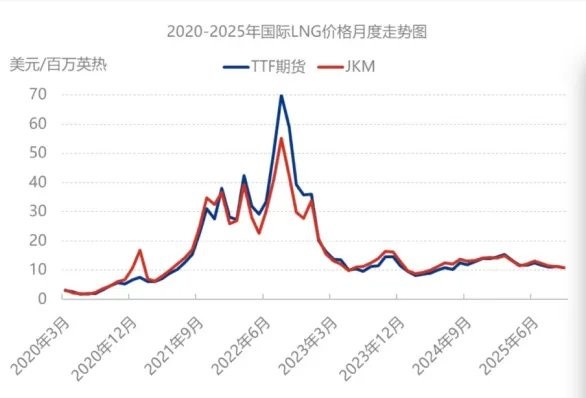
The fluctuation of international natural gas prices in the past five years. Data source: Longzhong Information
Consulting firm Rystad Energy stated that in October 2025, global LNG production will reach a record high, approaching 40 million tons. This indicates that a new wave of supply is about to arrive, and high LNG production will become the norm in the coming years.
Multiple global LNG projects are set to commence production in the next five years. According to statistics from the CNOOC Energy Economics Institute, the average annual new LNG production capacity globally is expected to reach 43.6 million tons per year from 2025 to 2030, far exceeding previous levels. The total production capacity is expected to approach 740 million tons by 2030, an increase of nearly 40% compared to 2025.
With the continuous increase in supply, the probability of high gas prices re-emerging is low. Longzhong Information analyst Wang Haohai told Caijing that in 2022, when international gas prices surged, many new long-term LNG contracts were signed internationally, and 2026 and 2027 will be peak years for the execution of these contracts. There is significant downward pressure on spot LNG prices, and it is expected that the average spot price of LNG may decline to $8-$9/MBtu in 2026-2027. The average prices for 2025 and 2024 are $12.4 and $12, respectively.
A research report released by China International Capital Corporation (CICC) stated that considering the gradual release of LNG production capacity under construction starting in 2026, the global natural gas market will gradually enter a loose cycle. During the tight balance period of natural gas from 2021 to 2025, resource cost advantages are the core competitiveness of natural gas companies; while in the loose cycle, the investment value balance of the natural gas industry chain will gradually tilt towards buyers.
In the more distant future, global LNG demand is expected to decline after stabilizing for a period at a plateau. There is a general consensus in the industry that in the process of achieving carbon neutrality, the scale of renewable energy such as solar and wind power will continue to expand, accounting for more than half of energy demand; the proportion of natural gas will decline from its peak around 2030, ultimately stabilizing at about half of the peak.
China's increase in imports of Russian pipeline gas is also beneficial for stabilizing import gas prices.
The China-Russia East Route Natural Gas Pipeline was completed and opened on December 20, 2019. The pipeline is designed for a maximum capacity of 38 billion cubic meters per year, expected to reach maximum capacity by the end of 2025. In September 2025, China and Russia reached a preliminary agreement to increase the annual gas supply scale of the East Route to China to 44 billion cubic meters per year. In addition, the supply of the Far East Route gas pipeline under construction by China and Russia will increase from 10 billion cubic meters per year to 12 billion cubic meters, with plans to open in 2027.
According to estimates by CICC, the increase in Russian pipeline gas could reduce China's LNG import demand by about 40 million tons per year, accounting for nearly 10% of the global LNG trade volume in 2024 The global LNG supply surplus pressure will further intensify.
Shi Ning, head of the gas division of China Development Group, told Caijing that after the increase in imports of Russian pipeline gas, some areas in the northern region and East China have started using gas from Russia, which ensures that there will be no gas shortages in China in the near future.
Risk Warning and Disclaimer
The market has risks, and investment should be cautious. This article does not constitute personal investment advice and does not take into account the specific investment objectives, financial conditions, or needs of individual users. Users should consider whether any opinions, views, or conclusions in this article are suitable for their specific circumstances. Investment based on this is at one's own risk
