


"Trump's confidant" Hassett leads the race for Federal Reserve Chair, and the market sees Bernanke's shadow

White House Chief Economic Advisor Kevin Hassett is leading the race for the next Chairman of the Federal Reserve. Due to his identity as a "Trump loyalist," the market has been concerned about the potential loss of the Federal Reserve's independence. However, investors see the shadow of Ben Bernanke: Bernanke also held a key position in the White House before taking office, but he demonstrated strong independence once in the role. The real test will be whether he can withstand political pressure in the future and maintain the credibility of the Federal Reserve
Kevin Hassett, the chief economic advisor at the White House, has emerged as a leading contender for the next chair of the Federal Reserve, a personnel change that is closely watched by the market. Although investors have concerns that his close ties to the Trump administration may affect the Fed's independence, the market's initial reaction has been surprisingly calm, reminiscent of an important historical precedent—Ben Bernanke, who also started in the White House economic team.
According to a previous article by Wall Street Insight, Kevin Hassett, the director of the National Economic Council under President Trump, is likely to receive the nomination for the next chair of the Federal Reserve, succeeding the current chair whose term ends in May next year. This news quickly changed market expectations, with the probability of Hassett receiving the nomination rising to 57% on prediction platforms like Polymarket and Kalshi, making him stand out among numerous candidates as the frontrunner.
However, this potential reshaping of the U.S. monetary policy outlook has not stirred significant waves in the financial markets. The yield on the U.S. 10-year Treasury bond, which serves as a global anchor for asset pricing, briefly dipped below 4% after the news broke but then stabilized, showing no signs of severe sell-offs or buying frenzies. Meanwhile, the long-term interest rate futures market has also seen little movement, indicating that market expectations for the path of the federal funds rate over the next few years remain stable.
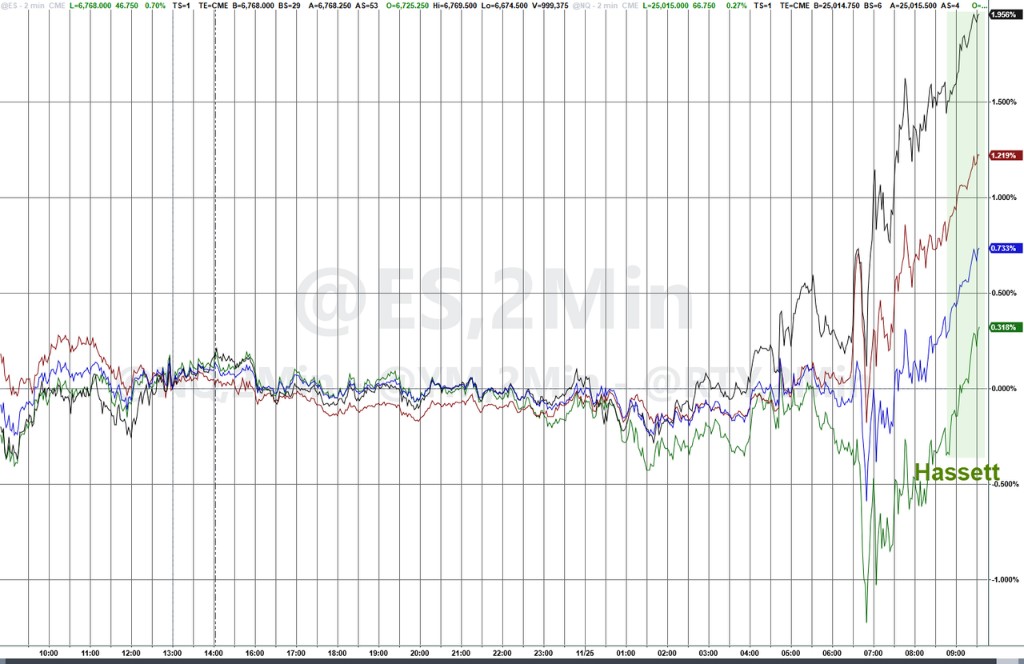
The calm in the market conveys a key signal: investors are currently not panicking over a candidate perceived as a "loyalist" leading the race. For Hassett, he has smoothly passed his first market stress test before taking office, which may in turn bolster his chances of receiving the nomination. However, the real test is far from over; the future challenge will be whether he can maintain the Federal Reserve's credibility as an independent central bank under political pressure from the White House.
"Loyalty" May Become the Key to Nomination
In this intense competition that has lasted for months, loyalty seems to be the primary criterion for the Trump administration in selecting the next chair of the Federal Reserve. Reports indicate that President Trump views his nomination of Jerome Powell eight years ago as a significant mistake, and therefore hopes that his successor will be more aligned with the government's policy priorities.
In this context, Hassett's advantages become apparent. Hassett is seen as highly aligned with Trump's economic views, including the belief that interest rates should be lowered. In a media interview on November 20, he stated that if he were to serve as the chair of the Federal Reserve, he would immediately cut interest rates because the data suggests that we should do so. Hassett also criticized the Federal Reserve for allowing inflation to spiral out of control after the pandemic George Pollack of Signum Global Advisors analyzed that the president believes Hassett is "the candidate most likely to support government priorities," and that he is "highly aligned and indebted to him on a personal level, thus will be the most cooperative." Joe Kalish of Ned Davis Research also pointed out that the government hopes to find a candidate who believes the U.S. economy can achieve faster growth without triggering inflation.
In contrast, several other strong competitors have gradually lost their edge. Former Federal Reserve Governor Kevin Warsh was once a frontrunner, but the momentum did not sustain. Current Governor Christopher Waller may have seen his chances diminished due to his failure to vote for larger rate cuts in the last two monetary policy meetings. Wall Street generally believes that whether it is Warsh, Waller, or BlackRock executive Rick Rieder, they may seek varying degrees of independence from the government.
Despite some analysts expressing concerns about Hassett's nomination, the financial markets have given a neutral to slightly optimistic vote through prices. According to Bloomberg's interest rate probability data, the market's long-term forecast for the federal funds rate has been almost unaffected, with a general expectation that it will bottom out below 3% in early 2027, which is basically consistent with expectations before Hassett became a frontrunner.
Joe Kalish of Ned Davis Research believes that from the perspective of Federal Reserve independence, Hassett as a cabinet member would be "the worst choice," criticizing his poor communication skills. However, the market's calm indicates that investors are currently more focused on macroeconomic data itself rather than potential personnel changes. As long as the inflation trajectory does not undergo significant changes, personnel issues will not immediately translate into market volatility.
Historical Echoes of Bernanke
Hassett's path to nomination bears a striking resemblance to that of Ben Bernanke nearly twenty years ago. In 2005, when President George W. Bush nominated Bernanke to succeed Alan Greenspan, Bernanke was also serving as the Chairman of the Council of Economic Advisers. At that time, he was viewed by the market as a politically reliable "safe" choice who could ensure policy continuity.
However, the course of history took an unexpected turn. Shortly after taking office, Bernanke faced the bursting of the U.S. subprime mortgage bubble and the global financial crisis. During this unprecedented crisis, he led the Federal Reserve in implementing a series of unconventional policies, including quantitative easing, with decisiveness and independence far exceeding initial expectations, ultimately earning him the Nobel Prize in Economic Sciences.
Bernanke's experience illustrates that a chairman initially seen as an "insider" may reveal their true policy stance and independence when faced with severe economic tests. Regardless of who ultimately takes the helm at the Federal Reserve, the real challenges often do not stem from political appointments but from unpredictable economic shocks For Hassett, the current label of "Trump loyalist" may become a double-edged sword. As the analysis points out, this perception may actually force him to work harder to prove his independence to the market after taking office in order to gain trust.
Currently, the White House's efforts to dismiss Biden-appointed Federal Reserve Governor Lisa Cook on the grounds of mortgage fraud seem to be at an impasse, indicating the significant difficulty of a complete overhaul of the Federal Reserve. This may also be one of the reasons why the market remains calm.
Ultimately, the judgment of any Federal Reserve Chair depends on the key decisions he or she will face in the future. While the market hopes that Hassett will not have to endure the brutal tests that Bernanke faced, history has shown that the position of Federal Reserve Chair has never been an easy job. He has passed the preliminary test, but that is just the beginning
