


Breakfast | Economic data is favorable for the Federal Reserve to cut interest rates in December, with the three major U.S. stock indices rising for three consecutive days

Economic data is favorable for the Federal Reserve to cut interest rates in December, with the three major U.S. stock indices rising for three consecutive days, and both the S&P and Nasdaq reaching nearly two-week highs. Nvidia fell over 7% during the session, closing down 2.6%; Google's AI chain rose, with Google up over 1%, hitting a historical high for three consecutive days, Broadcom rose nearly 2%, approaching record highs, and after reports of considering using Google's TPU, Meta rose nearly 4%; the U.S. labor market is weak, and core PPI growth is below expectations, leading to a further increase in U.S. Treasury prices, with the ten-year U.S. Treasury yield falling below 4.0% during the session for the first time this month
Market Overview
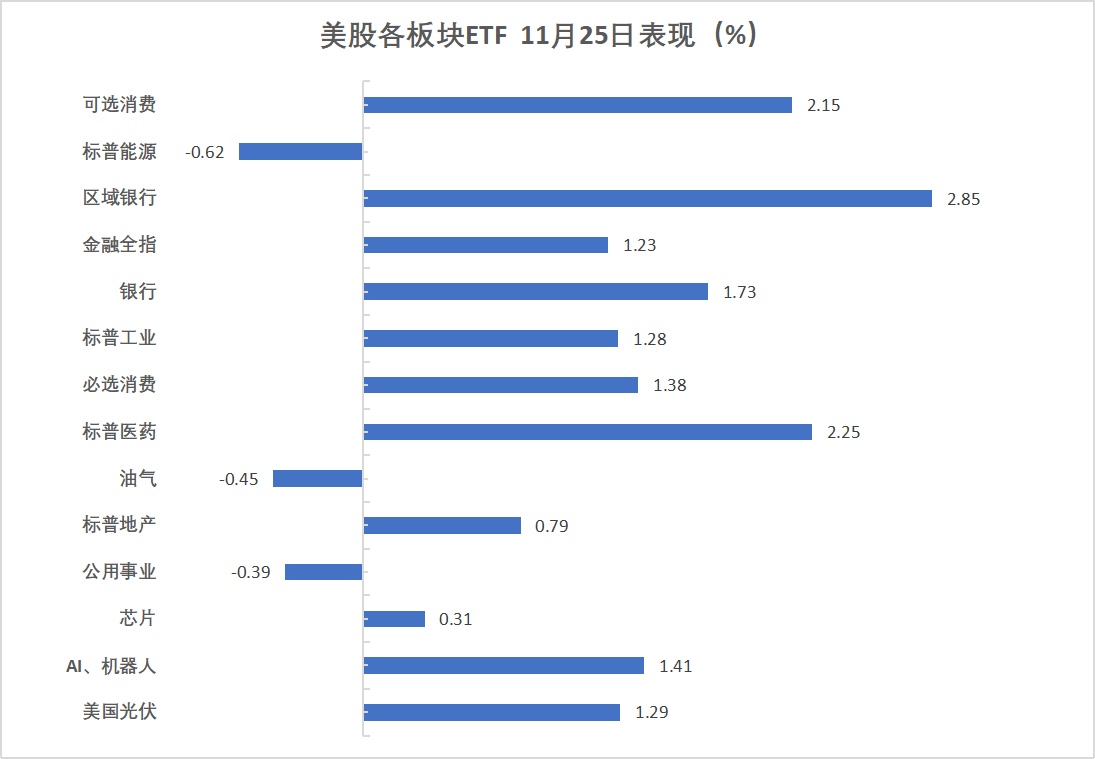
Economic data is favorable for the Federal Reserve to cut interest rates in December, the three major U.S. stock indices have risen for three consecutive days, but some tech stocks were under pressure, leading to a drop during the session. By the close, the Dow Jones rose over 1%, and both the S&P and Nasdaq reached nearly two-week highs. Nvidia fell over 7% during the session, closing down 2.6%, the only loser among the seven major tech giants, with Nvidia's AI chain also declining, CoreWeave down over 3%; Google's AI chain rose, Google up over 1%, hitting a new historical high for three consecutive days, Broadcom rose nearly 2%, approaching record highs, and after reports of considering using Google's TPU, Meta rose nearly 4%.
The China concept index underperformed the broader market, with Xiaoma Zhixing rising nearly 6% after announcing its financial report, Alibaba initially rising then falling, closing down over 2%, and Nio down over 4%.
The U.S. labor market is weak, and core PPI growth is below expectations, leading to a further rise in U.S. Treasury prices, with the ten-year Treasury yield falling below 4.0% for the first time this month during the session. The U.S. dollar index has fallen away from a nearly six-month high over the past two days; the offshore yuan rose over 200 points during the session, breaking 7.08 for the first time in 13 months; cryptocurrencies, which had been rebounding for several days, fell back, with Bitcoin dropping over 3% during the session, falling below $87,000.
Investors are focused on the prospects for peace between Russia and Ukraine, crude oil fell to a one-month low, dropping nearly 3% during the session. Gold futures rose for three consecutive days, up over 1%, closing at a new high for over a week.
During the Asian session, A-shares and Hong Kong stocks fluctuated and closed higher, with the ChiNext rising 1.77%, the "Google chain" surged, and the Hang Seng Index rose 1.2%, with tech stocks following the upward trend.
Key News
U.S. economic data indicates an increased likelihood of interest rate cuts: September PPI rose 0.3% month-on-month, driven by energy costs pushing inflation up, core PPI month-on-month growth of 0.1% was below expectations; ADP weekly report: over the past four weeks, private sector jobs decreased by an average of 13,500 per week, with losses intensifying; September retail sales rose 0.2% month-on-month, far below expectations, with auto sales being a major drag.
U.S. Treasury Secretary Yellen: the announcement of the Federal Reserve Chair candidate may come before Christmas, and the Federal Reserve should return to a behind-the-scenes role; Trump's chief economic advisor Hassett is reportedly considered the frontrunner for the Federal Reserve Chair position; Trump "appointed" Federal Reserve Governor Milan: significant interest rate cuts are needed, as current monetary policy hinders economic development and gradually raises the unemployment rate.
Reports indicate that Ukraine has agreed to the core terms of the plan proposed by the U.S., with crude oil dropping nearly 3% during the session; Trump stated that there are only a few remaining differences, and has assigned U.S. officials to negotiate with both Russia and Ukraine on the peace plan; the Ukrainian side stated that Zelensky plans to meet with Trump on the 27th.
The AI competitive landscape is changing, with Nvidia experiencing a sharp drop of 7% during the session, while Google reached a new high; after the significant drop, Nvidia rarely reassured the market: our GPUs are a generation ahead of Google's AI chips; the "big short" has initiated a debate on the "AI bubble," claiming "Nvidia is the Cisco of its time."
Huawei press conference: Mate 80 series starts at 4699 yuan, first to feature HarmonyOS 6, foldable Mate X7 series priced from 12,999 yuan
Alibaba's Q3 revenue increased by 4.8% year-on-year, with cloud business revenue surging by 34%, and instant retail growing strongly by 60%; conference call: Qianwen is expected to become the future entry point for AI life, and significant contraction in flash purchase investment is anticipated in Q4, additional investment outside the 380 billion capital expenditure commitment is not ruled out.
Pony.ai's Q3 revenue increased by 72% year-on-year, with gross margin rising to 18.4%, and Robotaxi business revenue increased by nearly 90%, achieving positive unit profitability at the city level.
Nio's Q3 revenue grew by 16.7% to 21.8 billion yuan, with vehicle gross margin reaching a record high of 14.7%, and Q4 revenue and delivery guidance both hitting new highs.
Dell's revenue guidance for the current quarter exceeded expectations, raising annual AI server shipment guidance, with shares rising over 5% in after-hours trading.
Market Report
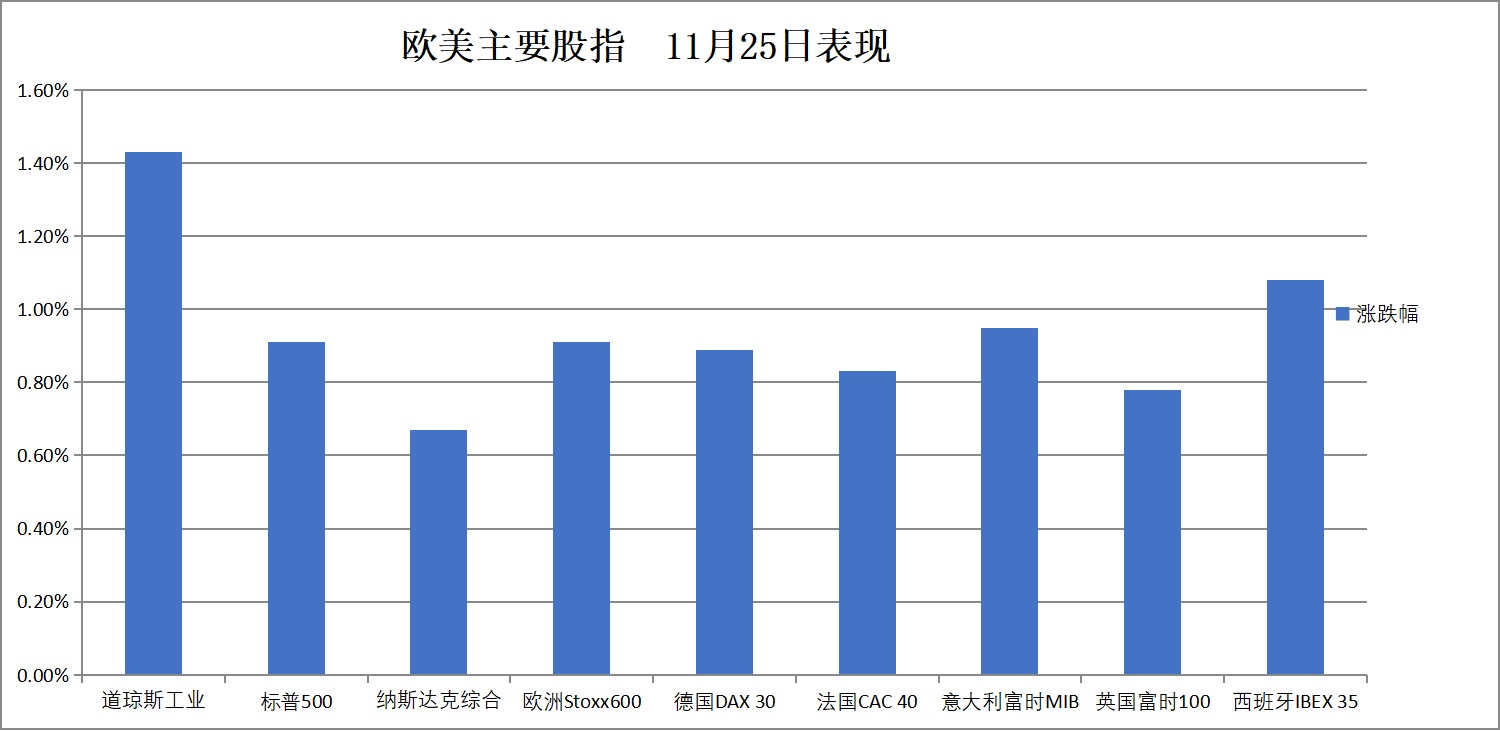
U.S. and European Stock Markets: The S&P 500 rose by 0.91%, closing at 6765.88 points; the Dow Jones rose by 1.43%, closing at 47112.45 points; the Nasdaq rose by 0.67%, closing at 23025.591 points. The European STOXX 600 index rose by 0.91%, closing at 568.01 points.
A-shares: The Shanghai Composite Index rose by 0.87%, closing at 3870.02 points; the Shenzhen Component Index rose by 1.53%, closing at 12777.31 points; the ChiNext Index rose by 1.77%, closing at 2980.93 points.
Bond Market: By the end of the bond market, the yield on the benchmark U.S. 10-year Treasury bond was about 4.00%, down about 2 basis points during the day; the yield on the 2-year U.S. Treasury bond was about 3.46%, down about 4 basis points during the day.
Commodities: WTI January crude oil futures fell by 1.51%, closing at $57.95 per barrel; Brent January crude oil futures fell by 1.40%, closing at $62.48 per barrel. COMEX December gold futures rose by 1.12%, closing at $4140 per ounce. LME nickel futures rose by about 1.2%, closing at $14872 per ton.
News Details
Global Highlights
U.S. September PPI rose by 0.3% month-on-month, driven by rising energy costs pushing inflation up, core PPI month-on-month growth rate lower than expected. Data shows that 60% of the increase in U.S. September PPI was attributed to rising gasoline costs. Excluding food and energy prices, the core PPI rose by 0.1% month-on-month in September, lower than the expected 0.2%, and increased by 2.6% year-on-year, the mildest increase since July last year. "The New Federal Reserve News Agency" Nick Timiraos commented that the rise in wholesale prices suggests limited increases in the Fed's preferred inflation indicator, PCE Increased likelihood of interest rate cuts: ADP weekly report shows average weekly reduction of 13,500 jobs in the U.S. private sector over the past four weeks, losses intensifying. The weekly data released by ADP indicates that private enterprises have averaged a reduction of 13,500 jobs per week over the past four weeks, up from the previously reported loss of 2,500 jobs per week, with layoffs accelerating significantly. Analysts point out that this data increases the probability of the Federal Reserve cutting interest rates in December.
U.S. September retail sales increased by 0.2% month-on-month, far below expectations, with auto sales being a major drag. U.S. retail sales in September grew by 0.2% month-on-month, marking four consecutive months of positive growth but significantly slowing down and falling short of market expectations. Auto sales saw their first decline in four months, primarily due to the expiration of electric vehicle tax credit policies. Actual retail sales have increased year-on-year for 12 consecutive months, but consumption shows a "K-shaped" divergence, coupled with a weak job market and low consumer confidence, which may reinforce expectations for interest rate cuts by the Federal Reserve.
U.S. Treasury Secretary Mnuchin: May announce Federal Reserve Chair nominee before Christmas, Federal Reserve should return to a behind-the-scenes role. U.S. Treasury Secretary Mnuchin stated on November 25 that Trump may announce the new Federal Reserve Chair nominee before Christmas. Mnuchin revealed that he still has one interview to complete and advocates for the Federal Reserve to return to a behind-the-scenes role, downplaying market intervention. Powell's term as Federal Reserve Chair ends in May 2026, and there are currently divisions within the Federal Reserve regarding interest rate cuts, with the December meeting still expected to achieve a third rate cut.
Trump's chief economic advisor and Director of the White House National Economic Council Kudlow reportedly seen as the frontrunner for Federal Reserve Chair. However, Trump is known for unexpected personnel and policy decisions, so nominations cannot be considered final until publicly announced. Kudlow is believed to be highly aligned with Trump's economic views, including the belief that interest rates should be lowered.
- Federal Reserve Governor Milan: Significant interest rate cuts needed, current monetary policy hinders economic development and gradually raises unemployment rate. Milan advocates for a series of 50 basis point cuts to quickly bring interest rates down to neutral levels. He emphasizes that almost all inflation overshoots are "illusions," primarily stemming from supply-demand imbalances in the housing market and the lagging effects of monetary policy.
- “Federal Reserve News Agency”: Allies pave the way for rate cuts next month, Powell will decide between “hawkish cuts” or “dovish pause”. The "New Federal Reserve News Agency" points out that Powell's core allies, including Williams and Daly, have publicly spoken out, paving the way for a rate cut in December, with market expectations for rate cuts soaring to 80% However, there are serious divisions within the Federal Reserve, and Powell faces a difficult choice: one is "hawkish rate cuts," cutting rates in December but hinting at a pause afterward; the other is to choose "dovish pause," holding steady and waiting for data. However, Bank of America believes that forcing a "hawkish rate cut" may backfire, and a "dovish pause" may be better.
Reports say Ukraine agrees to the core terms of the plan proposed by the U.S., Trump claims only a few differences remain, and Ukraine states Zelensky plans to meet Trump on the 27th. Following the report, crude oil fell nearly 3% during trading. The Secretary of the National Security and Defense Council of Ukraine stated that Ukraine and the U.S. have reached a consensus on the "core terms" of the agreement proposed during the Geneva talks. The White House press secretary stated that the U.S. has made "significant progress" in reaching a peace agreement, with only "a few subtle but not insurmountable details" remaining to be resolved. Trump stated that the 28-point peace plan initially drafted by the U.S. has been refined, and only a few differences remain; to finalize the plan, he has assigned U.S. officials to negotiate with both Russia and Ukraine on the peace plan.
- At a critical moment in the Russia-Ukraine negotiations: U.S., Russia, and Ukraine meet in Abu Dhabi to promote the implementation of the "19-point peace framework". Representatives from the U.S., Russia, and Ukraine gathered in Abu Dhabi to accelerate the revised "19-point peace framework," shifting the focus of negotiations from early gamesmanship to finalizing specific terms. The 28-point proposal previously put forward by the Trump administration has been reduced to a more favorable 19-point agreement for Kyiv, but the core sensitive terms involving territory and NATO relations still await final decisions from the leaders, with the White House maintaining a cautiously optimistic attitude toward the negotiation progress.
AI competitive landscape changes: Nvidia plummets 7%, Google hits a new high. Media reports indicate that Meta is considering using Google TPU in its data centers by 2027, rather than Nvidia chips. Investors are capturing the subtle changes in the AI competitive landscape, with previously lagging Google showing signs of a comeback. Wall Street insiders say that the release of Gemini 3 "may prove to be a more subtle but more significant event than the DeepSeek impact," and the market is accepting the view that Google is the clear AI leader. Google's latest model has "reset" the "AI hierarchy," pulling the market into a "new DeepSeek moment."
-
Nvidia rarely reassures the market after a big drop: Our GPUs are a generation ahead of Google's AI chips. Nvidia posted that it currently leads the industry by a generation, being the only platform capable of running all AI models and being versatile across various computing scenarios, emphasizing that its chips offer "higher performance, versatility, and interchangeability" compared to Google TPU and other ASIC chips. Google stated that the demand for its custom TPUs and Nvidia GPUs is accelerating, and it will continue to support both
-
“Google Chain”: AI Full-Stack Innovation, TPU + OCS Co-Creating the Next Generation Intelligent Computing Network. Zhongtai Securities believes that the key technological variable for the outbreak of this round of "Google Chain" lies in the comprehensive introduction of OCS optical switching technology. Essentially, it directly transmits data using physical optical paths, completely abandoning the "optical-electrical-optical" signal conversion process. By deeply integrating its self-developed TPU chips with OCS (Optical Circuit Switch) technology, Google has not only broken through the energy efficiency and scalability bottlenecks of traditional data centers but has also established new architectural standards for the next generation intelligent computing network. Google has built an AI moat around the full-stack advantages of chips (TPU) - networks (OCS) - models (Gemini) - applications (cloud computing/search/advertising, etc.).
-
In-Depth Analysis of Google TPU's "Real Combat Power", Performance Strongly Competing with Blackwell, Energy Efficiency Outperforming GPU. For investors and cloud vendors, the greatest value of TPU is not just speed, but profit margins. By controlling the full-stack design of TPU, Google has successfully bypassed the "NVIDIA tax." Meanwhile, Broadcom's gross margin is far lower than NVIDIA's, allowing Google to push computing costs to the extreme. From TPU v6 to the recently exposed TPU v7, Google is not only making chips but is also building an almost insurmountable moat for the upcoming "AI Inference Era."
-
How is Gemini 3 Trained Without NVIDIA? The newly launched multimodal Gemini 3 by Google adopts a sparse MoE architecture and native multimodal design, fully trained based on its own TPU, with a 1M token context processing capability. This model is specifically optimized for multi-step reasoning ability through reinforcement learning. Although it performs well in factual accuracy and reasoning benchmark tests, its hallucination rate remains as high as 88%, and it has not made substantial breakthroughs in self-awareness at the level of "knowing that one knows."
"The Big Short" Battles NVIDIA, "AI Bubble" Debate Begins. "Big Short" Michael Burry released a heavy manifesto titled "The Gluttony of the Supply Side," officially declaring war on the AI bubble. He refuted the argument that "profit equals safety," bluntly stating that "NVIDIA is the Cisco of its time," warning that the market is facing a disastrous trap of excessive supply and depreciation. This legendary short-seller believes that no matter how many people try to prove this time is different, the history of 1999 is repeating itself.
Huawei Conference: Mate 80 Series Starting at 4699 Yuan, First to Feature HarmonyOS 6, Foldable Mate X7 Series Starting at 12999 Yuan The Huawei Mate 80 series has been officially launched, achieving an extreme brightness of 8000 nits for the first time, a full metal high-strength body, and AI intelligent adjustment technology, bringing a performance leap of over 35% compared to the previous generation. The starting price for the Huawei Mate 80 series is 4,699 yuan, while the starting price for the Huawei Mate 80 Pro series is 5,999 yuan.
Alibaba's Q3 revenue increased by 4.8% year-on-year, cloud business revenue surged by 34%, and instant retail grew strongly by 60%; Conference call: Qianwen is expected to become the future AI lifestyle entry point, with significant contraction expected in flash purchase investments in Q4, additional investments outside the380 billion capital expenditure commitment are not ruled out**.
- Alibaba's Q3 revenue reached 247.8 billion yuan, a year-on-year increase of 4.8%, slightly above market expectations. Cloud intelligence business revenue surged by 34%, and AI products continued to grow rapidly, ranking first in the domestic AI cloud market share. Instant retail business revenue was 22.906 billion yuan, a year-on-year increase of 60%. Adjusted net profit plummeted by 72%, which the company attributed to investments in instant retail, user experience, and technology.
- Alibaba's management stated that the third quarter was the peak of investment in the flash purchase business. With significant improvements in overall efficiency and stable scale, it is expected that the overall investment in the flash purchase business will significantly contract in the next quarter. Eddie Wu mentioned that currently, not only are new GPUs basically running at full capacity, but even previous generations or GPUs from three to five years ago are also running at full capacity. Therefore, it is unlikely to see the so-called AI bubble within the next three years.
Xiaoma Zhixing's Q3 revenue increased by 72% year-on-year, gross margin rose to 18.4%, and urban-level single-vehicle profitability turned positive. Xiaoma Zhixing's revenue in the third quarter reached 25.4 million USD, a year-on-year increase of 72%, with gross margin rising to 18.4%, mainly driven by the Robotaxi business. This business generated revenue of 6.7 million USD during the same period, a year-on-year increase of 89.5%, with passenger fare revenue surging over 200%, becoming the core driver of the company's growth and gross margin improvement. The company achieved a milestone in urban-level single-vehicle profitability and reduced hardware costs through technological iteration, but still faced an operating loss of 69.7 million USD and cash flow pressure.
Nio's Q3 revenue grew by 16.7% to 21.8 billion yuan, with vehicle gross margin reaching a record high of 14.7%, and Q4 revenue and delivery guidance both set new highs. The financial report shows that 87,071 smart electric vehicles were delivered in the third quarter, a year-on-year increase of 40.8%. The company's three major brands, Nio, Lido, and Firefly, all achieved market breakthroughs, laying the foundation for the company to enter a new growth cycle. It is expected that deliveries in the fourth quarter will be between 120,000 and 125,000 vehicles, a year-on-year increase of 65.1% to 72.0%, with total revenue expected to be between 32.8 billion and 34 billion yuan, a year-on-year increase of 66.3% to 72.8% Dell's revenue guidance this season exceeds expectations, raises annual AI server shipment guidance, and rises over 5% after hours. Dell announced after hours that its third-quarter revenue slightly missed expectations, but EPS earnings exceeded expectations, and the fourth-quarter revenue guidance also surpassed expectations. Dell raised its annual AI server expected shipment value from $20 billion to $25 billion, reflecting sustained demand in the key AI server market.
Domestic Companies
Taiwan Semiconductor Manufacturing Company CEO: Advanced process capacity is "not enough, not enough, still not enough," existing capacity is still three times short. TSMC CEO C.C. Wei revealed that based on the product planning and growth expectations of major clients, TSMC's existing capacity is still about three times short. He even joked that he originally wanted to wear a T-shirt with "No more wafer" on it when he went on stage to accept an award, implying that wafer demand is so strong that it is difficult to digest.
Overseas Macro
Drawing parallels to "Apollo Moon Landing," Trump officially signs the "Genesis Plan," gathering U.S. resources to promote AI research. U.S. President Trump instructed Energy Secretary Chris Wright to create and operate the "U.S. Science and Security Platform." This platform will gather high-performance computing resources, AI modeling and analysis frameworks, computing tools, domain-specific foundational models, and secure access to datasets. The White House likened this plan to the Apollo program that sent Americans to the moon in the 1960s, calling it the largest mobilization of U.S. scientific resources since the Apollo program.
"Fivefold impact" hits simultaneously! The logic behind this round of Bitcoin's plunge is completely different from the past. Deutsche Bank believes that unlike previous crashes primarily driven by retail speculation, this round of Bitcoin's adjustment and decline is the result of a combination of macroeconomic headwinds, hawkish signals from the Federal Reserve, stagnation in regulatory processes, outflow of institutional funds, and profit-taking by long-term holders, referred to as the "fivefold impact." This indicates a shift in Bitcoin's investment logic, with the importance of risk management elevated to unprecedented heights.
Has the central bank started "selling gold"? Global central bank gold purchases surged from 450 tons in 2021 to 1,089 tons in 2024, becoming a major demand engine for gold. Although countries like Russia are starting to reduce holdings in 2025 due to exceeding target levels, major central banks like China and India still have gold reserves significantly below the 20% benchmark, indicating that there is still a 4.7 percentage point room for improvement in global central bank gold allocation.
Acknowledging that energy storage demand exceeds expectations, but Goldman Sachs remains "bearish on lithium prices in the medium term" Goldman Sachs stated that the explosive demand for energy storage is rewriting the short-term supply and demand pattern of the lithium market. By 2026, the lithium market will present a "tight first half and loose second half" pattern: prices will remain at $11,000 per ton in the first half, and in the second half, as the supply growth accelerates, prices will fall to $9,500 per ton. Goldman Sachs maintains its bearish stance in the medium term, expecting a supply surplus to re-emerge in 2027, at which point supply will exceed demand by 18% unless producers cut back on capacity expansion plans.
Overseas Companies
OpenAI's "AI hardware" is coming! Altman: More peaceful and tranquil than the iPhone. Altman stated that the screenless AI device developed by OpenAI in collaboration with former Apple chief designer Jony Ive is expected to be launched in two years, offering a "new experience beyond the iPhone." The product focuses on extreme simplicity and ambiance, rejecting information noise, and concentrating on human-centric intelligence, allowing AI to accompany users with a tranquility akin to "mountain lakes."
Musk has started replacing employees with Grok, with the worst-hit department seeing a 90% layoff. Musk continues to push for AI to replace human labor. Following the September layoffs of over 500 people from the data labeling team under xAI, he has recently significantly reduced the size of X company's content safety team, which has been cut by nearly 90% from the initial team of 100 at the time of acquisition. Previously, he stated in a tweet that he plans to completely remove X's heuristic recommendation algorithm in the coming weeks, with Grok taking over to automatically match user interests by reading and watching all content. At the same time, he is accelerating the layout of AI automation software development through xAI and the "Giant Soft Plan."
"E-commerce Agent"—an AI application with enormous commercialization potential is "emerging". AI e-commerce Agents are reshaping the consumer entry point: Morgan Stanley predicts that by 2030, the scale of Agent e-commerce will reach $385 billion, accounting for 20% of total U.S. e-commerce. Current general platforms like ChatGPT have already demonstrated strong commercial conversion power—36% of users completed purchases through AI recommendations. The layout of Alibaba's Qianwen APP and OpenAI's shopping search shows that tech giants are fully seizing the new traffic entry point from "conversation" to "transaction."
Today's News Preview
U.S. durable goods orders for September.
U.S. initial jobless claims for last week.
U.S. new home sales for October.
The Federal Reserve will release the Beige Book on economic conditions.
U.S. EIA crude oil inventory changes for last week
