


A piece of news ignites the market, the AI competitive landscape changes! NVIDIA plummets 7% during trading, and Alphabet is set to hit a new high

On Tuesday morning, NVIDIA's stock price fell more than 7% at one point, with a market value evaporating by nearly $350 billion. The stock price of Google's parent company Alphabet rose further, as the market reacted to Meta's consideration of using Google's TPU instead of NVIDIA chips, along with the excellent performance of Google's newly released Gemini 3 model. This news affected the technology sector, causing the stock prices of NVIDIA's partners to decline, while Google's market value approached $4 trillion. Google is seen as an AI leader, and the market landscape is changing
This Tuesday morning, NVIDIA's stock price plummeted more than 7%, with a market value evaporating nearly $350 billion. The decline later narrowed to within 5%, still marking a new low in over two months. Meanwhile, Alphabet, Google's parent company, saw its stock price rise further, gaining over 3% in the morning session, and despite giving back most of those gains, it is expected to set a new historical high for the third consecutive trading day.
Behind the market's dramatic reaction, investors are capturing the subtle changes in the artificial intelligence competitive landscape—Google is beginning to gain the upper hand. This tech giant, once considered behind in the AI race, is showing signs of a comeback.
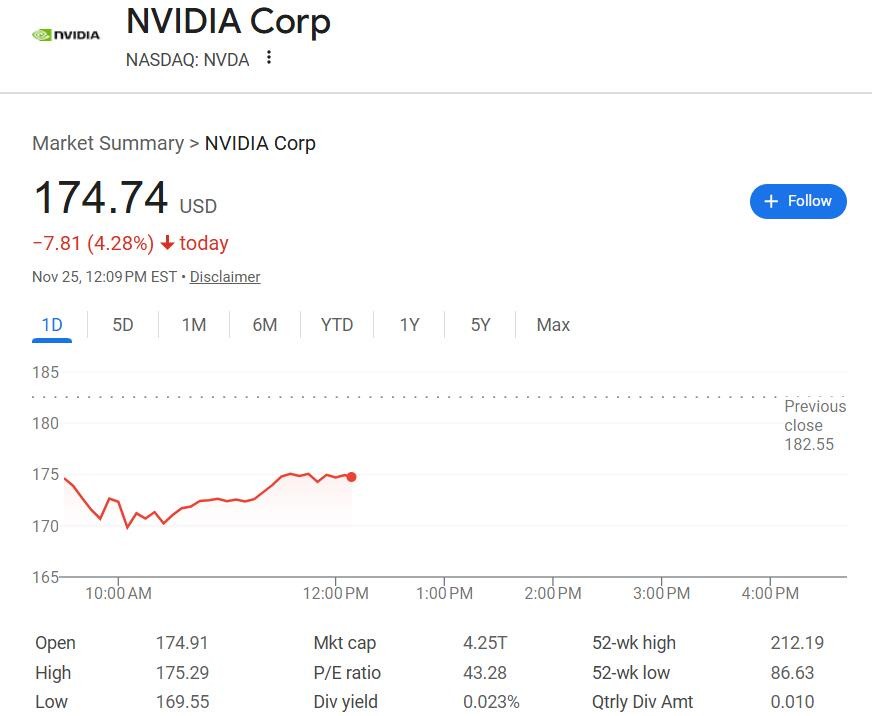
On the surface, this turbulence stems from a report by The Information after Monday's trading session: Meta is considering using Google's Tensor Processing Units (TPUs) in its data centers in 2027, rather than NVIDIA chips. However, the deeper reason is that Google's newly released Gemini 3 model has received immediate acclaim, being regarded as surpassing OpenAI's ChatGPT in reasoning and coding capabilities, and this model is trained using TPUs instead of NVIDIA chips.
The impact of this news on the market landscape was immediate. NVIDIA's sharp decline affected the entire tech sector, with its key partner Super Micro Computer (SMCI) dropping over 6% in early trading on Tuesday. Its data center operator CoreWeave, in which it holds shares, saw a drop of nearly 10% at one point, and even NVIDIA's main competitor AMD fell nearly 9.7% during the session. Meanwhile, Broadcom, which helped design the TPUs for Google, saw its stock surge 11% on Monday, and although it turned down on Tuesday, it initially rose over 2%. Alphabet's market value is approaching the milestone of $4 trillion.
Mike O'Rourke, chief market strategist at Jones Trading, stated that the release of Gemini 3 "may prove to be a more subtle but more significant event than the DeepSeek shock," and the market is accepting the view that "Google is the clear AI leader." Nomura Securities strategist Charlie McElligott believes that Alphabet's latest model has "reset" the "AI hierarchy," pulling the market into a "new DeepSeek moment."
Google’s Full Awakening: From Laggard to Leader
Since the launch of ChatGPT three years ago, analysts and tech experts—even including Google engineers and the company's former CEO—once claimed that Google was lagging in the high-stakes AI race. This assertion is now outdated.
Media outlets believe that Google's release of new AI software and several deals have convinced investors that the company will not easily lose to OpenAI, the creator of ChatGPT, and other competitors. Neil Shah, analyst and co-founder of Counterpoint Research, stated, "Google can be said to have always been the dark horse in this AI race, a sleeping giant that is now fully awakened." "Numbers speak for themselves. Since mid-October, Alphabet's stock price has increased by nearly $1 trillion in market value, partly due to Warren Buffett holding $4.9 billion in shares in the third quarter, as well as Wall Street's widespread enthusiasm for its AI efforts. On Tuesday, the stock price of SoftBank Group, one of the largest supporters of OpenAI, fell to a two-month low due to concerns over Google's Gemini competition.
Google's advantage comes from its years of deep investment in a "full-stack" capability. Its CEO Sundar Pichai told investors last quarter, "We have taken a complete, deep, full-stack approach to AI, and it has really paid off." Unlike OpenAI, Google has a ready-made data corpus to train and refine AI models, a continuous stream of profits, and its own computing infrastructure.
Unique Advantage of TPU: Specialization vs. Generalization
Google's TPU fundamentally differs from NVIDIA's GPU in architecture, and this difference is translating into market advantages.
Media reports indicate that GPUs were originally developed to render video game images in a realistic manner, processing multiple tasks in parallel through thousands of computing "cores." This architecture allows them to perform AI tasks at speeds unmatched by other technologies. In contrast, TPUs are specifically built for AI-related tasks like matrix multiplication, which is the primary operation for training neural networks, involving sequential rather than parallel repetitive computations.
This specialization brings practical advantages. Seaport analyst Jay Goldberg stated that TPUs outperform GPUs in certain AI tasks because Google can "strip away many other parts of the chip" that are not tailored for AI. TPUs are seen as less adaptable and specialized than NVIDIA GPUs, but they are more energy-efficient when running these operations. NVIDIA GPUs are considered more adaptable and programmable, but this flexibility may lead to higher operational costs.
Ben Barringer, head of technology research at Quilter Cheviot, commented, "Many other companies have failed in their quest to build custom chips, but Google clearly can add another string to its bow here."
Customer Validation: From Exclusive Use to Market Expansion
Google began developing its first TPU in 2013 and released it two years later. Initially used to accelerate the company's web search engine and improve efficiency. In 2018, Google first deployed TPUs in its cloud platform, allowing customers to register for computing services using the same technology as its search engine.
For many years, Google was effectively the sole customer of its self-developed processors. This situation is changing. AI startup Anthropic announced in October that it would use up to 1 million Google TPUs in a deal worth tens of billions of dollars. This marks a significant shift for TPUs from internal tools to market products According to The Information, Meta plans to use Google chips in its data centers by 2027. Google declined to comment on specific plans but stated that demand for custom TPUs and NVIDIA GPUs in its cloud business is "accelerating." "We have been committed to supporting both for years," a Google spokesperson wrote in a statement. Meta declined to comment on the report from Monday evening.
Current TPU customers also include Safe Superintelligence, a startup founded last year by OpenAI co-founder Ilya Sutskever, as well as Salesforce and Midjourney. The involvement of these major AI companies provides significant validation for the market position of TPUs.
Market Outlook: Complementary Rather Than Replacement
Despite the strong momentum of TPUs, no one—including Google—currently wishes to completely replace NVIDIA GPUs. The pace of AI development means this is not feasible at the moment.
Gartner analyst Gaurav Gupta stated that although Google has its own chips, it remains one of NVIDIA's largest customers because it must maintain flexibility for its clients. If a client's algorithms or models change, GPUs are better suited to handle a wider range of workloads.
Meryem Arik, CEO of AI startup Doubleword, pointed out that Google's TPUs mainly attract a handful of companies with large computing bills, such as Meta and Anthropic. There is also a key limitation: "Once you use TPUs, you are locked into Google's cloud ecosystem." AI developers can only access TPUs through Google's own cloud services, while using NVIDIA GPUs is more flexible.
Barringer noted that the chip industry "is not a zero-sum game with only one winner." In fact, even tech companies that have signed contracts for TPUs are still heavily investing in NVIDIA chips. For example, Anthropic announced a significant deal with NVIDIA just weeks after reaching a TPU agreement with Google.
Bloomberg Intelligence analysts believe that Anthropic's deal increases the likelihood of TPUs being extended to other cloud platforms. For Google TPUs, the best outlook may be to become part of a bundled product needed to support AI growth.
Forrester analyst Thomas Husson summarized: "It is safe to say that Google is back in the competition with Gemini 3. In fact, to paraphrase Mark Twain, reports of Google's death have been greatly exaggerated, and can even be said to be meaningless."
Risk Warning and Disclaimer
The market has risks, and investment requires caution. This article does not constitute personal investment advice and does not take into account the specific investment goals, financial situation, or needs of individual users. Users should consider whether any opinions, views, or conclusions in this article align with their specific circumstances. Investment based on this is at one's own risk
