


Google's "full-stack" counterattack, strongly reclaiming AI dominance!

Huatai Securities believes that Google is making a strong comeback with its self-developed TPU v7p chip and the full-stack AI ecosystem of the Gemini model. TPU has driven cloud business growth to 34%, second only to Azure; Gemini has reached 650 million monthly active users, and the AI Overviews service has over 2 billion users. The search market share has returned to over 90%, and abundant advertising cash flow supports high-intensity capital expenditures
The market has long underestimated Google's "full-stack" AI counterattack capability.
Recently, Huatai Securities stated in its latest research report that, unlike OpenAI's heavy reliance on external computing power (NVIDIA) and cloud facilities (Microsoft), Google is building a fully self-sufficient ecological closed loop from chips (TPU v7p) to models (Gemini 3.0) to applications (Search + Waymo). They are optimistic about Google's self-sufficient "full-stack" AI ecosystem and capabilities, believing it is the right time to regain dominance.
The report points out that this closed loop is translating into tangible financial returns: TPU deployment has significantly reduced inference costs, and search market share has stabilized and rebounded to over 90%, with abundant advertising cash flow providing ample ammunition for high-intensity capital expenditures (Capex).
Huatai Securities believes that Google's large-scale self-developed TPU and supporting software ecosystem in the cloud are driving growth and market share increases in its cloud business; the advertising business, empowered by Gemini, has monetization flexibility, and abundant cash flow is reinvesting in AI input and application implementation. In contrast, OpenAI only possesses large model development capabilities. Although the current user base is large, the willingness to pay from end consumers is low, and the commercialization path for businesses has yet to be established, leaving the sustainability of its first-mover advantage in question.
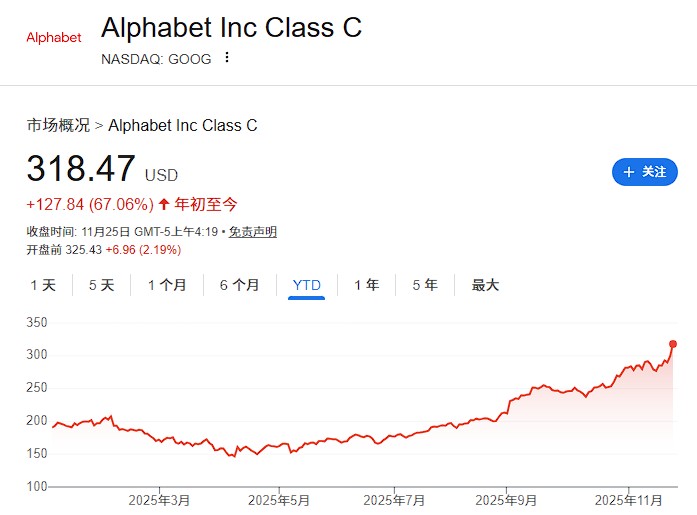
Huatai Securities has raised Google's target price to $380, indicating an upside potential of over 18% from the current level, corresponding to a 30x PE for 2026.
Hard Technology Moat: TPU v7p Competes with B300, Cloud Business Growth Surpassing AWS
Google's computing foundation is demonstrating astonishing dominance.
The report states that TPU v7p, as the latest iteration of Google's self-developed chip, has an FP8 computing power of up to 4.5PF, directly competing with NVIDIA's B300 chip. Unlike its competitors, Google skipped the Scale-up phase in its interconnect architecture and achieved Scale-out directly through optical circuit switching (OCS), allowing a single cluster to scale up to 9216 pods interconnected.
Huatai Securities believes that unlike competitors that rely on external computing resources, Google initiated TPU deployment as early as 2016 and had training and inference capabilities by 2017. It is currently promoting TPU deployment to third-party cloud service providers, such as Fluidstack, and adopting a usage-based revenue-sharing model, which is expected to open up new growth opportunities.
At the same time, competitor Anthropic has announced plans to deploy 1 million TPUs by 2026, and OpenAI has also begun using TPUs to reduce inference costs. Google's AI ecosystem, built on TensorFlow, OpenXLA, and other learning frameworks combined with TPUs, has the potential to compete with NVIDIA's CUDA.
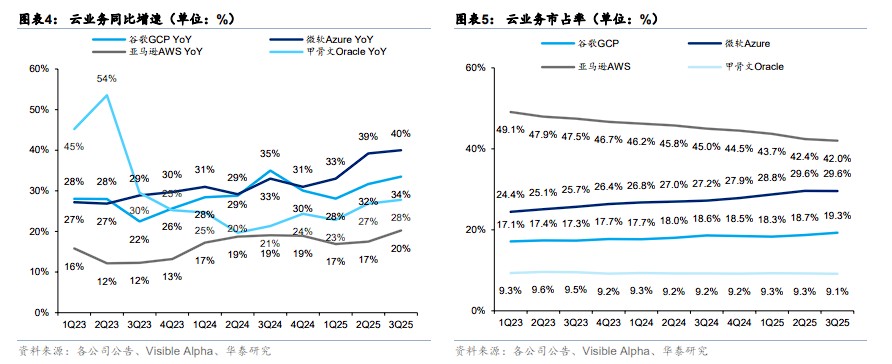
The report points out that this computing power advantage not only serves Google itself but also becomes an engine for cloud business growth Huatai Securities pointed out that in the third quarter, Google Cloud revenue reached $15.2 billion, a year-on-year increase of 34%, with growth rate second only to Azure's 40% among major cloud service providers, significantly higher than Amazon AWS's 20% and Oracle's 28%. The market share of cloud business increased from 18.6% in the same period last year to 19.3%.
Cash Cow Unbreakable: Search Share Returns to 90%, Advertising Business Strongly Supports AI
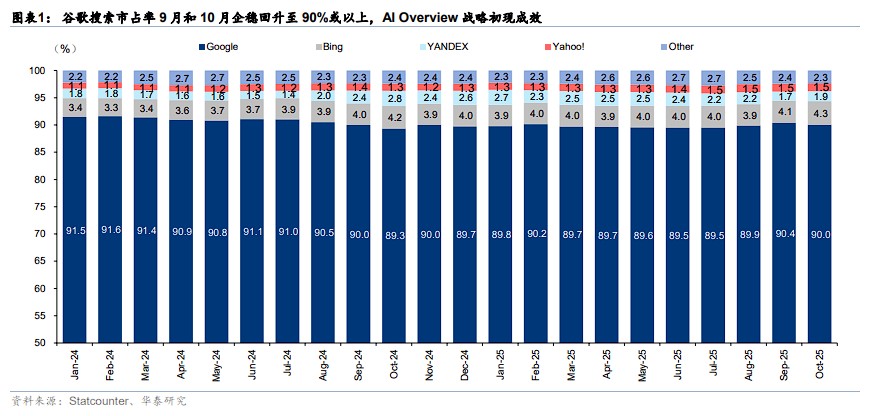
There were previous market concerns that large models would disrupt the search advertising model, but data shows that Google has stabilized its position.
The report states that Google's latest release, Gemini 3.0, leads in multiple benchmark tests, with improvements in reasoning, agent, and interaction capabilities. Currently, Gemini has 650 million monthly active users, although still lagging behind ChatGPT's 800 million weekly active users, it is expected to capture Google’s overall user traffic with deep synergy with the search business.
The Chrome browser is accelerating the integration of Gemini features, adding multiple agent functions such as task execution and contextual understanding, making the ecosystem more cohesive. The AI Overviews feature has served over 2 billion users, providing personalized search results and content generation services. Data shows that in September and October, Google's search market share has rebounded to over 90%.
Huatai Securities analysts pointed out that Google's search and advertising business provides a stable cash flow and a large user traffic base for AI development. Empowered by Gemini, the advertising business has strong commercialization elasticity, capable of providing ample funding support for ongoing capital expenditures.
Diversified AI Ecosystem Layout
In addition to its core search, advertising, and cloud businesses, Google’s layout in the AI field is becoming more diversified.
Huatai Securities stated that the Waymo autonomous driving fleet currently has over 2,500 vehicles, having entered multiple cities including Phoenix, San Francisco, and Los Angeles, with weekly order volume exceeding 300,000, representing the advanced level of global autonomous driving and physical AI.
The report pointed out that the AlphaFold project has made breakthrough progress in protein structure prediction, reshaping the AI drug development field. Currently, five Nobel Prize winners are working or have worked for Google, covering cutting-edge technology fields such as neural networks, protein structure prediction, and quantum computing.
Huatai Securities noted that based on the overall ecosystem construction, it has raised its revenue forecast for Google for 2025-2027. It is expected that revenue will reach $405.169 billion in 2025 (approximately $405.2 billion), with net profit expectations raised to $131.513 billion The report indicates that Huatai Securities maintains a "Buy" rating, raising the target price to $380, corresponding to a 30 times price-to-earnings ratio based on the projected earnings per share (EPS) for 2026
