


Illusion of Prosperity? Wall Street Warns: The U.S. Economy is Overly Tied to AI, and a Halt in Investment Will Trigger a Recession

AI investment contributed nearly half of the GDP growth in the first half of the year, with capital expenditures from the four major tech giants, including Microsoft and Alphabet - C, reaching 1.1% of GDP. Analysts point out that without the AI boom, the economy might have already fallen into recession. If AI stock prices plummet or investment slows down, it could trigger a recession through the reverse wealth effect, with a 20-30% drop in the stock market potentially reducing GDP growth by 1-1.5 percentage points
The U.S. economy's reliance on artificial intelligence investment has reached a dangerous level. Last week's sharp fluctuations in AI-related stocks exposed a broader risk: if the AI boom turns into a bubble burst, it could drag the entire economy into recession.
On November 24, it was reported that AI-related investments may have contributed nearly half of the U.S. real GDP growth in the first half of this year. Capital expenditures from Microsoft, Amazon, Alphabet, and Meta are expected to reach $344 billion this year, equivalent to 1.1% of GDP. Meanwhile, the rise in AI stocks has boosted household wealth, thereby stimulating growth in consumer spending.
However, this reliance is exacerbating the economy's vulnerability. Peter Berezin, Chief Global Strategist at BCA Research, stated, "Without the AI boom, the economy would likely have already fallen into recession."
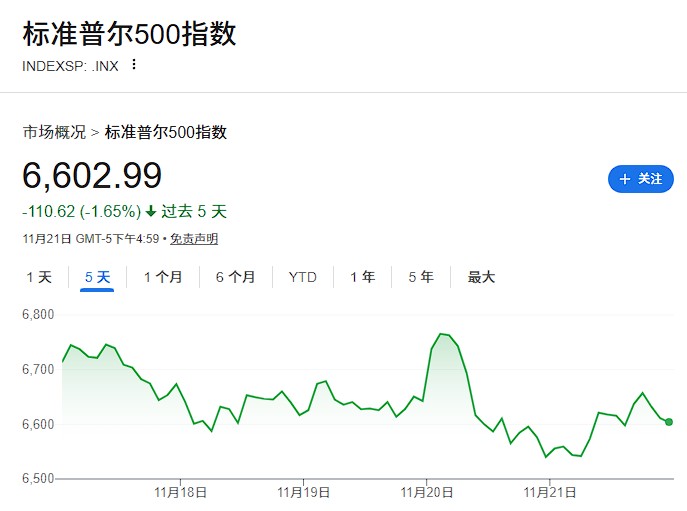
The S&P 500 index fell about 2% last week, as concerns about an AI bubble are rising. Analysts warn that once AI investment slows or stock prices plummet, it could trigger a reverse wealth effect, ultimately pushing the fragile labor market into recession.
AI Investment Becomes the Sole Engine of Economic Growth
Reports indicate that AI-related investments have become a core pillar supporting the U.S. economy.
Bank of America estimates that capital expenditures from Microsoft, Amazon, Alphabet, and Meta will reach $344 billion this year, equivalent to 1.1% of GDP, a significant increase from last year's $228 billion.
Barclays estimates that investments in software, computer equipment, and data centers will raise the GDP annualized growth rate by about 1 percentage point in the first half of 2025, with AI investment contributing the majority.
Although companies like NVIDIA sell the bulk of the chips used for AI spending, most need to be imported and must be deducted when calculating domestic production. Nevertheless, AI spending still contributed to an annualized output growth of 0.8% in the first half of the year, while the GDP annualized growth rate during the same period was 1.6%. This means that without the growth in AI-related spending, the economic growth rate would only be a weak 0.8%.
Bank of America economist Stephen Juneau bluntly stated, "This is currently the only source of investment."
Data from Deutsche Bank shows that private sector investment in the U.S. has seen almost no growth since 2019 when excluding AI-related categories. Although job growth in September exceeded expectations, overall job creation has slowed this year, and the unemployment rate is slowly rising.
Stock Market Wealth Effect Amplifies Economic Risks
The surge in AI stocks has provided additional support to the economy through the wealth effect.
JP Morgan calculates that the rise in AI stock prices alone has driven consumer spending up by 0.9% over the past year, equivalent to about $180 billion. While this is a small portion of the 5.6% consumer growth over the 12 months ending in August, it remains significant considering that consumption accounts for about two-thirds of annual output However, this reliance carries significant risks. The stock price-to-earnings ratio is nearing historical highs. Last week, the S&P 500 index fell about 2% due to bubble concerns, although it rebounded 1% on Friday. If the high earnings expectations prove to be incorrect, stock prices could plummet, leading to a slowdown in investment.
At the same time, the minutes from the Federal Reserve's October policy meeting showed that some officials expressed concerns about falling stock prices, "especially in the context of a sudden reassessment of the possibilities of AI-related technologies."
Jonathan Millar, a senior U.S. economist at Barclays, estimated that a 20% to 30% drop in the stock market could lower GDP growth by 1 to 1.5 percentage points within about a year. If AI investment stops growing, it could further drag down growth by 0.5 percentage points; if it drops to zero, it would drag down a full 1 percentage point.
Additionally, Berezin from BCA stated that the already weak economy has increased the likelihood of a recession triggered by a collapse in the stock market and AI spending. "If you take a fragile labor market and then kick it with a collapse in capital spending, you are very likely to get a recession."
Despite job growth in September exceeding expectations, the overall pace of job creation this year has slowed, and the unemployment rate is slowly rising. In contrast to the tech employment surge during the late 1990s internet bubble, the impact of AI on the labor market is much smaller.
Debt Expansion Poses Hidden Dangers
The rapid growth of AI-related borrowing constitutes another source of risk.
After Oracle recently issued $18 billion in bonds, its total debt has surpassed $100 billion, with some of the funds potentially used for AI infrastructure development. Companies like CoreWeave, which lease data centers and rent servers to tech companies, are also heavily borrowing to expand.
Berezin from BCA Research warned that if the income needed to service the debt fails to materialize, lenders could be hit, which could in turn affect the debt market.
Although the scale of AI-related debt is not sufficient to directly trigger a financial crisis, the complexity of financial markets means that problems in one area could indirectly harm other areas
