


Three joint-stock commercial banks AIC gather to open with a capital of 10 billion aimed at "specialized, refined, distinctive, and innovative"

On November 23rd, China Merchants Bank and CITIC BANK both announced that their subsidiary AIC (Financial Asset Investment Company) has obtained approval from the Financial Regulatory Administration
On November 23, China Merchants Bank and CITIC Bank both announced that their AIC (Asset Investment Company) has received approval from the Financial Regulatory Bureau to commence operations;
In addition, with the recent opening of Xingyin Investment, there are now three new players officially entering the AIC market this year.
Looking back, the pace of initiating AIC companies in this round has been relatively fast:
In March of this year, regulators issued a notice to expand the pilot program for AIC equity investments, opening a policy channel for commercial banks to establish AICs:
Subsequently, Industrial Bank, CITIC Bank, and China Merchants Bank were approved to establish AICs successively from May to July, and Postal Savings Bank also received regulatory approval for establishment in October.
As of November 24, the number of AICs among national commercial banks has expanded to 9, with 8 having been approved to commence operations;
Due to a paid-in capital threshold of 10 billion yuan at the time of establishment, and the high reliance on the parent bank for subsequent business resource connections, the players entering the AIC track are still large banks, with the industry’s registered capital scale approaching 150 billion yuan.
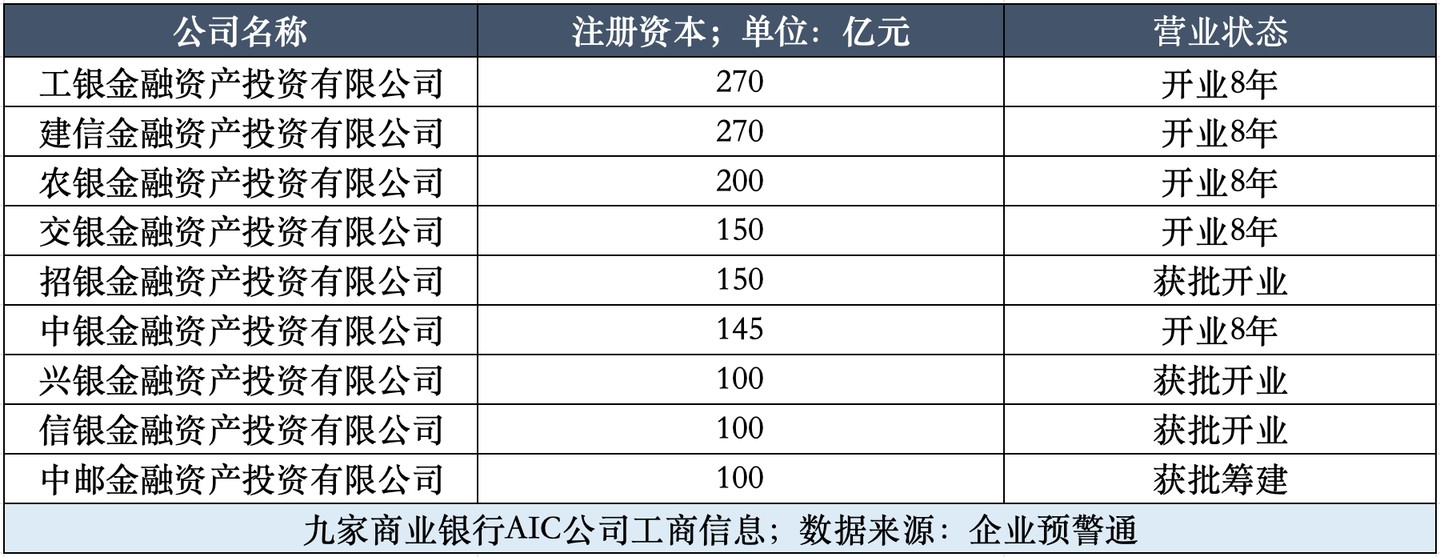
Regarding the opening of the AIC company, China Merchants Bank stated that it will conduct market-oriented debt-to-equity swap business through specialization, deepen industrial-financial collaboration and group synergy, actively carry out pilot equity investment businesses, and enhance the company’s comprehensive operational capabilities;
CITIC Bank indicated that it will focus on strategic emerging industries and key areas such as "specialized, refined, characteristic, and innovative" to carry out market-oriented debt-to-equity swaps and equity investment businesses, helping enterprises reduce leverage.
Unlike the initial strict limitations on debt-to-equity swaps and their supporting measures, the business scope of AICs has gradually evolved into three categories: core debt-to-equity swaps, on-balance-sheet direct investments, and off-balance-sheet businesses.
As of November 24, the number of AIC equity investment enterprises (including direct and indirect) nationwide has reached 629, with the proportions of first, second, and third-tier shareholding levels being 62.9%, 29.5%, and 7.1%, respectively;
Investment fields are concentrated in manufacturing, construction, scientific research and technical services, as well as electricity, heat, gas, and water production and supply;
More than 30% of the invested institutions are "specialized, refined, characteristic, and innovative" small and medium-sized enterprises, and "specialized, refined, characteristic, and innovative little giants."
It is worth noting that the development of AIC institutions is still in its infancy, especially since equity investment businesses have started relatively late, and the profits of these institutions have not yet formed a feedback loop to the parent banks;
In the first half of 2025, the profits of the AIC companies under the "Big Five" banks (Industrial and Commercial Bank of China, Agricultural Bank of China, China Construction Bank, Bank of Communications, and China Merchants Bank) totaled 7.191 billion yuan, contributing only 0.55% to the overall profits of the head office;
This indicates that the current role of AICs is still more about mitigating risks and leveraging comprehensive benefits, achieving low-cost deposit accumulation, and increasing space for fee income.
However, in terms of growth rate, the compound annual growth rate of profits for the AIC institutions of the five major banks from 2018 to 2024 has reached as high as 57.93%;
With the further relaxation of equity investment businesses, AICs may still hope to become a new performance growth point in the future amid narrowing interest margins and weak wealth management With the expansion of the industry and the entry of new players ready to take off, the AIC industry will also see more changes:
For example, Xingyin Investment, upon its establishment, signed strategic cooperation agreements with four investment institutions in Fujian Province, including Fujian Jin Investment Asset Investment and Fujian Min Investment Asset Management, and signed project cooperation agreements with 12 companies, with a total intended amount exceeding 10 billion yuan.
In the future, whether companies can transform their strategic layout into a sustainable business model and achieve a substantial contribution to the profits of their parent banks remains to be seen
