


"NVIDIA, Rich Enough to Rival a Nation": The Trouble of Having Too Much Money?

NVIDIA is accumulating cash at an unprecedented rate in the history of technology, with free cash flow expected to reach USD 96.5 billion this fiscal year, far exceeding USD 3.8 billion two years ago. In the face of massive capital, the company has adopted a unique allocation strategy: on one hand, it returns value to shareholders through stock buybacks, and on the other hand, it invests in client companies like Anthropic to strengthen the AI chip ecosystem. This capital deployment approach, which focuses on the core ecosystem, is prompting the market to reassess its long-term influence
NVIDIA is accumulating cash at an unprecedented rate in the history of the technology industry, with explosive growth in its free cash flow pushing the company to new heights of wealth accumulation.
As massive profits continue to flow in from the wave of artificial intelligence, this chip giant is facing a happy yet tricky strategic challenge: how to effectively allocate its rapidly expanding capital.
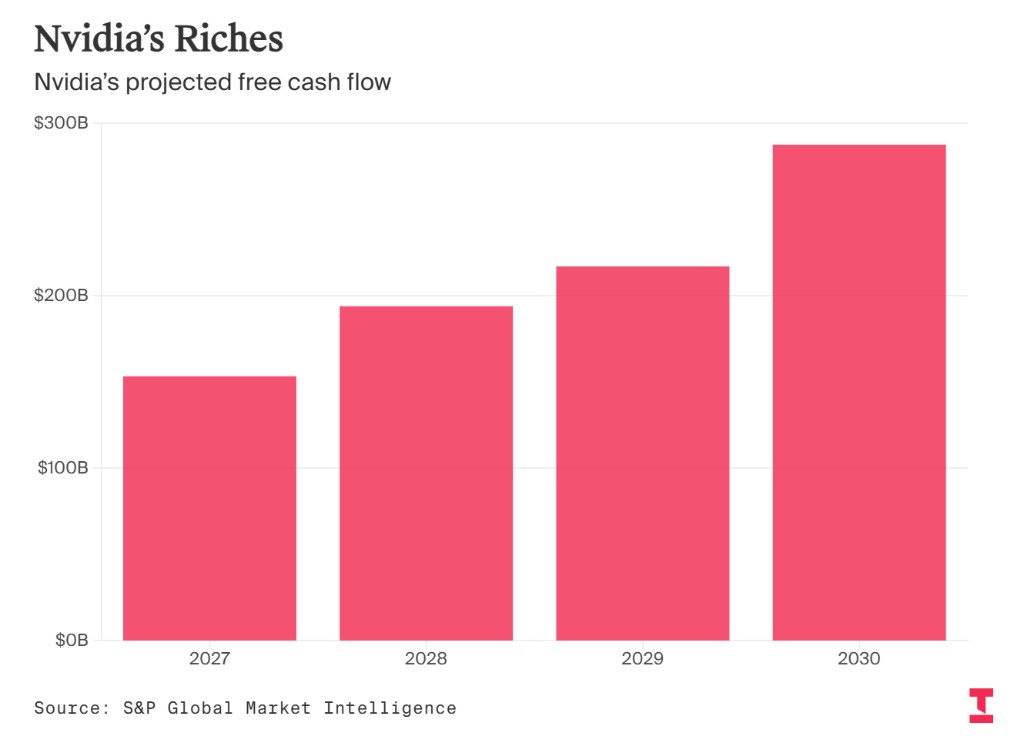
Benefiting from the surge in sales of AI-specific chips, NVIDIA's free cash flow for the fiscal year ending January next year is expected to reach $96.5 billion, compared to just $3.8 billion two years ago. Analysts expect that over the four years leading up to January 2030, the company's total cash generation after capital expenditures will reach as high as $850 billion. This scale indicates a dramatic shift in wealth distribution within the technology industry, moving from a group of tech giants focused on building AI infrastructure to NVIDIA, which serves as a core upstream supplier.
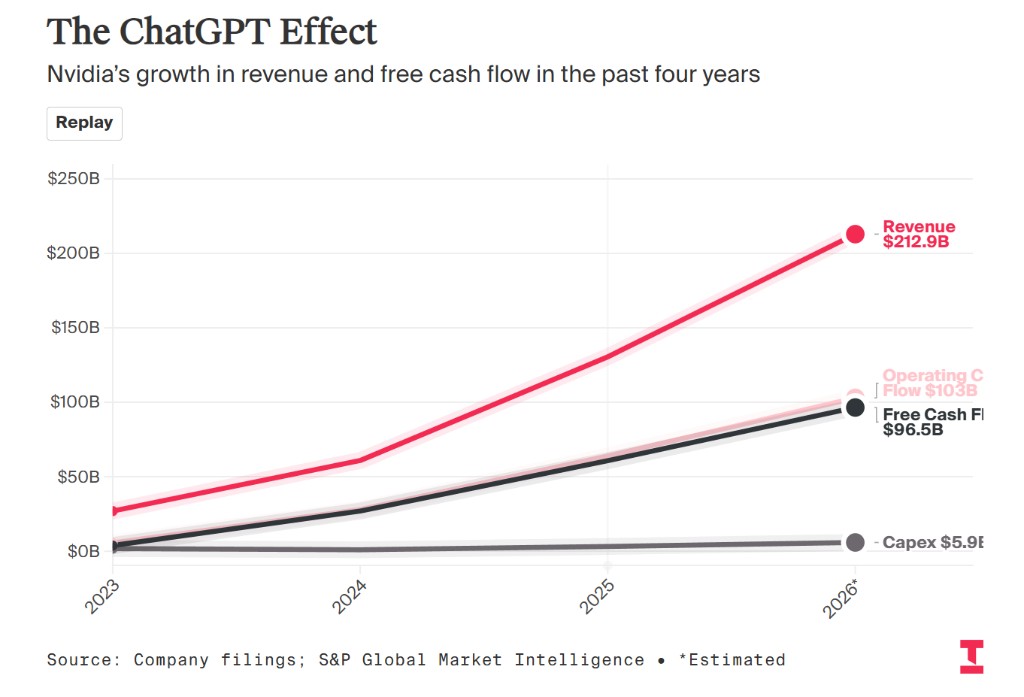
In light of the surge in liquidity, NVIDIA CEO Jensen Huang stated that the company will continue to advance stock buybacks and use funds to support growth and expand its ecosystem. Currently, the company's cash reserves on its balance sheet have risen from approximately $13 billion at the beginning of 2023 to $60 billion by the end of October this year. Meanwhile, NVIDIA is attempting to solidify its market demand through customer injections and more complex financial maneuvers, a unique expansion strategy that is drawing close attention from the market regarding its capital usage logic.
While competitors like Google and Meta have often chosen to consume cash through diversified investments in the past, NVIDIA seems more inclined to reinvest its capital into its own dominant AI chip ecosystem. This unprecedented cash generation capability and highly focused spending model are prompting investors to reassess the company's long-term capital return path and potential market influence.
Epic Cash Flow Explosion
NVIDIA's cash generation capability is undergoing a qualitative leap. Data shows that for the year ending January 2023, NVIDIA's free cash flow was only $3.8 billion, but with the takeoff of AI chip sales, this figure is expected to soar to $96.5 billion for the fiscal year ending next January. This revenue growth represents a compound annual growth rate of up to 194%.
During the same period, NVIDIA's expected total free cash flow will significantly exceed the anticipated levels of Google, Meta, Amazon, and Microsoft. Looking back at the financial history of large tech companies since 1990, the only comparable period was Apple's surge in the years following the launch of the iPod in 2001.
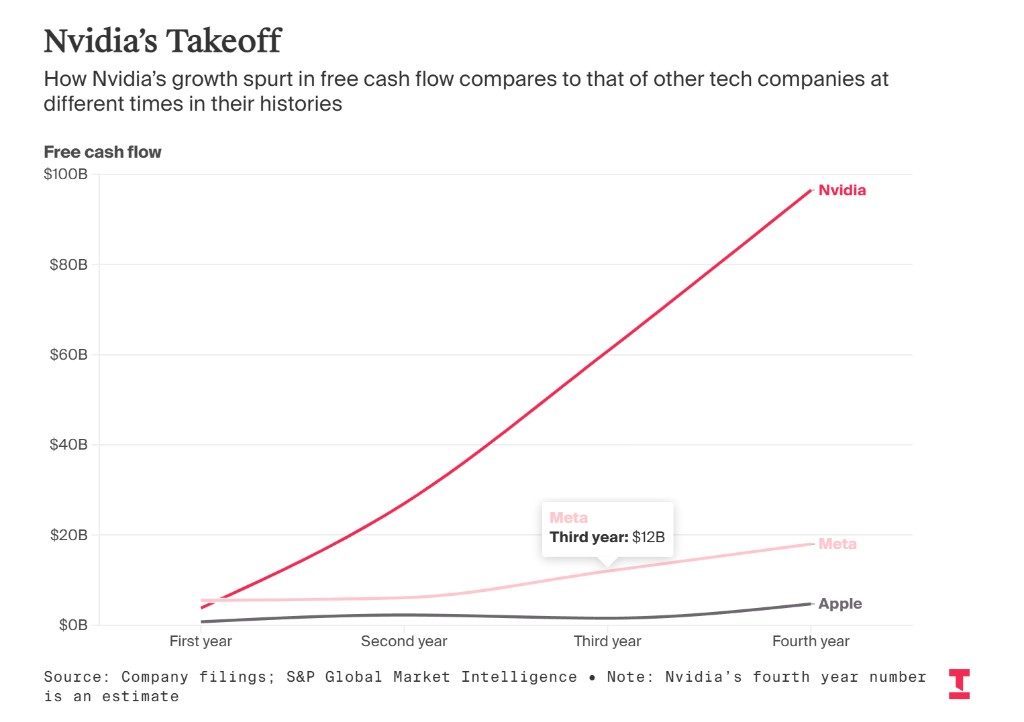 The four major tech giants are currently significantly increasing capital expenditures to build AI infrastructure, a move that is compressing their own free cash flow while effectively causing a massive transfer of wealth within the industry—huge amounts of money are flowing like a tide from these major clients to NVIDIA.
Additionally, NVIDIA's expected total cash flow has surpassed that of Apple. Unlike the aforementioned four companies, Apple's investment scale in AI is relatively small, and its overall capital expenditures have historically been low, making NVIDIA's surpassing of cash generation capabilities even more symbolic.
Looking ahead, this growth trend shows no signs of slowing down. The company's report released last week indicated a 62% revenue growth for the October quarter. According to S&P Global Market Intelligence, analysts expect NVIDIA to generate a total of approximately $850 billion in cash after capital expenditures over the four years ending January 2030. Even if the final actual amount is halved, it would still be a significant surpassing of the total of $21 billion generated by the company during the four fiscal years from 2020 to 2023.
Building Ecosystems and Reverse Investment
Suddenly "awash with money," the market is focusing on NVIDIA's allocation of funds. The company has announced a series of investment plans targeting companies that use its chips, including plans to invest $10 billion in Anthropic and $100 billion in OpenAI. These moves have raised market questions: Is NVIDIA trying to artificially increase demand for its chips by funding its customers?
In addition to direct investments, NVIDIA has also invested in emerging cloud service companies like CoreWeave that purchase its chips. In some cases, NVIDIA has taken more aggressive financial measures. The company stated this week that it has provided guarantees for multi-center leases for an unnamed cloud company in exchange for stock warrants. This guarantee helps reduce loan risks, thereby lowering the financing costs for that data center.
Jensen Huang responded during the earnings call that investing in companies like OpenAI is aimed at expanding "our ecosystem" and using cash to fund growth. This indicates that NVIDIA has taken a different growth path compared to Meta and Google: the latter typically diversifies into other businesses (such as virtual reality or autonomous vehicles) using cash, while NVIDIA chooses to double down on its core business ecosystem.
Stock Buybacks and Cash Reserves
In addition to external investments, returning capital to shareholders remains an important component of NVIDIA's fund utilization. In the first three quarters of the current fiscal year, NVIDIA's stock buyback expenditure has increased from $10 billion in fiscal 2023 to $36 billion. Jensen Huang confirmed that the company will continue to "engage in stock buybacks."
Despite the large expenditure plans, cash on NVIDIA's balance sheet continues to accumulate steadily, as some high-profile investments have yet to be completed—for example, negotiations between OpenAI and NVIDIA are still ongoing regarding final terms Growing from approximately $13 billion at the beginning of 2023 to $60 billion by the end of October, this ever-expanding figure is both a testament to strength and leaves significant room for imagination regarding its future capital allocation strategy
