


Morgan Stanley: The end of QT by the Federal Reserve does not equal the restart of QE, and future balance sheet expansion is not easing; the Treasury's bond issuance strategy is the key!

Morgan Stanley believes that the Federal Reserve's end of quantitative tightening does not equate to the restart of quantitative easing. The essence of its operations is asset swapping, replacing maturing MBS with short-term debt, aimed at changing the composition of the balance sheet rather than expanding its size, thus it is not monetary easing. Any potential future balance sheet expansion would only be a technical operation to hedge cash demand. It emphasizes that the real market key lies in the U.S. Treasury's bond issuance strategy, which will dominate market duration and liquidity
The Federal Reserve's decision to end quantitative tightening (QT) has sparked widespread discussion in the market about its policy shift, but investors may not simply equate this move with the onset of a new round of easing.
According to a report by Morgan Stanley, the Federal Reserve announced at its recent meeting that it would end quantitative tightening on December 1. This action comes about six months earlier than the bank had previously anticipated. However, its core mechanism is not the "flooding" of liquidity that the market expected.
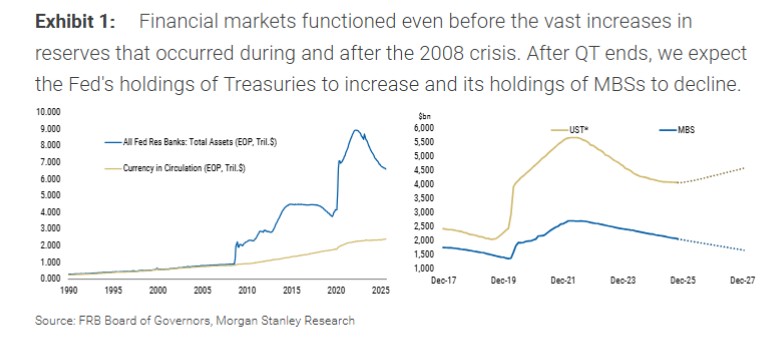
Specifically, the Federal Reserve will stop reducing its holdings of Treasury securities but will continue to allow approximately $15 billion of mortgage-backed securities (MBS) to mature and flow out of its balance sheet each month. At the same time, the Federal Reserve will purchase an equivalent amount of short-term Treasury bills (T-bills) to replace these MBS.
The essence of this operation is an asset swap, rather than an increase in reserves. Seth B Carpenter, Chief Global Economist at Morgan Stanley, emphasized in the report that the core of this operation is changing the "composition" of the balance sheet, rather than expanding its "size." By releasing the duration and convexity risks associated with MBS into the market while purchasing short-term debt, the Federal Reserve has not materially loosened financial conditions.
Ending QT Does Not Mean Restarting QE
The market needs to clearly distinguish this operation from the fundamental differences of quantitative easing (QE). QE aims to inject liquidity into the financial system through large-scale asset purchases, thereby lowering long-term interest rates and easing financial conditions. In contrast, the current plan of the Federal Reserve is merely an adjustment within its asset portfolio.
The report points out that the Federal Reserve's replacement of maturing MBS with short-term Treasury securities is a "securities swap" with the market and will not increase reserves in the banking system. Therefore, interpreting it as a restart of QE is a misunderstanding.
Morgan Stanley believes that although the Federal Reserve's decision to end QT early has attracted significant market attention, its direct impact may be limited. For example, stopping the monthly reduction of $5 billion in Treasury securities six months early results in a cumulative difference of only $30 billion, which is negligible in the context of the Federal Reserve's massive investment portfolio and the overall market.
Future Balance Sheet Expansion Is Not "Flooding": Just for Hedging Cash Demand
So, when will the Federal Reserve's balance sheet expand again? The report suggests that, aside from extreme situations such as a severe recession or financial market crisis, the next expansion will be for a "technical" reason: to hedge against the growth of physical currency (cash).
When banks need to replenish cash for their ATMs, the Federal Reserve provides banknotes and correspondingly deducts from that bank's reserve account at the Federal Reserve. Therefore, the growth of cash in circulation will naturally consume bank reserves. Morgan Stanley predicts that in the coming year, to maintain stable reserve levels, the Federal Reserve will begin purchasing Treasury securities. At that time, the Federal Reserve's bond-buying scale will increase by an additional $10 billion to $15 billion per month, on top of the $15 billion used to replace MBS, to match the reserve loss caused by cash growthThe report emphasizes that the purpose of this bond-buying behavior is merely to "prevent a decline in reserves," rather than "increase reserves," and therefore should not be overly interpreted by the market as a signal of monetary easing.
The Real Key: The Treasury's Bond Issuance Strategy
Morgan Stanley believes that for the asset market, the real focus should shift from the Federal Reserve to the U.S. Treasury.
The report analyzes that the Treasury is the key player in determining how much duration risk the market needs to absorb. The Treasury's new bond issuance ultimately brings back the Treasury bonds that the Federal Reserve has reduced. Recently, the Treasury's strategy has leaned towards increasing the issuance of short-term bonds. The Federal Reserve's purchase of short-term Treasury bonds may facilitate the Treasury's further increase in short-term bond issuance, but this entirely depends on the Treasury's final decision.
The above exciting content comes from [Chasing Wind Trading Platform](https://mp.weixin.qq.com/s/uua05g5qk-N2J7h91pyqxQ).For more detailed interpretations, including real-time analysis and frontline research, please join the【 [Chasing Wind Trading Platform ▪ Annual Membership](https://wallstreetcn.com/shop/item/1000309)】[](https://wallstreetcn.com/shop/item/1000309)For investors, this means that the future liquidity and interest rate trends in the market will be more influenced by the Treasury's financing strategy (i.e., whether to issue long-term or short-term bonds). This is the core variable that determines the market direction