


 Commemorative
 Likes Received
JPMorgan Chase's 2024 Q1 earnings report interpretation: Revenue exceeds expectations with significant profit improvement

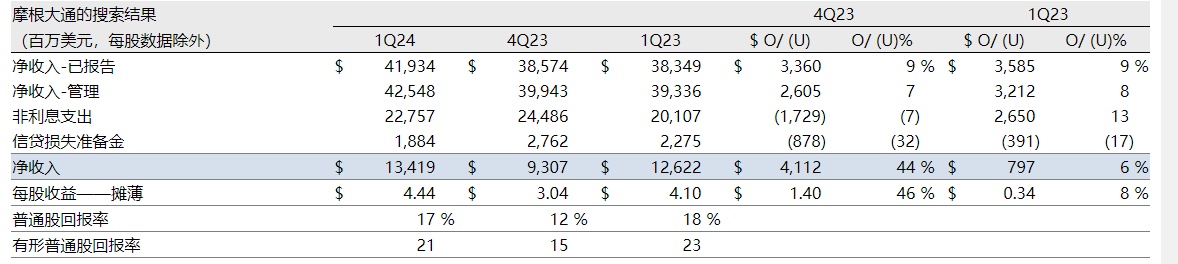
On Friday, April 12, before the U.S. stock market opened, JPMorgan Chase released its Q1 2024 earnings report. JPMorgan Chase achieved revenue of $41.934 billion in Q1, exceeding market expectations, with both quarter-over-quarter and year-over-year growth at 9%.$JPMorgan Chase(JPM.US)$Dow Jones Industrial Average(.DJI.US) $Direxion S&P 500 Bull 3X(SPXL.US) $NASDAQ Composite Index(.IXIC.US) $Hang Seng Index(00HSI.HK) $Invesco QQQ Trust(QQQ.US) $BlackRock(BLK.US) $Citigroup(C.US)
I. Summary of Personal Views
1. From the specific data, JPMorgan Chase's performance growth in Q1 was quite significant, with revenue growth far exceeding expectations, and profit growth was also very notable. The trend in net interest income growth remains solid.
2. The overall performance of the banking sector is highly divergent. Financial giants like JPMorgan Chase and Wells Fargo face certain risks of net interest income falling short of expectations, while Citigroup's performance guidance is quite impressive.
3. Based on the performance guidance, JPMorgan Chase is quite cautious about its full-year 2024 performance, influenced by overall banking sector volatility and U.S. interest rate cut expectations. Short-term stock price pressure is high, but the long-term bullish trend remains intact.
Overall, JPMorgan Chase's Q1 performance was impressive, with both revenue and profit growth exceeding expectations, and net interest income growth remaining solid. However, the banking sector's performance is divergent, with JPMorgan Chase and Wells Fargo facing risks of net interest income falling short, while Citigroup's guidance is strong. For the full-year 2024 performance, JPMorgan Chase remains cautious due to banking sector volatility and U.S. rate cut expectations, leading to short-term stock price pressure, but the long-term bullish trend is still promising.
II. Financial Analysis: Revenue Growth Exceeds Expectations, Profit Improvement Evident
In terms of revenue, JPMorgan Chase achieved $41.934 billion in Q1, exceeding market expectations, with both quarter-over-quarter and year-over-year growth at 9%. This reflects steady revenue growth. However, in terms of specific business segments, JPMorgan Chase's net interest income (NII) in Q1 was $23.2 billion, up 12% YoY but down 4% QoQ. This marks the first quarterly decline since 2021, possibly indicating pressure on net interest margins, which is also reflected in the guidance.
In terms of profitability, JPMorgan Chase continued its strong performance from the previous quarter, achieving net income of $13.419 billion, up 44% QoQ and 6% YoY. The overall growth trend remains robust. Earnings per share were $4.44, compared to $4.1 in the same period last year, largely in line with market expectations.
III. Operational Insights: Solid Net Interest Income Growth, Mixed U.S. Banking Sector Performance, Cautious 2024 Guidance
1. Solid Net Interest Income Growth
In its core business performance this quarter, JPMorgan Chase once again demonstrated its financial strength, with net interest income showing strong growth.
Specifically, JPMorgan Chase's net interest income (NII) reached $23.2 billion in Q1, up 12% YoY. This figure not only highlights JPMorgan Chase's strong performance in interest income but also continues the steady growth trend from previous quarters. However, compared to the previous quarter, NII contracted by 4%, possibly due to market rate fluctuations and loan portfolio adjustments. Overall, JPMorgan Chase's interest income performance remains solid.
In terms of deposit and loan volumes, JPMorgan Chase also performed well. As a leading bank, its deposit-gathering capabilities are widely recognized, providing a stable funding source to support business growth. Additionally, loan loss provisions decreased significantly, reflecting improved credit quality and effective risk management.
In investment banking, JPMorgan Chase also delivered strong results. IPO-related investment income met expectations, boosting non-interest income and further solidifying its leading position in global investment banking.
2. Mixed U.S. Banking Sector Performance
As one of the first companies to report Q1 earnings, JPMorgan Chase, along with other financial giants like Wells Fargo, released results on Friday, showing a mixed performance. Notably, JPMorgan Chase's guidance for net interest income fell short of market expectations, raising investor concerns about whether high-interest rates are starting to pressure profitability. Similarly, Wells Fargo also missed net interest income expectations, reinforcing the market view that the benefits of high rates may be fading after multiple quarters of strong banking performance.
However, not all banks faced challenges. Citigroup exceeded market expectations in Q1 FICC sales and trading revenue, earning market recognition. On the other hand, asset management giant BlackRock fell short of net inflow expectations, raising doubts about future profitability. That said, BlackRock remains one of the world's largest wealth managers.

3. Full-Year Guidance Analysis
For full-year financial guidance, JPMorgan Chase provided a relatively cautious outlook. Despite market expectations for an upward revision to net interest income guidance, the company maintained its previous forecast. This reflects its emphasis on risk control and cautious stance on future market trends.
JPMorgan Chase expects full-year 2024 net interest income to remain around $90 billion, unchanged from its previous annual report. This shows the company's commitment to stable income. Additionally, it slightly adjusted its NII guidance (excluding market operations) to approximately $89 billion.
In terms of expenses, JPMorgan Chase revised its guidance upward, expecting expenses to rise to $91 billion, $1 billion higher than the previous forecast. This suggests increased investments in business expansion, technology upgrades, and market expansion to enhance competitiveness and market share. Combined with the lower-than-expected NII, the overall guidance is quite cautious, explaining the sharp stock price decline post-earnings.
This article is a personal interpretation of the quarterly report, reflecting my analysis within my capabilities. Feedback is welcome. Additionally, this does not constitute investment advice; readers should conduct their own research.
The copyright of this article belongs to the original author/organization.
The views expressed herein are solely those of the author and do not reflect the stance of the platform. The content is intended for investment reference purposes only and shall not be considered as investment advice. Please contact us if you have any questions or suggestions regarding the content services provided by the platform.
