


 Posts
Posts Likes Received
Palantir: What determines its high valuation?
After Dolphin finished the first part of the Palantir, there was a big news in the big data field-Cisco announced that it would buy Splunk, a big data analysis company, at a premium. Splunk's share price soared 21% that day. The news raised the market's attention to AI and big data, and the Palantir also gained nearly 25% in the next two weeks after the mood warmed up.
But when it comes to Palantir, most people love and hate it: the mysterious technical strength seems to indicate the unlimited potential of Palantir, but the listing of three years of 37% CAGR growth rate, in fact, contains a lot of epidemic dividend water, after the real growth rate may not match the "unlimited potential.
Moreover, since the fourth quarter of last year, Palantir revenue growth has fallen back to 15% +, especially for non-governmental (corporate) institutions. If this level of growth continues, it will be difficult to match the current valuation of the Forward PS 14x.
In "Palantir: AI-Activated" Mysterious "Military Weapons" above, Dolphin explained the growth pressures of the Palantir in terms of the factors influencing the expansion of the defense budget and the competitiveness of the Palantir in the corporate market. Although we can not arbitrarily believe that the growth potential of the Palantir is very small, after all, in the eyes of the management, the company's touchable market size is nearly 100 times the current operating income. Through the revaluation of the potential market size TAM, we believe that AI empowerment is not only the icing on the cake for finding the Palantir of the moment, but more like the core key to helping the company maintain high growth in the medium and long term.
However, before answering the growth question, Dolphin would also like to discuss the Palantir business model (whether it can be consistently profitable). After all, a re-customization, re-operation of the product, more rely on the pile of people (service), but Palantir competitors tend to choose lighter products (software), in the increasingly competitive situation, will drag down the Palantir to achieve profitability speed?
Eventually Dolphin will focus on the results of the discussion of these two issues, to give a reasonable valuation of the Palantir.
The following is the main text:
1. The blood and tears of peers: Data analysis platforms cannot escape the" profit curse "?
It is common for software companies to lose money in their early days. But as long as the product passes and there is demand in the market, the revenue scale can be expanded exponentially in a short period of time by selling kits to collect licensing fees. For SaaS companies, the market tends to give higher valuations because of the scalability of the product itself and the sustainability and predictability of the subscription model.
It turns out that the SaaS giants that eventually survived and grew have reached very impressive profit margins after a period of high growth. Even if the annual revenue growth rate has been less than 20%, but a good profit model still allows them to earn high profits, the market value is also growing step by step.
But Dolphin studied the development history and financial data of three vertical big data analysis companies (Qlik, Splunk, Tableau) and found that they all have the "curse" of difficulty in making profits.
Although these three companies enjoy sufficient popularity in the field of data analysis segmentation, after the rapid slowdown in revenue growth (indicating that the company's growth encounters a bottleneck or enters a mature period), profit margins have not reached the desired height. Even positive margins are only available during the Q4 signing season, but most seasons are still in the red. Eventually Qlik and Tableau were privatized and delisted in 2016 and 2019, respectively, and Splunk, while still trading in the open market, has not yet broken even, and it is only with the ever-expanding scale of revenue from Cloud products that there has been a significant loss reduction.
Why is it difficult for a data analysis company to make money? Does it mean that Palantir also have the problem of being difficult to make profits? How to predict whether the Palantir business model will work?
Next, Dolphin King will make an analysis.
1.1 data analysis track long-term profits are thin: giants eat fat, small companies only hard bones.
In the big data industry chain, generally divided into three important links-data sources, infrastructure, data processing (storage, quality control, integration, analysis, etc.). Big Data Analysis (Big Data & Analytics) belongs to the data processing link, which is subdivided into four parts according to specific technologies and functions-performance management and planning, business intelligence and analysis, management and integration of analytical data, AI software and related cloud services.
The products Palantir mainly belong to the second sector, namely BI, or Business Intelligence Software (Business Intelligence software) and Business Analysis (Analytics), referred to as "BIA".
However, from the peer comparison in the figure below, it is more accurate to say that the Palantir's advantages are focused on the latter's "analysis", which is manifested in data visualization, predictive analysis, and geospatial intelligence (e. g., collecting and integrating various types of data to predict potential natural disasters). Of course, other sectors in big data analysis, Palantir also have more or less some products involved. Companies that also have a competitive advantage in the analysis process are mainly giants in the industry such as IBM, Oracle, SAP, Microsoft, etc. In addition to Tableau having the same strong competitive advantage in data visualization, vertical companies do not have the ability to compete directly with Palantir in other aspects. Therefore, in terms of product power, Palantir most direct competitors are actually the giants of the industry.
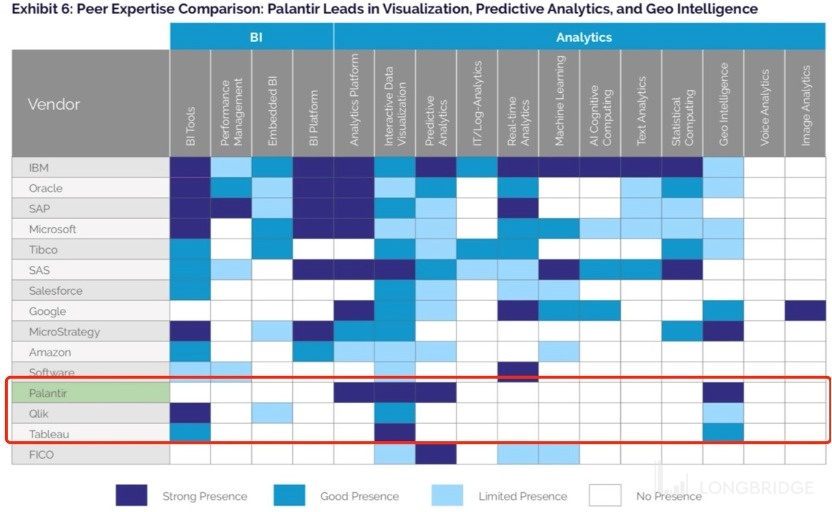
But the question is whether the "data analysis" link in the industry chain can be profitable alone, there have always been doubts in the market. The above-mentioned giants in the field of big data (IBM, Oracle, SAP, Microsoft, Google, etc.) often take advantage of their original advantages in data sources (data accumulation) or software and hardware infrastructure to further dabble in the subdivision of data analysis. Moreover, compared with [business analysis], which has higher technical requirements and more personalized customer needs, [BI business intelligence software] is more versatile, that is, it is easier to scale, so it will run faster in business models.
However, for vertical companies that do data analysis alone, especially those that focus on the subdivision of [business analysis], such as Palantir, Splunk, Tableau, Qlik, etc., they have been in business for many years (Palantir 2003,Splunk 2003,Qlik 1993), but are still struggling to break-even line.
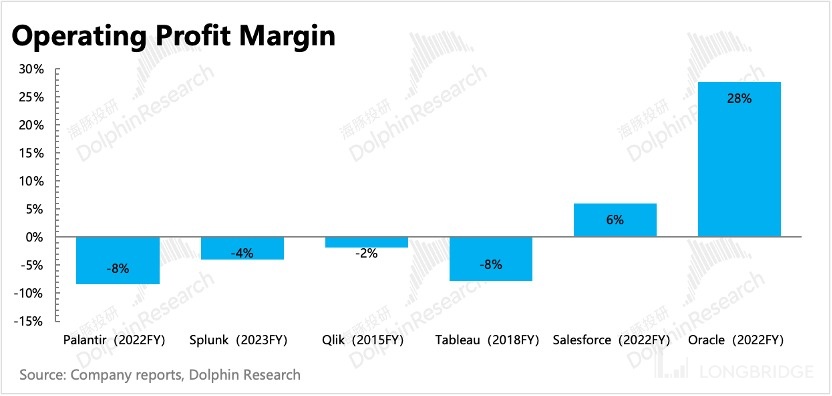
It can be said that the place with the fattest (most profitable) meat in the industrial chain has been targeted by the giants early on and has carved up most of the market with its own capital and scale advantages. For small companies, they can only rely on hard strength to gnaw the remaining bones.
1.2 Comparison of Indicators of Four Vertical Companies: Big Data Analysis, Where Does It Burn the Most Money?
(1) Small companies rely on sales, but business model adjustment is the key to breaking the game.
If you take a closer look at the cost distribution of P, S, and Q, you will find that in addition to the constant investment required in technology, the three still have another common high expenditure item-marketing and promotion costs. The Non-GAAP sales expense rates for Palantir(2022FY), Splunk(2023FY), Qlik (pre-delisting, 2015FY) and Tableau (pre-delisting, 2018FY) reached 26.6 percent, 36.8 percent, 53.5 percent and 43.9 percent, respectively.
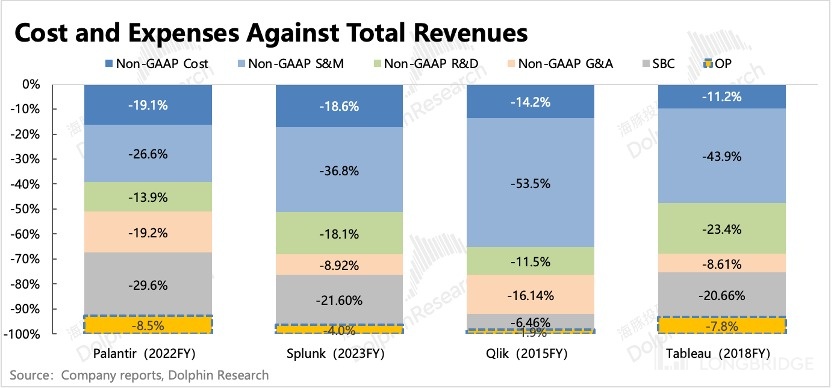
At this point, the Palantir sales rate is still low. However, **Dolphin Jun believes that this may be related to the fact that Palantir has an absolute advantage in the field of government defense. If we only look at the non-governmental commercial market, the rates that may be Palantir are not low. * * The high sales fee rate indicates that the ability to "scale the business" is relatively weak. On the one hand, it may be caused by the lack of competitiveness of the product itself, on the other hand, it may be related to the track it is on and the business model of the track. As we know from the previous article and the previous article, Palantir is not a poor technical strength in the segment to which it belongs ("Business Analysis"), which, combined with Splunk, Qlik, and Tableau, suggests that the higher cost of sales ratio is more related to the business model of the entire track. In this regard, the data analysis company's solution is to transform into a cloud SaaS product, generally adopting a subscription charging model, but at present, most of the revenue contribution of Palantir and Qlik still comes from the licensing revenue of the project system, as well as the revenue of operation and maintenance services related to the contract. And Splunk timely transformation of the cloud, cloud services revenue accounted for nearly 10% in 2020 after the start of separate disclosure, the current cloud business has become a pillar business.
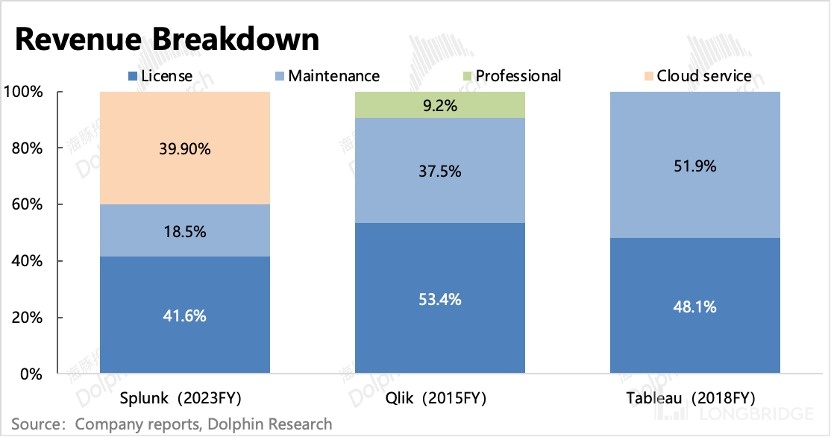
Compared with the sustainable and predictable growth driven by the easy scalability of cloud products, the disadvantages of the business model of the project system are obvious:
1) The income fluctuates greatly
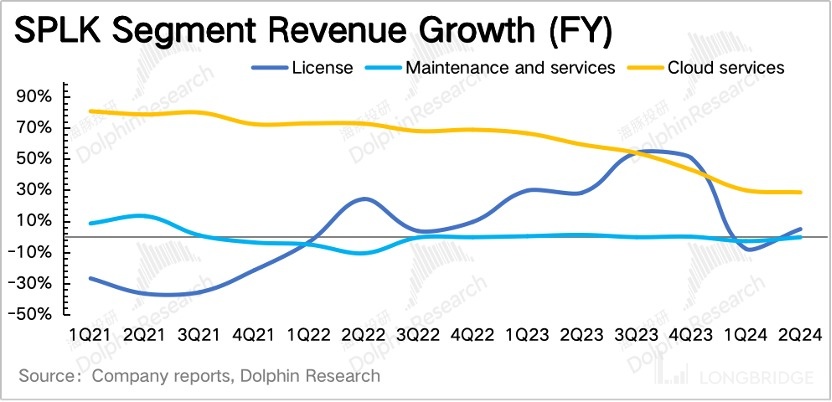
For example, from the income structure of Splunk, it can be seen that the growth rate of Cloud subscription income in the subdivided business keeps steady convergence with the expansion of scale, but the License income is highly related to whether there is a contract increment in the current period, therefore, there will be sharp fluctuations in the growth rate.
2) Marketing rigidity
Generally speaking, under the project system, the supplier will sign a typical 3-5 year authorization contract with the customer, which will then be recognized as License revenue in installments. Because suppliers need to go deep into the customer's business to develop customized analysis modules and provide a complete set of products and services, the amount of a single contract can be huge, and even changes in a single contract can have a large impact on revenue. High unit prices will delay the customer's decision-making time, and the customer still has the right to terminate the contract early. Therefore, in addition to the need to invest a large amount of marketing expenses when the initial conversion of customers, during the life of the contract, data analysis companies may still need to continue to generate essential expenses in order to maintain customer relationships.
(2) Palantir have higher equity incentives than their peers
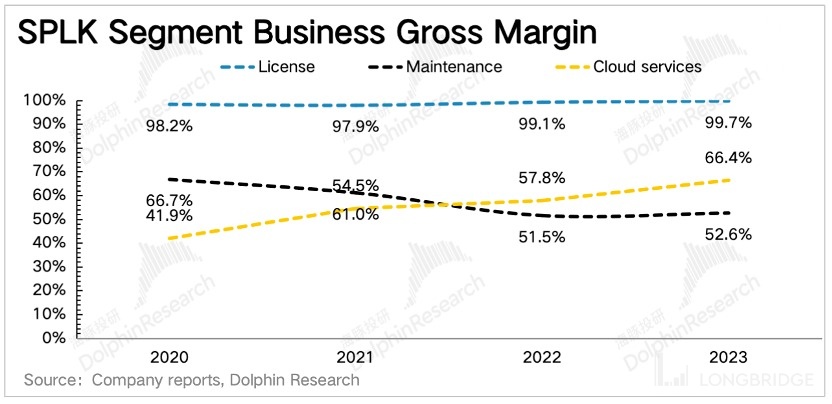
In addition to marketing costs, the other relatively high are research and development costs and equity incentives for employees. For software companies, gross margins are usually higher because the cost is mainly depreciation and amortization of some infrastructure. Both Splunk and Qlik's combined gross margin reached more than 80%, Splunk's gross margin was somewhat affected in the early days of the launch of cloud services, but Splunk's overall gross margin began to gradually recover as the scale effect of cloud services continued to increase and the gross margin of individual businesses improved rapidly.
In comparison, the Palantir is slightly lower, but it is also 70% +, possibly due to a slightly higher proportion of revenue from professional services (Professional services) with low gross margins. (Refer to Splunk's combined gross margin for maintenance and professional services and Qlik's gross margin for professional services versus License authorized revenue)
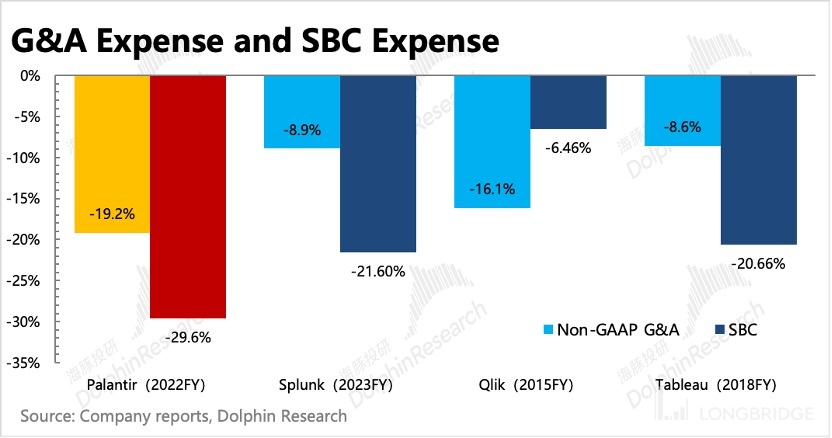
Palantir Compared with Splunk and Qlik, there are also differences in other expenditure items. The main difference is that the Palantir management fees and equity incentives for employees are significantly higher. In addition to the salary of the company's administrative and operational personnel, the Palantir's management expenses also include the cost of some third-party professional service personnel. But in any case, whether it is management fees or equity incentives, accounting for too high a proportion of revenue is the company's inefficient operation, unfriendly to small and medium-sized shareholders. Of course, on the other hand, it can also be said that Palantir still have a lot of room for improvement and loss reduction in the future.
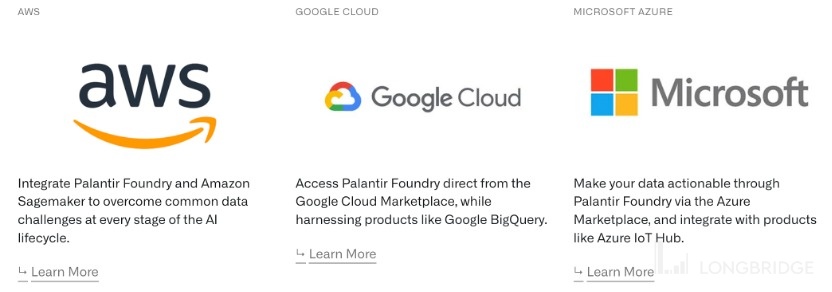
In summary, although the Palantir in sales, technology investment are relatively high, resulting in revenue growth at the same time on the cost of the cost of the effect is not obvious, but compared to the technology research and development of burning money, Dolphin Jun believes that the urgent need to solve is the business model (product form, charging method). This is also the key point for Palantir to really get rid of the profit dilemma-that is, cloud revenue can quickly become the main support for revenue like Splunk * * * *(Palantir has cooperated with AWS, Google cloud and Azure to provide cloud products since 2019, and has continuously expanded its cooperation with these public cloud providers in the past two years)
In addition, the Palantir also has some room for optimization in the company's operating expenses and employee benefits. Whether it is adjusting the binding mechanism between salary and performance or rigidly compressing employee salary, it will help ——to accelerate loss reduction ,and reduce the market's suppression of valuation due to potential equity dilution risks.
1.3 A measure of whether the scale effect exists-Contribution Margin (marginal revenue)
How to predict whether the company's business model has economies of scale before the software company really achieves break-even?
Qualitatively, of course, the most critical thing is the company's own business model switch-such as from signing contracts to selling licenses to cloud subscriptions. From Splunk's pre-and post-transformation comparison, we conclude that the shift from selling mainland-deployed kits to offering cloud-based subscriptions will gradually improve overall profitability as the scale of cloud service revenue continues to expand and the acquisition and maintenance cost rate of individual customers decreases.
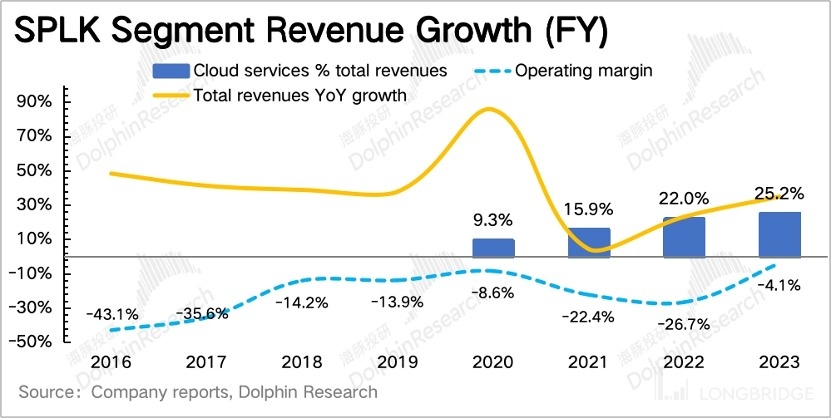
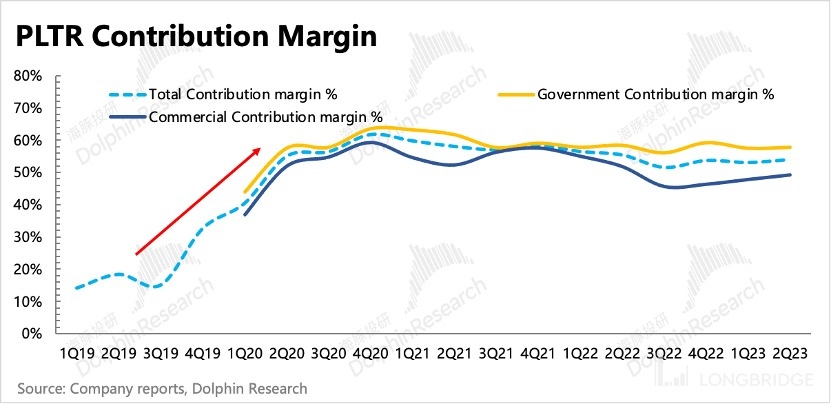
On the other hand, it has been four years since the Palantir moved to the cloud from 2019 to now, is the scale effect (the cost of acquiring customers as a proportion of customer generated revenue is getting lower and lower) reflected? Palantir proposed a "Contribution Margin" operating indicator concept to measure the proportion of revenue that exceeds variable costs. That is, management expenses, research and development expenses, and employee equity incentive SBC are treated as fixed expenses that do not vary with revenue, and operating costs and selling expenses excluding SBC are treated as variable expenses to measure the level of profit per unit of product sales.
The formula is: Marginal revenue = [total revenue -operating costs (excluding SBC)-selling expenses (excluding SBC)]/total revenue
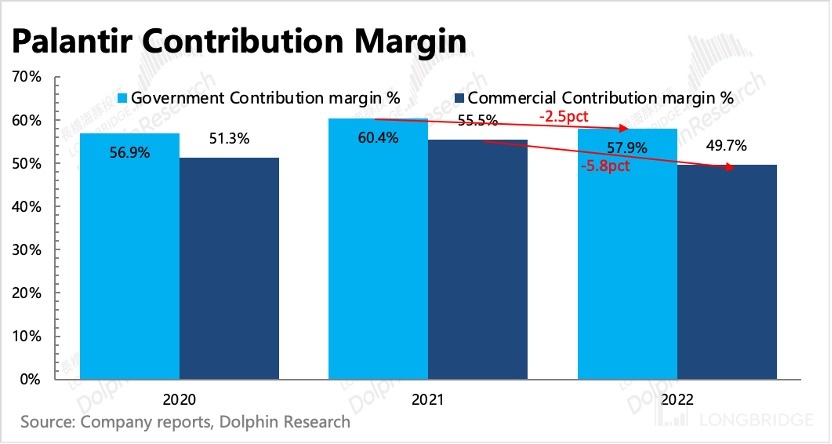
Looking at the Palantir alone, the combined marginal rate of return will surge rapidly in 2020, but will weaken again significantly in the second half of 2022. Thus, the performance of the past two years has mainly benefited from the outbreak dividend. The Palantir has a clear advantage in the government sector, with marginal yield volatility before and after the epidemic (+-3%) more robust than the commercial market (+-8%).
What level does that Palantir place in the peers? Because Palantir have a special advantage in the government sector, we compare the marginal profit margin of the commercial market horizontally with our peers (Splunk, Tableau, Qlik):
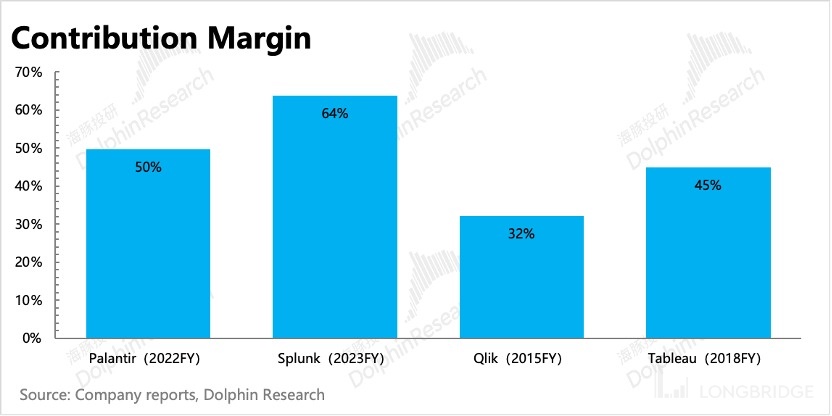
In static comparison, the marginal rate of return of Palantir is higher than that of Qlik 8 years ago and Tableau 5 years ago. However, in terms of the front and back trends of the three peers, Splunk (continuous improvement) is significantly better than Qlik (sharp fluctuations) and Tableau (continuous decline).
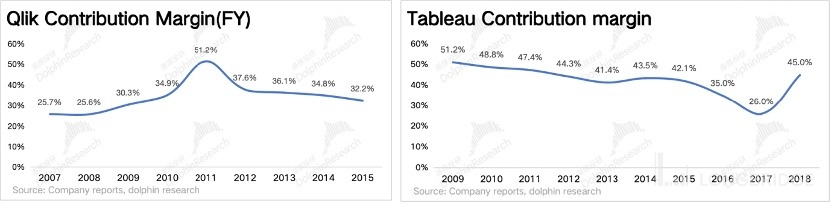
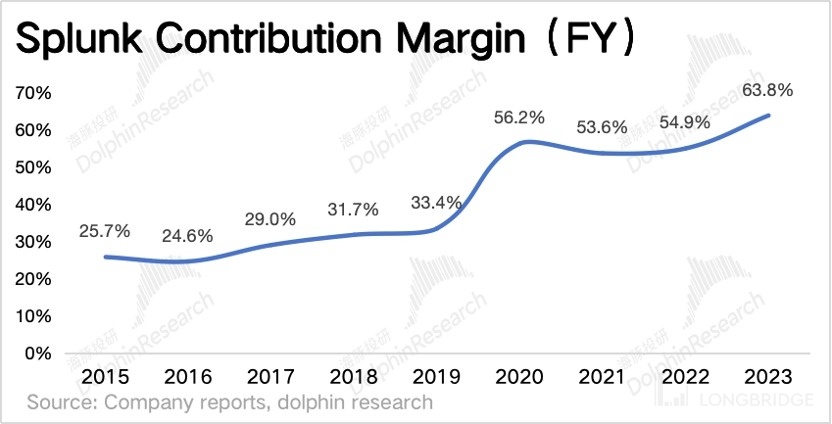
To sum up , Dolphin believes that although Palantir has its own genes that are difficult to make money because of the particularity of the track, it is not without the possibility of continuous profit.
Splunk's scale effect can run out, the core key still depends on its timely transformation of cloud service subscriptions, as well as in its own advantages to maintain the continued expansion of cloud service scale.
This is also illustrated from another perspective, in the third-party consulting firm IDC's market size forecast for future business intelligence analysis, also gave a significantly higher growth rate for cloud-based service product forms than the business model of selling software alone.
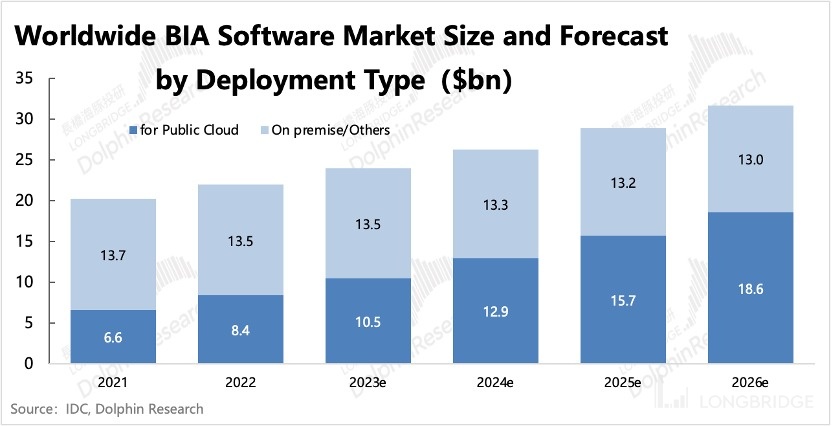
In the current Palantir, although it has tried to switch business models, the revenue contribution of cloud products has not yet formed obvious support, so it will appear that the Contribution margin will increase slowly. In addition, since the marginal rate of return of the Palantir government business is already relatively high (around 60%) under the monopoly advantage, there is limited room for further improvement due to the special field. But the business sector is different, customer choice is purely market-oriented behavior , data analysis companies in the adoption of the adapted business model, as long as the more competitive, theoretically the company's marginal rate of return can be very high.
For example, in 2022, while government contracts grew significantly in Palantir and revenue growth picked up, the marginal return on government business did not improve significantly, but instead ended up dragging down the company's overall Contribution margin because of the commercial market's pull.
2. potential market of 100 billion? Estimating the true TAM of Palantir
Palantir management is more confident that in the 2020 prospectus, the company's potential market space (TAM) exceeds 100 billion US dollars, of which the government market is 63 billion and the commercial market is 56 billion. But the big data analysis market is very large, and there are many subdivided fields, so how many TAMs Palantir really have advantages among them? Next, Dolphin Jun will discuss by market.
2.1 Government Market
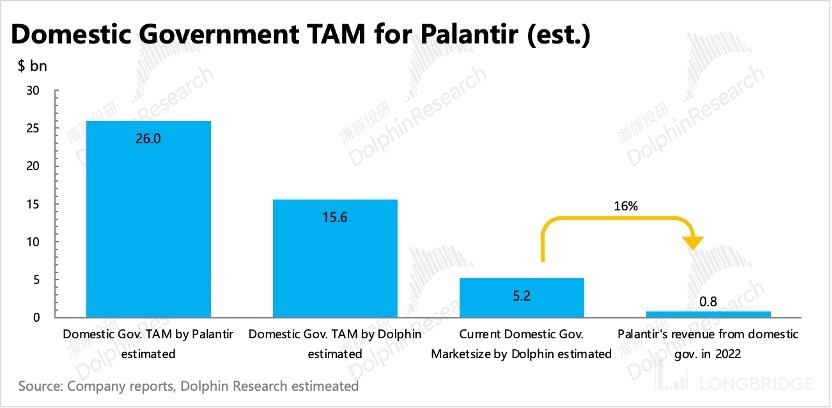
It is expected that the proportion of government IT expenditure will increase moderately.First, look at the potential market space of government agencies. Palantir, when estimating TAM, it is divided into the international market (US $37 billion) and the US domestic market (US $26 billion), I .e. assuming that 5% of the total government expenditure is spent on IT investment, and then give a percentage weight to the areas that it can reach.
Government TAM = Federal & state IT expenditures * X%= Total federal & state expenditures * 5% * X%
For the international market, Dolphin believes that although Palantir does have contract forms from Europe, Australia and other countries, due to increasing attention to homeland security and data privacy issues, it is not ruled out that more countries, like France, will choose to replace Palantir after the expiration of the existing contract. Therefore, it is reasonable to consider the real TAM only as the US market. In the U.S. government, due to the obvious advantages of Palantir, the real TAM mainly depends on how much budget government departments can actually spend on big data analysis. In terms of spending in fiscal year 2021 (2020.9-2021.9), the federal government's IT spending accounted for only 1 percent of total spending, and just before the epidemic period of the fiscal deficit, it also reached 1.5 percent. Among the institutional departments with clear IT investment budgets, the highest proportion is mainly the National Archives Department, the Nuclear Regulatory Commission and the Ministry of Commerce, which can reach about 15%, but the proportion of IT expenditure in most other departments is less than 5%.
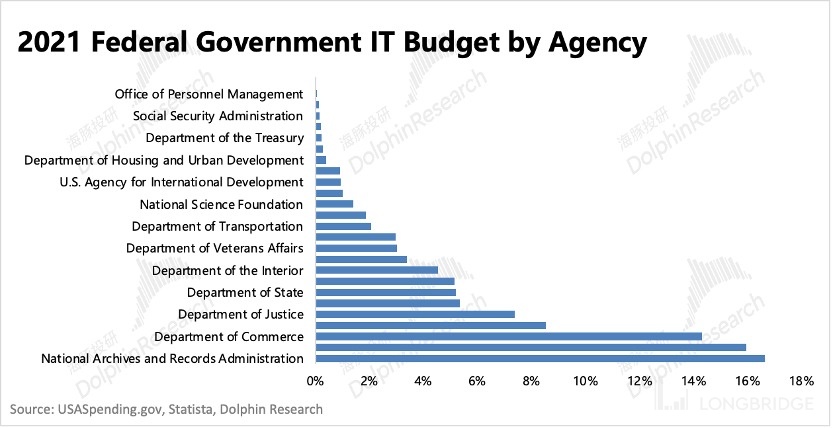
Dolphin believes that although there is data in the trend, it is still too difficult to rapidly increase the proportion of 5% expected by the Palantir in the medium and long term perspective of 5 years. Therefore, we lowered it to 2%, which is equivalent to doubling the current expenditure in the next five years, but with a disguised 40% discount compared to the company's expectations, I .e. 10.4 billion for the US government TAM in five years. In addition, according to this proportion, we estimate that the current core market size is 5.2 billion, and the revenue in the US government Palantir 2022 is 0.826 billion, with a market share of 16%.
2.2 Commercial Market
In addition to increasing the stock market share, AI is the key to increment market. As learned from the foregoing, Palantir is mainly in the Big Data & Analytics (BDA) market, of which the main advantage is scenario prediction analysis in "Business Intelligence and Analysis (BIA). Of course, the product package of Palantir project system also includes providing customers with services such as data management, data fusion and data storage, as well as AIP platform and related cloud services just launched this year. These do not belong to BIA, but all belong to BDA as a whole.
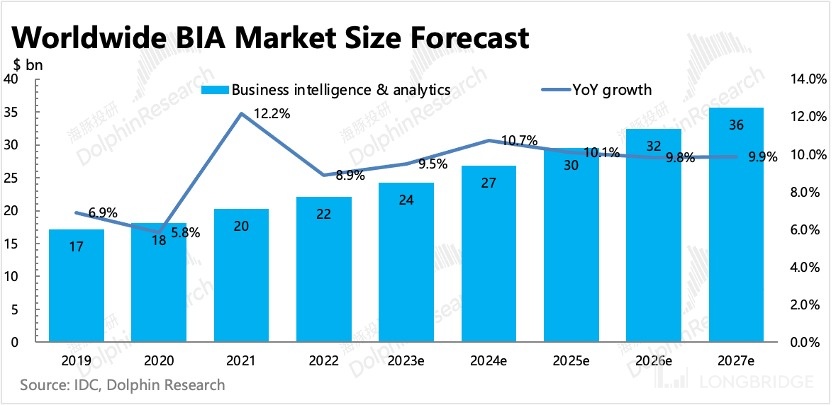
Therefore, from a more accurate point of view, Dolphin believes that the core market that can be applied to Palantir as a potential market is BIA for business intelligence, but in an optimistic case, it can also be partially extended to two sub-segments such as data management and fusion and AI platform. According to IDC's forecast data, BIA market size can reach 24.2 billion US dollars in 2023, accounting for about 18% of the whole big data analysis market. It is estimated that the compound growth rate from 2023 to 2027 will be 10%, that is, it will reach 35.6 billion in 2027. This growth rate is barely acceptable, but it is not bright. It may be difficult to digitize some businesses with traditional enterprises, thus it is difficult to realize all-round business intelligence. When the effect of scenario prediction is general, it is difficult to drive traditional enterprises to increase payment.
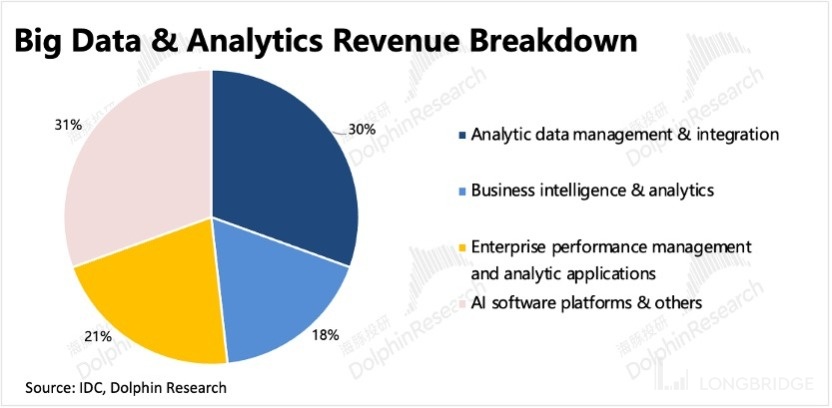
However, the growth prospects of data management and AI platform are much better: 1) Data management and integration will have a 35.6 billion market size in 2022, with CAGR expected to reach 18% in the next five years and expected to expand to 80.7 billion in 2027, doubling growth. 2) AI platform should be the "most beautiful boy" to grow in the next five years. It will only exceed 20 billion in 2022 and is expected to reach 87 billion in 2027, with an annual CAGR of 34%.
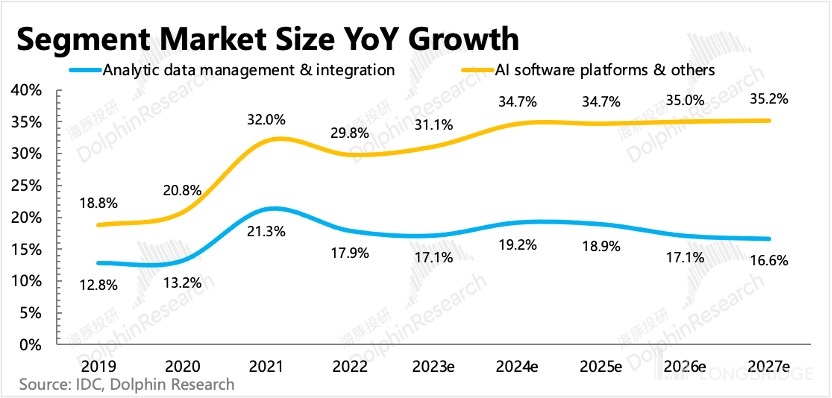
This also shows in disguise that although in the existing BIA market, Palantir can snatch customers, increase market share and increase revenue growth by adjusting their business models, introducing products that better meet their needs and expanding their sales teams. However, AI is the key to increment. With the help of the rapid growth of AI industry, it is relatively easier to reach the growth target by taking a ride. Therefore, it is not difficult to understand that Palantir quickly launched its own AIP platform and gave high hopes two months after OpenAI first showed its popularity. Therefore, in the commercial field of non-governmental organizations, according to the size of the core BIA market, the Palantir commercial TAM is expected to reach 35.6 billion US dollars in 2027, which is smaller than the company's own forecast.
However, optimistically, if independent data management platform products are hatched in the subsequent Palantir, and the scale expansion is successfully realized together with the AI products currently introduced, then coupled with the incremental market (data management, AI) that can be extended, Dolphin thinks that the Palantir commercial TAM is expected to hit US $207 billion in 2027, but YY components are the majority before the full landing.
Finally, with the core TAM of government departments, under reasonable (non-optimistic) expectations, Dolphin Jun estimates that the real TAM of Palantir is 460 billion (= 104+356) billion, which is significantly smaller than the 119 billion estimated by management, but belongs to a more focused core market space.
3. How can give a reasonable valuation of Palantir?
Although we say that AI is a very key growth driver for Palantir in the future, due to the current fierce competition in the field of data management, Palantir its own AI platform has not yet begun to be formally commercialized, Dolphin Jun believes that from a margin of safety, there is no need to rush into the expectation of entering too many non-core markets immediately at the moment. In other words, in the commercial sector, we still determine the Palantir growth space according to the core market size above ($46 billion, of which government 10.4 billion and commercial 35.6 billion).
3.1 Government Market
Dolphin assumes that Palantir advantage in U.S. government agencies can continue in the medium to long term, maintaining the current market share level of 16%. Then it is estimated that by 2027 in 5 years, the Palantir government revenue can reach 104* 16%= $1.6 billion. International government revenues, as they relate in the short term to the willingness of several countries, such as Europe, to suspend the agreement, do not make growth assumptions (zero growth) under neutral expectations and maintain the current 0.25 billion income level. In summary, we expect Palantir government revenue, local and international, to total $1.85 billion in 2027, a CAGR of 11.5 percent from the 1.07 billion-year compound growth rate in 2022.
3.2 Commercial Market
According to IDC's 2021 data, the main share of BIA market is in the hands of software giants such as Microsoft, Salesforce, SAP and IBM. Although these giants may not be "specialized" in specific fields, these giants can quickly reach users with their original product advantages from the perspective of universal requirements. In the vertical category, Qlik currently has a relatively high share, with a market share of 4.7 per cent, although it is Palantir to have a market share of 3.2 per cent in 2021.
Dolphin believes that it is still very difficult for vertical companies to break the current competitive landscape to capture the home of the general software giant. Based on relatively reasonable expectations, we believe there is hope for the Palantir to increase its long-term market share to 5% (aligned with Qlik levels) by introducing more standardized product types and adapted business models.
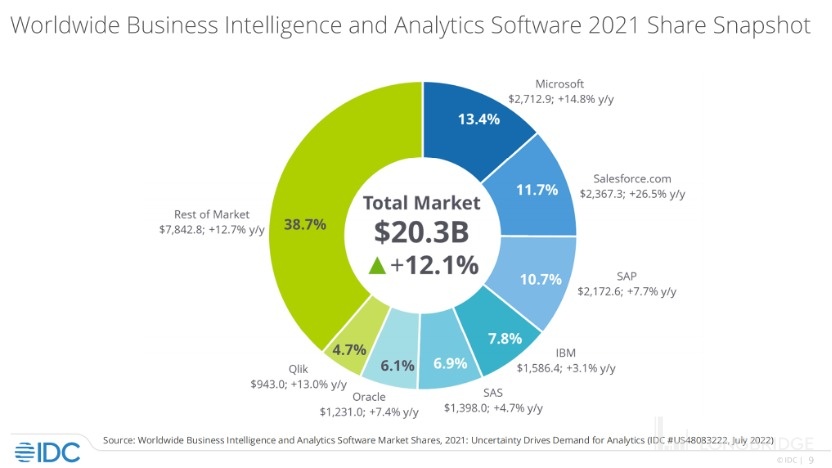
Therefore, Dolphin Jun expects to reach a commercial income of 356* 5%= $1.78 billion Palantir 2027 based on a BIA market share of 5%, corresponding to a compound annual growth rate of 16.3% CAGR.
To sum up, without considering the premium brought by AI, we expect Palantir government + commercial revenue to total $3.63 billion in 2027, with a CAGR of 13.8 percent of total revenue. At the same time, in our expectation, since the Palantir's future is mainly revenue expansion from the cloud business, we can simultaneously improve the company's own profit margin level when revenue expands.
Compared with the current similar software and SaaS companies, the valuation EV/Revenue average is 7.2x, and the growth rate of more than 20% in the past two years can reach the 10-15x range. It is also worth mentioning that although Adobe's growth rate is only 10%, the market has pulled down the valuation by 11.7x due to AI's emotional premium.
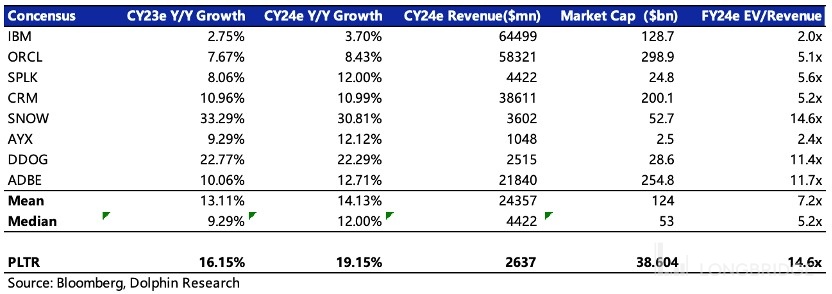
Dolphin expects the growth rate of Palantir income to gradually converge to 10% in 2027. If AI premium is not included, it is reasonable to give a 5-6x EV/Rev. But if you add AI's emotional premium, it is expected to match the 10-12x valuation. In other words, the Palantir valuation range is 21.8 billion ~ 42.5 billion, and the present value corresponds to 155~30.2 billion according to the 12% fold line per year until the end of 2024.
As of October 12, 2023, the market capitalization of the Palantir was 26.3 billion, significantly higher than the core business valuation (forward 21.8 billion, present value 15.5 billion), indicating that most of the AI premium is already implied in the current valuation. Unless AI products start to cash in, the results far exceed market expectations. On the whole, Dolphin Jun believes that the winning rate of continuing to catch up is not high (the AI plate has rebounded emotionally in the past few weeks), and it is recommended to leave enough safety pads.
Dolphin Investment Research "Palantir" Historical Article:
September 26, 2023 ** Palantir: AI-Activated "Mysterious" Military Weapons **
Risk Disclosure and Statement:
** Dolphin Investment Research Disclaimer and General Disclosure **
The copyright of this article belongs to the original author/organization.
The views expressed herein are solely those of the author and do not reflect the stance of the platform. The content is intended for investment reference purposes only and shall not be considered as investment advice. Please contact us if you have any questions or suggestions regarding the content services provided by the platform.
